
U.S. Air Mail Pilot Charles Ames Delivering First Overnight Mail Service, 1925
THF93957 / U.S. Air Mail Pilot Charles Ames Delivering First Overnight Mail Service, 1925
01
Artifact Overview
Federally subsidized air mail service encouraged commercial aviation. Pilots first navigated by visible landmarks, flying only in daylight. Lighted beacons, installed along flight paths, enabled night flights. It was dangerous work. Air mail pilot Charles Ames died when his plane crashed in central Pennsylvania, on the route from New York to Chicago, in 1925.
Artifact Details
Artifact
Photographic print
Date Made
1925
Subject Date
02 July 1925
Creators
Place of Creation
Collection Title
Location
By Request in the Benson Ford Research Center
Object ID
2001.0.107.25
Credit
From the Collections of The Henry Ford.
Material
Paper (Fiber product)
Technique
Gelatin silver process
Color
Black-and-white (Colors)
Dimensions
Height: 6.5 in
Width: 8.5 in
Inscriptions
Typed sheet, now detached, reads in part: ...PILOT CHARLES H. AMES DELIVERING THE MAIL UPON ARRIVAL AT HADLEY FIELD, NEW BRUNSWICK, NEW JERSEY, AFTER THE NIGHT FLIGHT FROM CHICAGO, WEDNESDAY, JULY 1st. THUS WAS OPENED OFFICIALLY THE OVERNIGHT AIR MAIL SERVICE BETWEEN CHICAGO AND NEW YORK, THE TERMINUS OF THE LATTER BEING HADLEY FIELD, NEW BRUNSWICK, NEW JERSEY.
Keywords |
|---|
02
Related Content
 Set
SetFlying the Night Mail
- 8 Artifacts
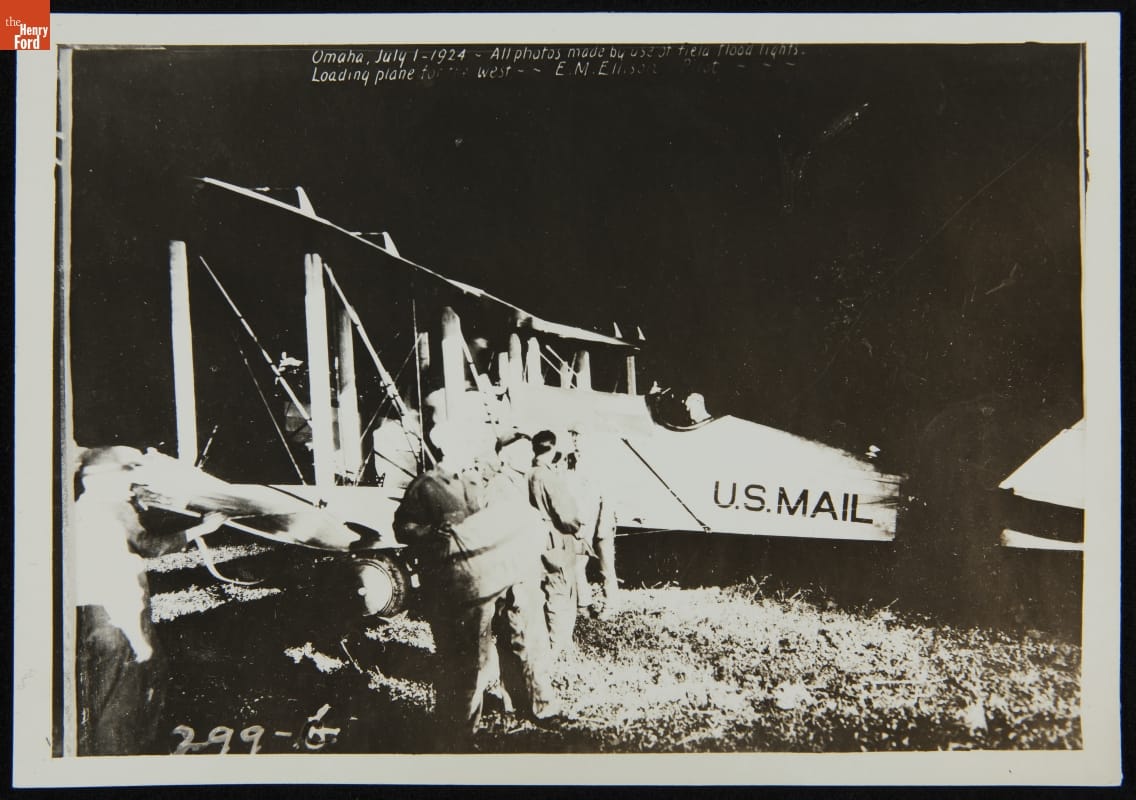
Transcontinental air mail pilots relied on a string of powerful light beacons to navigate sections of the New York to San Francisco route at night. They flew night mail planes equipped with illuminated instrument panels, navigation lights, and landing lights. At airfields along the way, floodlights helped workers inspect the planes, refuel, and unload and load the mail.