
Luther Burbank Garden Office, Original Site, Santa Rosa, California, circa 1910
THF130305 / Luther Burbank Garden Office, Original Site, Santa Rosa, California, circa 1910
01
Artifact Overview
Luther Burbank (1849-1926), an American horticulturalist and author, gained a reputation for selective breeding that yielded more than 800 new fruits, vegetables, flowers, and other plants. He opened this Bureau of Information in 1910 at the corner of his 40-acre experimental garden in Santa Rosa to sell seeds and souvenirs. After 1913, the building had various uses until Burbank's widow offered it to Henry Ford in 1928.
Artifact Details
Artifact
Photographic postcard
Subject Date
circa 1910
Creators
Collection Title
Location
Not on exhibit to the public.
Object ID
2008.0.1.4
Credit
From the Collections of The Henry Ford.
Material
Paper (Fiber product)
Linen (Material)
Technique
Gelatin silver process
Color
Black-and-white (Colors)
Dimensions
Height: 3.125 in
Width: 5.5 in
Inscriptions
front, lower edge:
J9025 Burbank's Bureau of Information Santa Rosa, Cal.
front door:
Bureau of Information Burbank's Experiment Farms
Keywords |
|---|
02
Related Content
 popular research topic
What If a Potato Could Change the World of Agriculture?
Luther Burbank introduced over 800 plant varieties, but his blight‑resistant potato remains his most enduring legacy.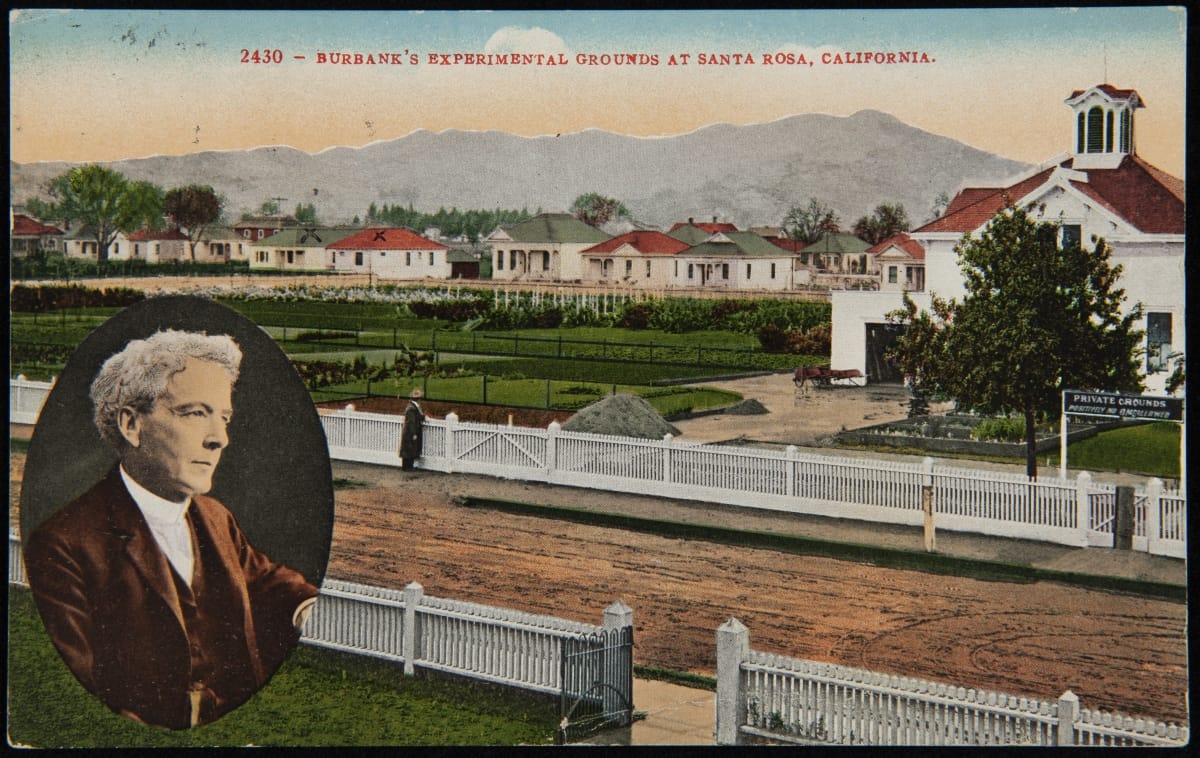 Set
SetLuther Burbank’s Experimental Gardens
- 19 Artifacts
After developing the Burbank potato in his native Massachusetts, prolific American horticulturalist Luther Burbank (1849-1926) relocated to California in 1875. There, at his vast experimental gardens, Burbank developed more than 800 new fruits, vegetables, flowers, and other plants.