
"The Young Mill-Wright and Miller's Guide," 1836
THF110215 / "The Young Mill-Wright and Miller's Guide," 1836
01
Artifact Overview
This instructional handbook was originally written and published by Oliver Evans (1755-1819). In the late 1700s, Evans developed a continuous conveyor system for milling flour. The Young Mill-Wright and Miller's Guide explained his labor-saving innovations through text and technical illustrations. Published in fifteen editions between 1795 and 1860, the influential book helped revolutionize the flour-milling industry.
Artifact Details
Artifact
Book
Date Made
1836
Subject Date
1836
Place of Creation
Creator Notes
Authored by Oliver Evans. This 9th edition with additions and corrections by Thomas P. Jones was published in 1836 by Carey, Lea & Blanchard in Philadelphia, Pennsylvania.
Location
By Request in the Benson Ford Research Center
Object ID
34.117.4
Credit
From the Collections of The Henry Ford.
Material
Paper (Fiber product)
Technique
Printing (Process)
Dimensions
Height: 8.75 in
Width: 5.5 in
Length: 1.625 in
Inscriptions
On spine:
MILL-WRIGHT'S / GUIDE
On title page: THE / YOUNG MILL-WRIGHT / AND / MILLER'S GUIDE; / ILLUSTRATED BY / TWENTY-EIGHT DESCRIPTIVE PLATES. / BY OLIVER EVANS, / THE NINTH EDITION, / WITH ADDITIONS AND CORRECTIONS, / BY / THOMAS E. JONES, / ...
Keywords |
|---|
02
Related Content
 Set
SetLoranger Gristmill
- 9 Artifacts
Gristmills -- usually among the earliest businesses established in a community -- ground grain harvested by local farmers. This mill, originally located in Monroe, Michigan, was set up to grind both corn and wheat. It incorporates a sophisticated conveyor system, developed by Oliver Evans in the late 1700s, that moves grain through the building to undergo a variety of processes.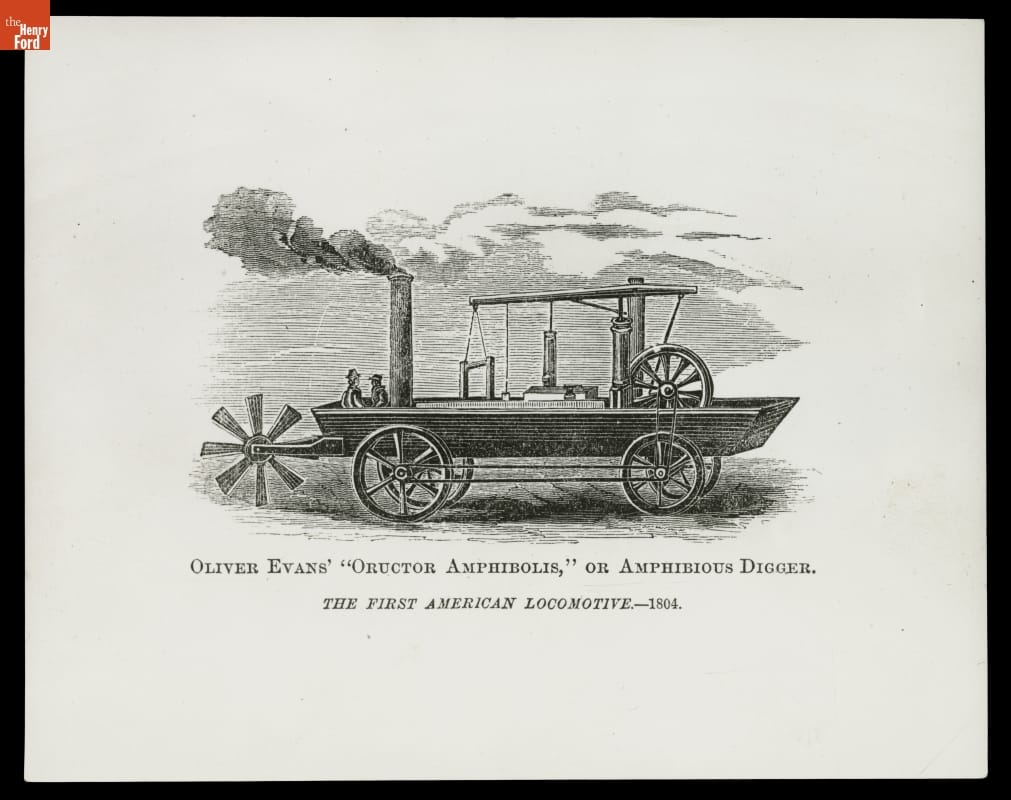 Set
SetOliver Evans (1755-1819)
- 5 Artifacts
Inventor and engineer Oliver Evans believed that steam engines, used to power mills and steamboats, could also propel land vehicles. An opportunity to experiment came with a commission from the Philadelphia Board of Health for a steam dredge. Evans designed a 30-foot-long, 17-ton amphibious digger that moved successfully over land in 1805. This one-time stunt proved the viability of steam-powered carriages.