
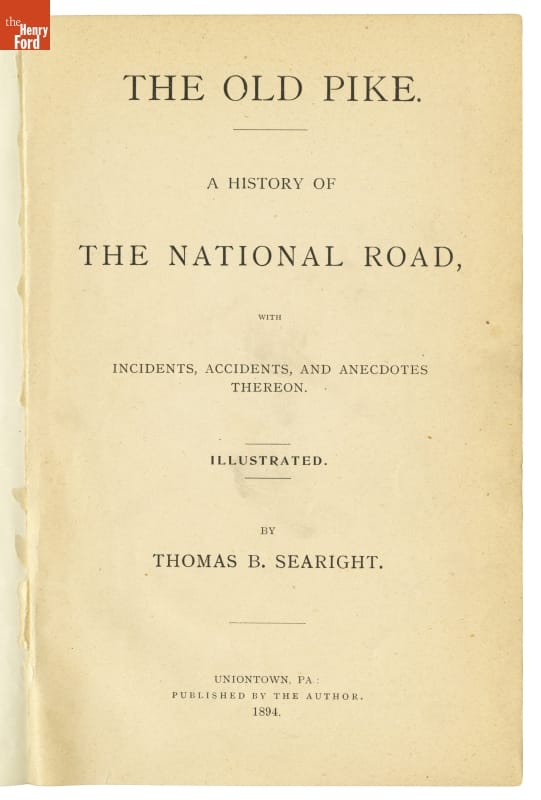
"The Old Pike: A History of The National Road and Incidents, Accidents, and Anecdotes Thereon," 1894
THF73389 / "The Old Pike: A History of The National Road and Incidents, Accidents, and Anecdotes Thereon," 1894 / front
01
Artifact Overview
The Cumberland Road (also known as the National Road) was the first highway built entirely with federal funds. It ran from Cumberland, Maryland, to Vandalia, Illinois. Its construction began in 1811 and ended in 1839. This book tells the road's story: the politics of creating the road, its building, and everyday life on and along the road.
Artifact Details
Artifact
Book
Date Made
1894
Subject Date
1811-1894
Place of Creation
Collection Title
Location
By Request in the Benson Ford Research Center
Object ID
64.167.13.26
Credit
From the Collections of The Henry Ford. Gift of Ford Motor Company.
Material
Paper (Fiber product)
Technique
Bookbinding (Process)
Color
Black-and-white (Colors)
Brown
Dimensions
Height: 8.5 in
Width: 5.75 in
Length: 1.75 in
Inscriptions
On spine of cover:
THE / OLD PIKE / A HISTORY OF / THE NATIONAL ROAD / T. B. SEARIGHT / 1894
Ink stamp on back of title page: Ford Motor Company / LIBRARY / DEARBORN, MICHIGAN
Keywords |
|---|
02
Related Content
 Set
SetGovernment & American Transportation
- 3 Artifacts
The Cumberland Road (also known as the National Road) was the first highway built entirely with federal funds. It ran from Cumberland, Maryland, to Vandalia, Illinois. Its construction began in 1811 and ended in 1839. This book tells the road's story: the politics of creating the road, its building, and everyday life on and along the road. Set
SetFunding the Interstate Highway System
- 25 Artifacts
The 48,000-mile Interstate Highway System connects all corners of the United States with high-speed, limited-access roadways. Funding for new construction and ongoing maintenance comes from taxes on vehicles, tires, and -- mostly -- fuel. But as cars get more efficient and drivers shift to hybrids and electrics, gas tax revenues get smaller. Highway funds shrink as the costs of caring for an aging system grow.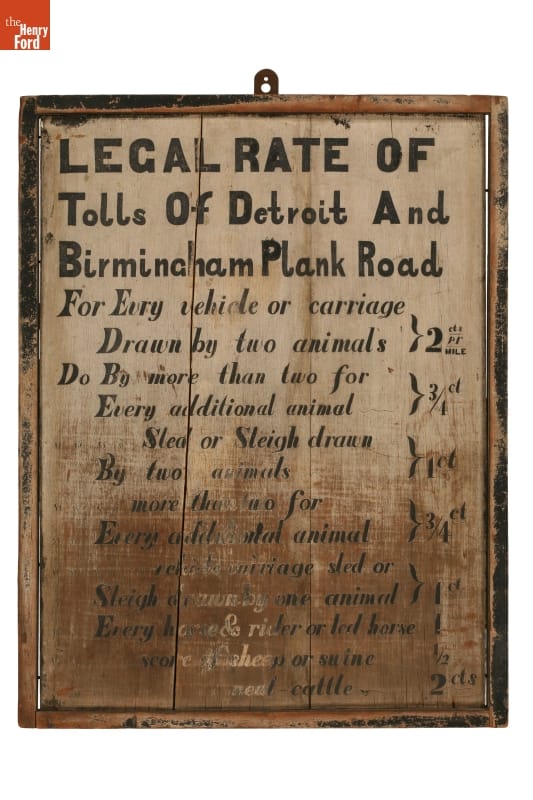 Set
SetLesson: Funding Public Goods
- 3 Artifacts
In the mid-19th century, road builders experimented with "plank roads" consisting of wood planks laid across longitudinal wood beams. Wood provided a smoother surface than dirt or gravel, especially in wet weather, but it deteriorated quickly. Maintenance costs, financed by user tolls, were prohibitively expensive and most plank roads were gradually resurfaced with gravel.