
Oldsmobile Special Driving Controls for Handicapped Persons and Driver Education Programs, 1965
THF627928 / Oldsmobile Special Driving Controls for Handicapped Persons and Driver Education Programs, 1965 / front
01
Artifact Overview
This booklet features specialized automobile controls offered by Oldsmobile in the mid-1960s. Special adapters, used to operate accelerator and brake pedals by hand rather than by foot, made cars more accessible for drivers of differing abilities. Dual brake controls, with a second brake pedal mounted on the passenger side, were used in student-driver cars.
Artifact Details
Artifact
Booklet
Date Made
1965
Subject Date
1965
Place of Creation
Creator Notes
Made by General Motors Corporation, Oldsmobile Division, United States
Collection Title
Location
Not on exhibit to the public.
Object ID
2011.145.1
Credit
From the Collections of The Henry Ford.
Material
Paper (Fiber product)
Technique
Printing (Process)
Color
Blue
White (Color)
Dimensions
Height: 7.75 in.
Width: 5.5 in.
Keywords |
|---|
02
Related Content
 Set
SetDriver Education
- 21 Artifacts
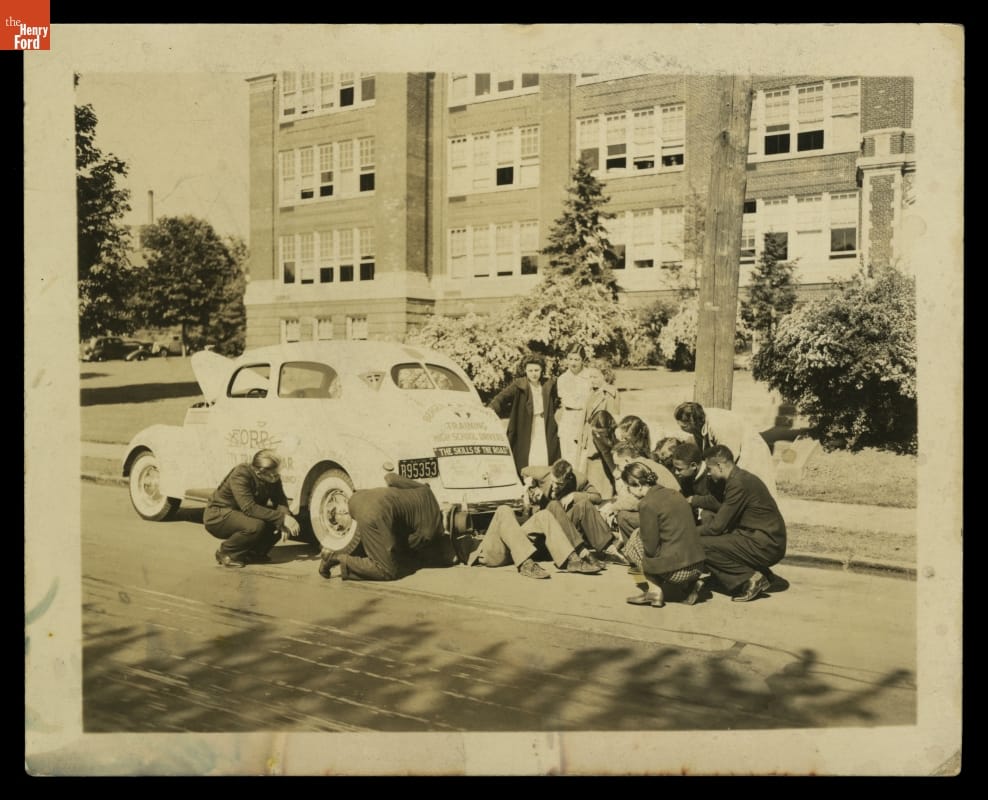
Early driver education in the United States was loose and inconsistent. New drivers might learn from a car dealership, or from a civic organization like the YMCA. In the 1930s, driver education became a standard part of public high school instruction. Courses involved a blend of study behind the desk and practice behind the wheel. By the early 2000s, school budget concerns had shifted driver education back into the private sector. article
Team Scandicapped: An Invention Convention Highlight
Scandicapped, invented by fifth-graders Anna Gareau, Claire Kinnaman, and Cooper Dyson, aims to discourage drivers from parking illegally in reserved accessible spaces.