
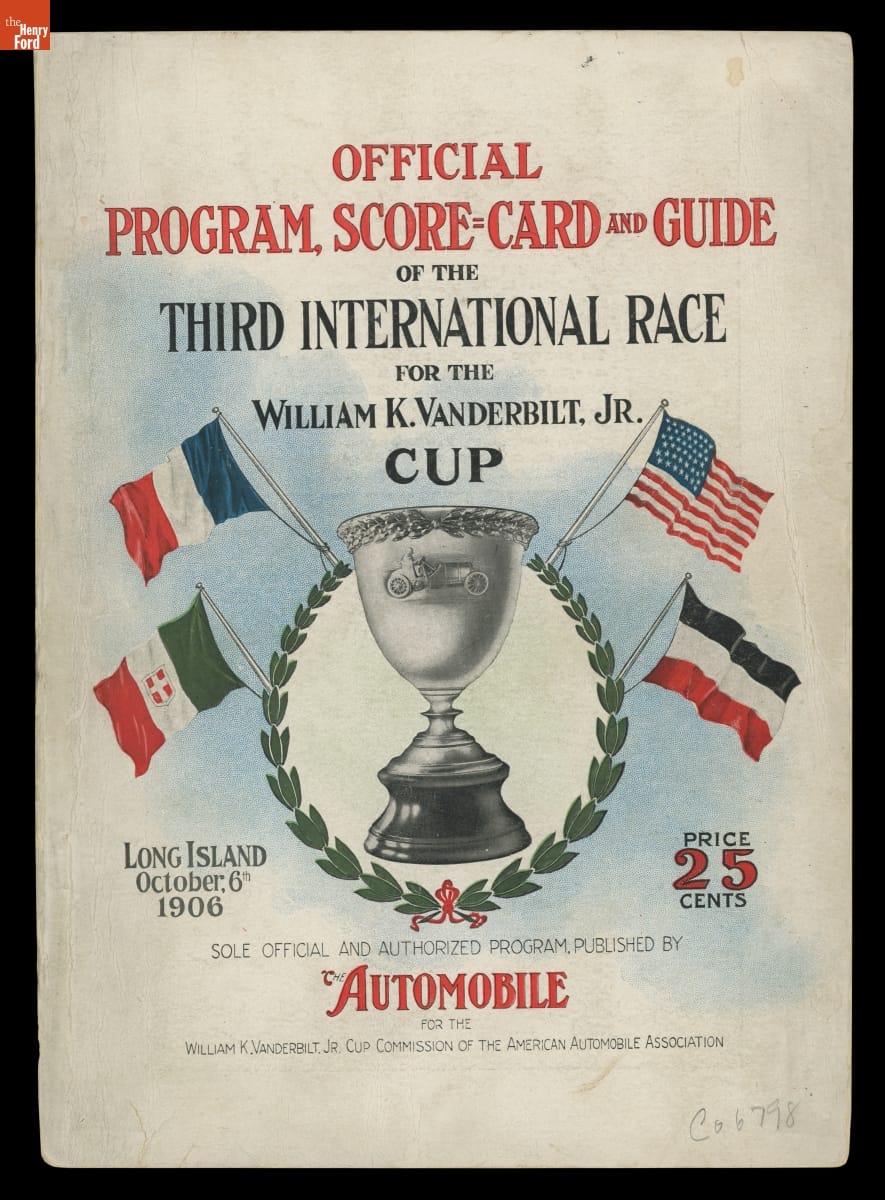
Official Program, Score Card and Guide of the Third International Vanderbilt Cup Race, 1906
THF703166 / Official Program, Score Card and Guide of the Third International Vanderbilt Cup Race, 1906
01
Artifact Overview
The Vanderbilt Cup, held on New York's Long Island from 1904 to 1910, was America's first internationally prominent automobile race. William K. Vanderbilt, Jr., a wealthy railroad heir, organized the competition over public roads. European cars dominated the event's first years. This program is from the 1906 race, won by French driver Louis Wagner in a French-built Darracq.
Artifact Details
Artifact
Program (Document)
Date Made
1906
Subject Date
06 October 1906
Collection Title
Location
By Request in the Benson Ford Research Center
Object ID
92.150.9668
Credit
From the Collections of The Henry Ford. Gift of the Family of Henry Austin Clark, Jr.
Material
Paper (Fiber product)
Color
Multicolored
Dimensions
Height: 9.5 in
Width: 6.75 in
Inscriptions
Printed on cover:
OFFICIAL / PROGRAM, SCORE-CARD AND GUIDE / OF THE / THIRD INTERNATIONAL RACE / FOR THE / WILLIAM K. VANDERBILT, JR. / CUP / LONG ISLAND / October 6 / 1906
Keywords |
|---|
02
Related Content
 Set
SetThe Vanderbilt Cup
- 34 Artifacts
America's earliest auto races were small-time contests. Wealthy enthusiast William K. Vanderbilt, Jr., thought the United States needed a big, signature event. Starting in 1904, he organized an annual road race through Long Island, New York, that attracted top American and European drivers and manufacturers. When a Connecticut-built Locomobile won the Vanderbilt Cup in 1908, it helped prove that America's automotive industry had arrived.