
1935 Chrysler Airflow Advertisement, "Yes, Son, You're Safe in a Bridgework of Steel"
THF106483 / 1935 Chrysler Airflow Advertisement, "Yes, Son, You're Safe in a Bridgework of Steel"
01
Artifact Overview
Ways of protecting child passengers have changed. In this 1935 Chrysler ad, children and passenger are not restrained with seatbelts or safety seats. Protection, according to the ad, comes from "a bridgework of steel." Today, children travel securely strapped into well-anchored and cushioned car seats and are much safer -- even when daddy speeds smoothly along at sixty miles per hour.
Artifact Details
Artifact
Advertisement
Date Made
1935
Subject Date
1935
Creators
Place of Creation
Creator Notes
Made for Chrysler Corporation, Detroit, Michigan
Collection Title
Location
Not on exhibit to the public.
Object ID
2011.336.1
Credit
From the Collections of The Henry Ford.
Material
Paper (Fiber product)
Color
Black-and-white (Colors)
Dimensions
Height: 13.5 in
Width: 10.375 in
Inscriptions
Text on front:
DEAR DADDY / YOU SEE I CAN / WRITE AT 60 / MILES AN HOUR
Printed to right of note: "YES, SON... and you're safe / in a bridgework of steel"
Keywords |
|---|
02
Related Content
 Set
SetChildren's Car Seats
- 13 Artifacts
The first state laws requiring child safety seats -- passed in 1978 -- not only protected young passengers, they also stimulated the market for the seats themselves. Automakers, baby products companies and toy manufacturers all got into the safety seat business at various times. This 1988 advertisement promotes the comfort and convenience of a seat produced by toymaker Fisher-Price. Set
SetBuckling Up
- 11 Artifacts
General Motors workers like Mary Ann Sanford spent each day making over 20 critical checks on seat belt systems in GM cars after they rolled off the line. Yet many Americans still didn't use these lifesaving devices -- "buckling up" wasn't yet mandatory in most states.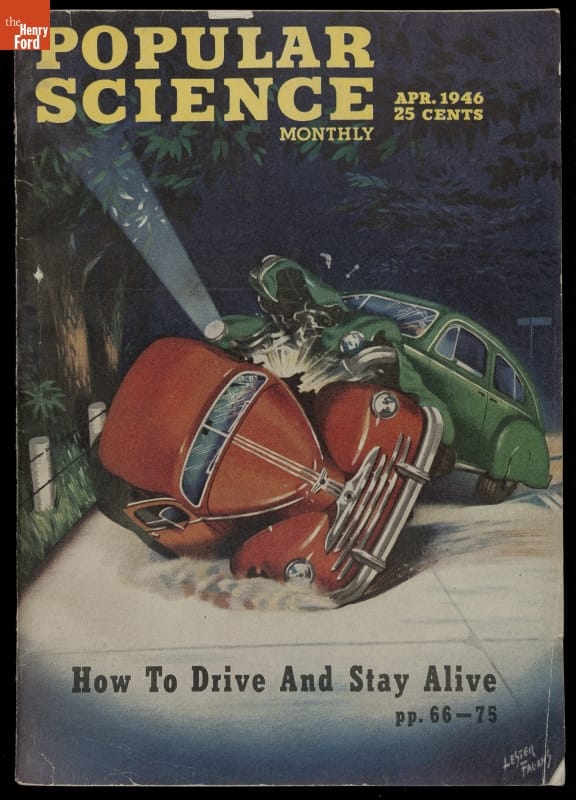 Set
SetSafety
- 31 Artifacts
Popular Science provided information about scientific and technological advancements. In the early 1900s articles about the automobile -- and its driver -- became commonplace in the monthly's pages. Editors included a series of articles on automobile safety in this April 1946 issue. In one article, readers could test their knowledge of safe driving.