
B-24 Engine Assembly Line, Willow Run Bomber Plant, 1942
THF93732 / B-24 Engine Assembly Line, Willow Run Bomber Plant, 1942
01
Artifact Overview
At Willow Run, Ford Motor Company built B-24 bomber planes for World War II using automobile mass production techniques. Airplanes were much more complex than cars. They required constant design changes poorly suited to a standardized assembly line. Ford overcame these difficulties and, at the plant's peak, Willow Run crews produced an average of one bomber every 63 minutes.
Artifact Details
Artifact
Photographic print
Subject Date
27 October 1942
Place of Creation
Collection Title
Location
By Request in the Benson Ford Research Center
Object ID
64.167.833.P.77071.K
Credit
From the Collections of The Henry Ford. Gift of Ford Motor Company.
Material
Paper (Fiber product)
Linen (Material)
Technique
Gelatin silver process
Color
Black-and-white (Colors)
Dimensions
Height: 8.25 in
Width: 11 in
Keywords |
|---|
02
Related Content
 Set
SetWillow Run Bomber Plant
- 33 Artifacts
Every American automaker turned its workforce and facilities to military production during World War II. But no project captured the public's imagination like Willow Run, where Ford Motor Company built one B-24 Liberator airplane every 63 minutes. The plant was the embodiment of America's "Arsenal of Democracy" — the enormous manufacturing capacity so vital to the Allies' victory.
 Set
SetHenry Ford: Assembly Line
- 25 Artifacts
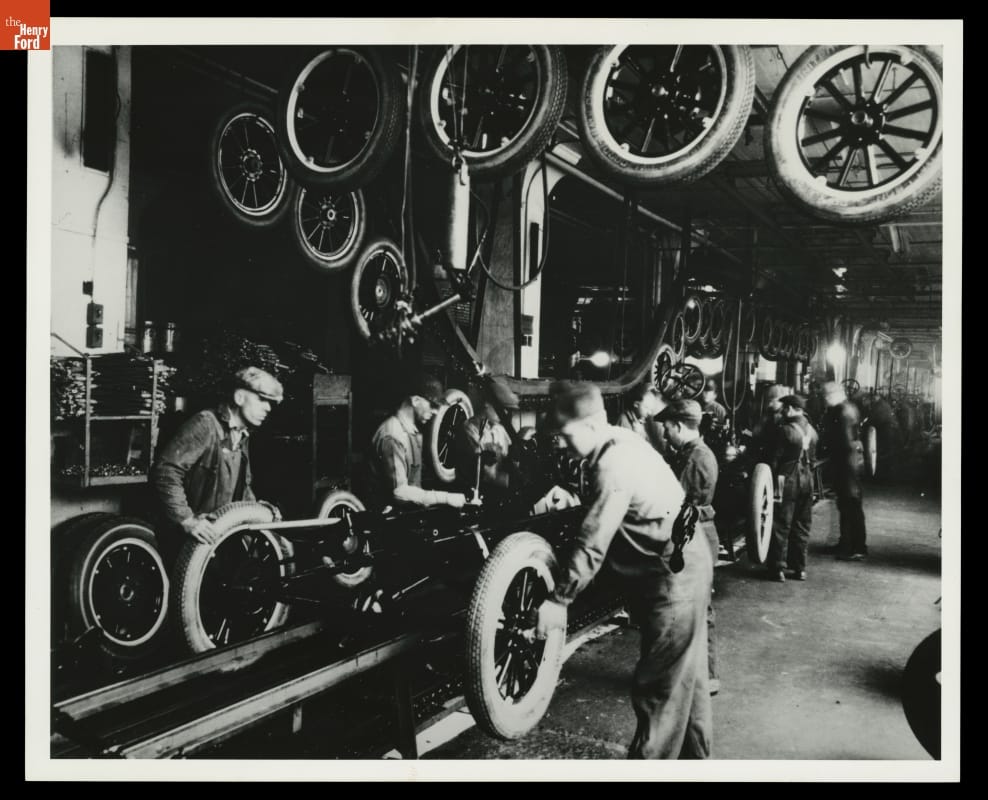
Ford constantly tweaked Model T assembly lines at its Highland Park plant for efficiency. In 1914, wheels and radiators were conveyed to a platform and slid down ramps for installation on the same line. By 1925, wheels (with tires already mounted and inflated) were conveyed directly to workers, who installed them on both sides of the chassis at once.