
United States Patent for Subscription Television Decoder Unit, June 27, 1961
THF111194 / United States Patent for Subscription Television Decoder Unit, June 27, 1961
01
Artifact Overview
Phonevision, the first subscription television system, allowed people to watch popular Hollywood films at home. To order a film, viewers called an operator, who would send a signal over the telephone and into a descrambling unit on top of the television. While a few extra steps were involved, Phonevision was similar to today's web-based "on-demand" streaming services.
Artifact Details
Artifact
Patent
Date Made
27 June 1961
Subject Date
27 June 1961
Creators
Collection Title
Location
By Request in the Benson Ford Research Center
Object ID
90.1.1746.25
Credit
From the Collections of The Henry Ford. Gift of Mel Boldt and Associates.
Material
Paper (Fiber product)
Technique
Printing (Process)
Color
Black-and-white (Colors)
Dimensions
Height: 11.25 in
Width: 7.875 in
Keywords |
|---|
02
Related Content
 Set
SetThe Patent Process
- 20 Artifacts
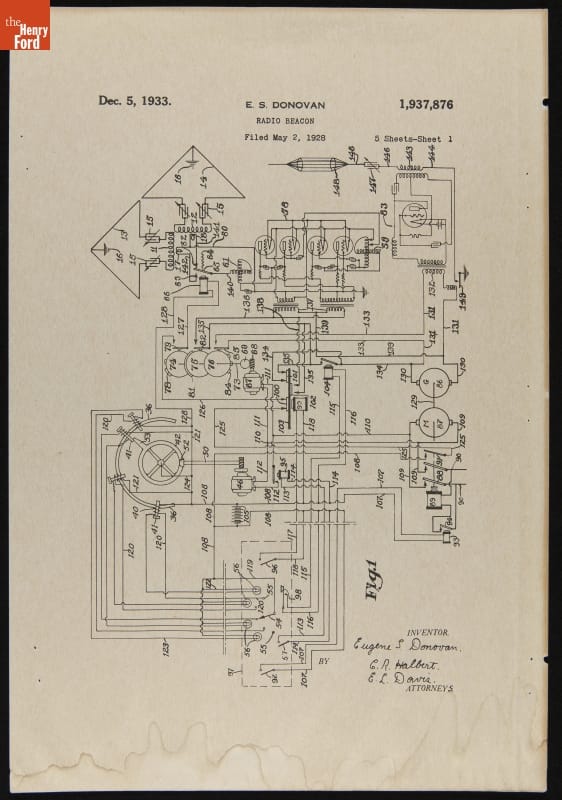
The radio beacon may be Henry Ford's most important contribution to aviation. Early pilots depended on landmarks, preventing reliable navigation in bad weather. Ford's engineers developed a radio beacon that simultaneously transmitted the Morse code letter "A" (dot-dash) in one direction and the letter "N" (dash-dot) in another. The pilot steered until the separate signals merged into a steady hum.