
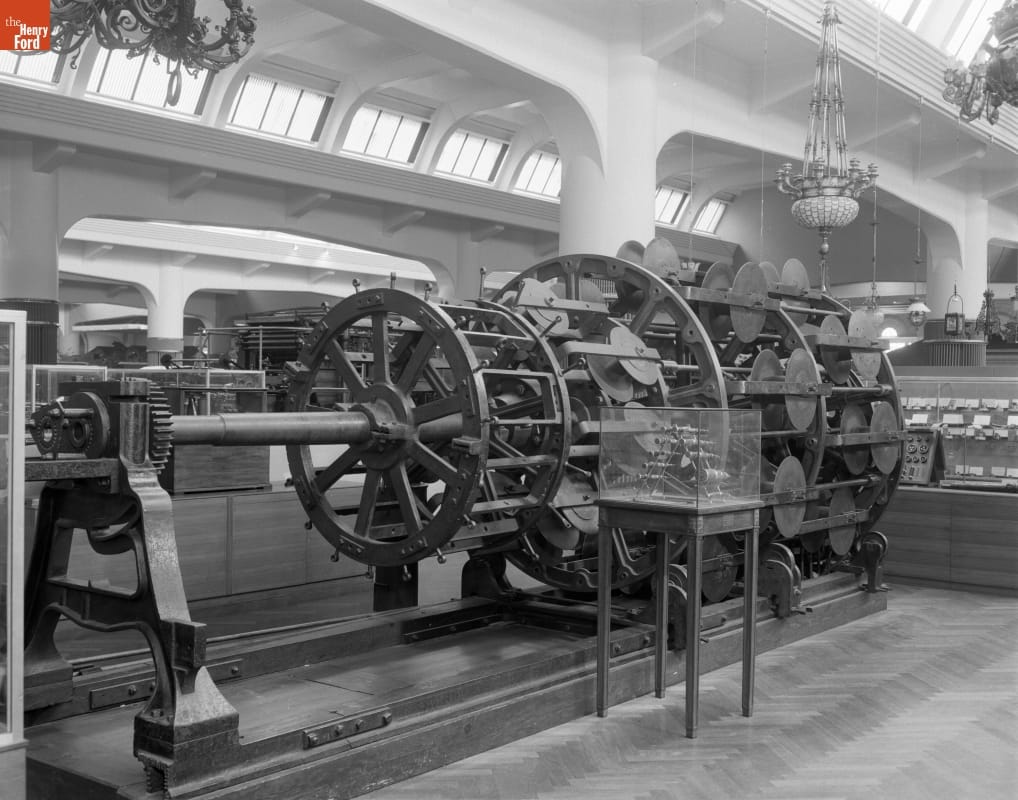
Transatlantic Cable Strander in Henry Ford Museum during Building Construction, July 1932
THF121644 / Transatlantic Cable Strander in Henry Ford Museum during Building Construction, July 1932
01
Artifact Overview
This cable machine helped to "wire the world." It was used in Greenwich, England in 1865 to prepare the second transatlantic cable. A core of iron and copper was protected from abrasion on the ocean floor with layers of steel, gutta-percha, and jute. These submarine cables--like modern-day fiber-optic cables that carry the signals of Internet traffic--connected cultures and communities.
Artifact Details
Artifact
Photographic print
Date Made
22 July 1932
Subject Date
22 July 1932
Collection Title
Location
By Request in the Benson Ford Research Center
Object ID
P.188.7273
Credit
From the Collections of The Henry Ford. Gift of Ford Motor Company.
Material
Paper (Fiber product)
Linen (Material)
Technique
Gelatin silver process
Color
Black-and-white (Colors)
Dimensions
Height: 7.375 in
Width: 10.875 in
Keywords |
|---|
02
Related Artifacts
 Artifact
Machine Used to Strand Transatlantic Cable, 1860-1865
Laying telegraph cable across the Atlantic Ocean in the 1860s was a huge undertaking. This massive cable stranding machine was used in Greenwich, England, to wind together the different elements of the cable: iron for strength, copper for conductivity, gutta-percha rubber for insulation, and tarred hemp for durability. Following several failed attempts, the heavy, flexible cable was laid successfully by the SS Great Eastern in 1866.
03
Related Content
 Set
SetStarts and Stalls: Creating a Successful Transatlantic Cable
- 14 Artifacts
This sheet music celebrates the first transatlantic cable. The ships depicted are the USS Niagara and HMS Agamemnon. These vessels met in the middle of the Atlantic Ocean, spliced their cable payloads together, and set off to separate shores in Ireland and Canada. The man at center is likely Cyrus W. Field, financier of the first and second transatlantic cables.