
1939 Douglas DC-3 behind Henry Ford Museum, August 26, 1999
THF21829 / 1939 Douglas DC-3 behind Henry Ford Museum, August 26, 1999
01
Artifact Overview
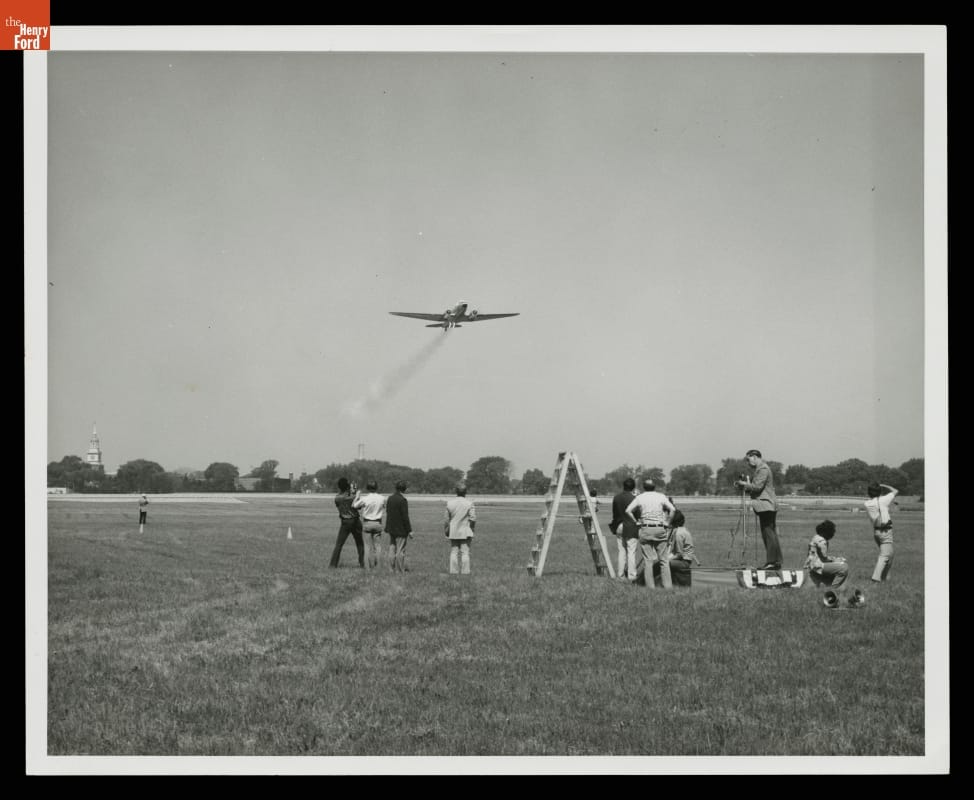
When North Central Airlines donated Douglas DC-3 number N21728 to The Henry Ford in 1975, it had logged nearly 85,000 flight hours -- a record for a commercial aircraft at the time. After flying into Dearborn under its own power, the plane was moved by crane to a display location behind Henry Ford Museum. It was moved inside the museum in 2003.
Artifact Details
Artifact
Digital image
Subject Date
26 August 1999
Collection Title
Location
By Request in the Benson Ford Research Center
Object ID
EI.1929.1323
Credit
From the Collections of The Henry Ford.
Technique
Digital imaging
Color
Multicolored
Keywords |
|---|
02
Related Artifacts
 Artifact
1939 Douglas DC-3 Airplane
The Douglas DC-3, introduced in 1936, carried 21 passengers -- enough to fly profitably without relying on subsidies from air mail contracts. While the DC-3's economy appealed to airlines, its rugged construction and comfortable cabin attracted passengers. More than any other aircraft, the DC-3 ushered in the era of dependable, long-distance air travel in the United States.
03
Related Content
 Set
SetRetiring “The Worlds High-Time Aircraft”
- 21 Artifacts
The Henry Ford's DC-3 flew to Dearborn under its own power, landing at Ford Motor Company's proving ground -- first developed as an airport in 1924 -- on May 28, 1975. Over its 36-year career for Eastern Airlines and North Central Airlines, the plane traveled 12 million miles and logged 84,875 flying hours, a record for a commercial aircraft at the time. article
1939 Douglas DC-3 Airplane
The Douglas DC-3 did more than any other single airplane to make commercial aviation a viable industry. Ours also completed more hours in the air than any other airplane in history.