
Cutting Millstones in Loranger Gristmill in Preparation for Summer, Greenfield Village, 1981
THF245043 / Cutting Millstones in Loranger Gristmill in Preparation for Summer, Greenfield Village, 1981
01
Artifact Overview
Gristmills use a pair of millstones to grind grain. An evenly balanced top stone, or runner stone, spins above a stationary bedstone. A precise pattern of grooves cut into both stones creates a scissoring action, shearing grain, channeling it across uncut grinding surfaces, and carrying it out from the stones. Millstones must be periodically dressed, or recut, to keep them clean and sharp.
Artifact Details
Artifact
Photographic print
Subject Date
1981
Place of Creation
Collection Title
Location
Not on exhibit to the public.
Object ID
EI.1929.1949
Credit
From the Collections of The Henry Ford.
Material
Paper (Fiber product)
Technique
Gelatin silver process
Color
Black-and-white (Colors)
Dimensions
Height: 10 in
Width: 8.125 in
Keywords |
|---|
02
Related Artifacts
 Artifact
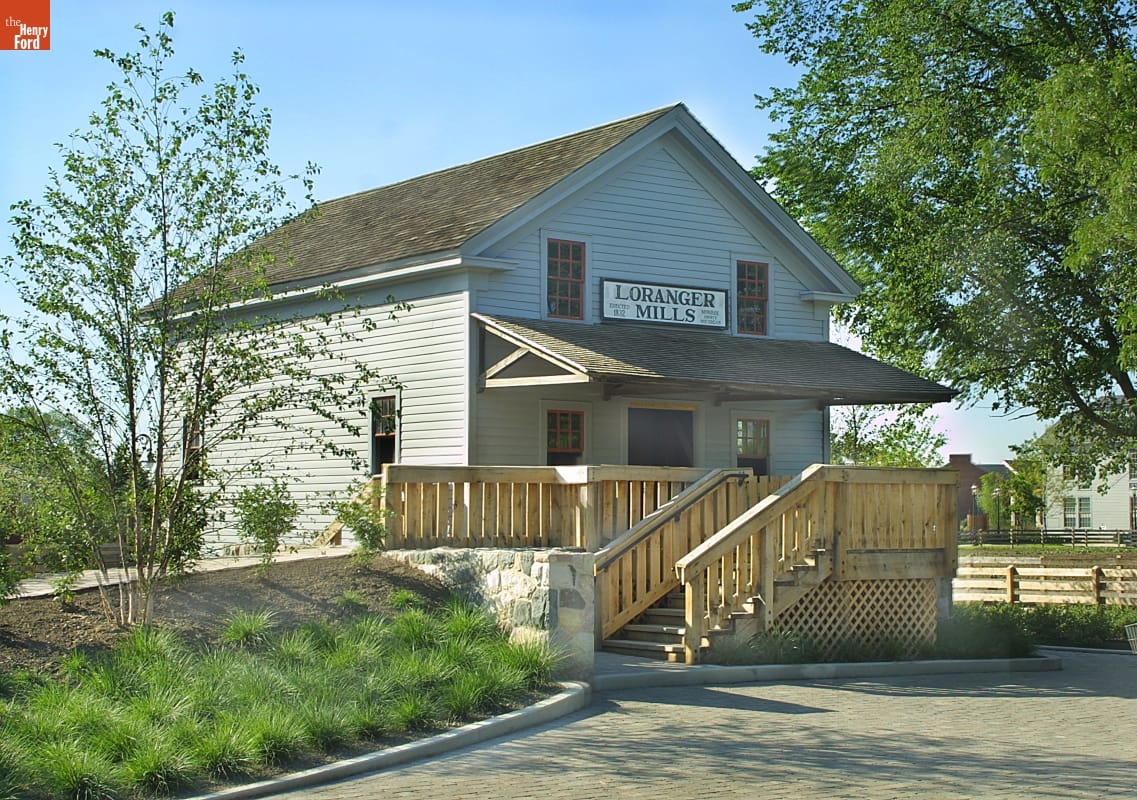
Loranger Gristmill
Gristmills -- usually among the earliest businesses established in a community -- ground grain harvested by local farmers. This mill, originally located in Monroe, Michigan, was set up to grind both corn and wheat. It incorporates a sophisticated conveyor system, developed by Oliver Evans in the late 1700s, that moves grain through the building to undergo a variety of processes.
03
Related Content
- Set
Loranger Gristmill
- 9 Artifacts
Gristmills -- usually among the earliest businesses established in a community -- ground grain harvested by local farmers. This mill, originally located in Monroe, Michigan, was set up to grind both corn and wheat. It incorporates a sophisticated conveyor system, developed by Oliver Evans in the late 1700s, that moves grain through the building to undergo a variety of processes.