
Preparing to Move Loranger Gristmill from Its Original Site to Greenfield Village, 1928
THF245093 / Preparing to Move Loranger Gristmill from Its Original Site to Greenfield Village, 1928
01
Artifact Overview
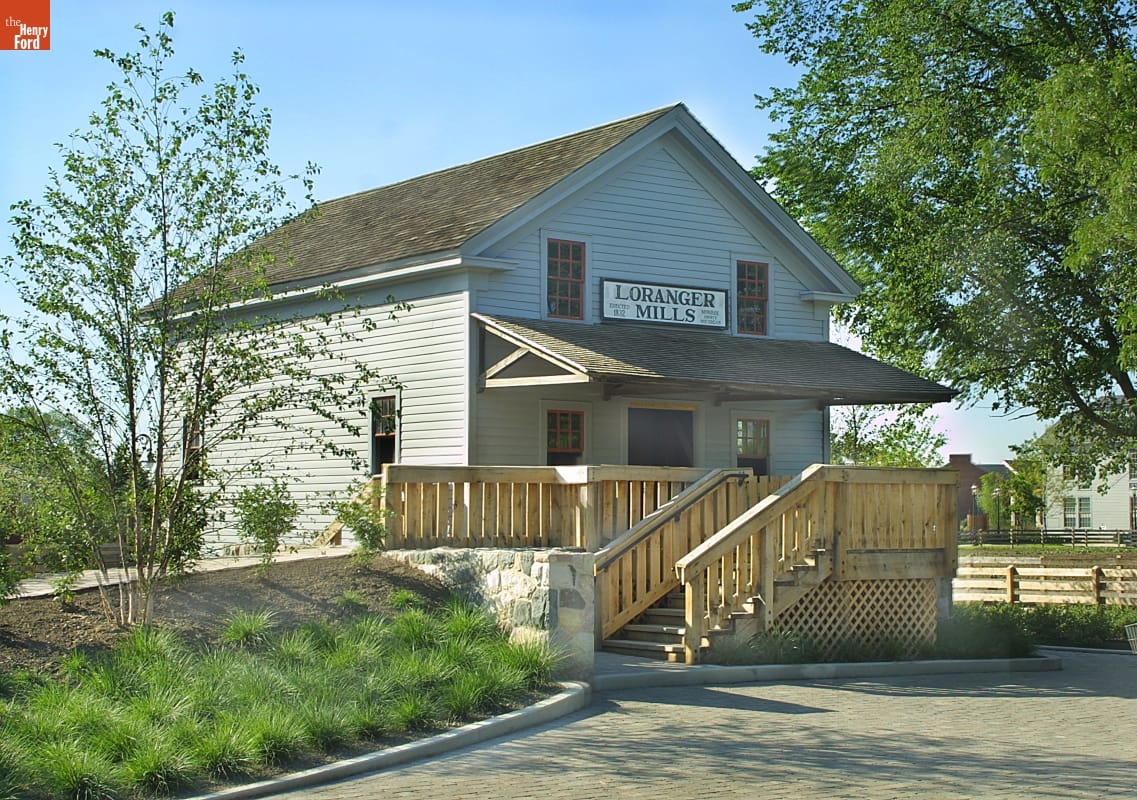
Loranger Gristmill was built in 1832 on Stoney Creek in Monroe, Michigan. It incorporated a sophisticated conveyor system, developed by Oliver Evans in the late 1700s, that moved grain through the building to be ground into flour or animal feed. Henry Ford acquired the mill and sent a crew to disassemble and relocate it to Greenfield Village in 1928.
Artifact Details
Artifact
Photographic print
Subject Date
1928
Collection Title
Location
Not on exhibit to the public.
Object ID
92.188.15
Credit
From the Collections of The Henry Ford.
Material
Paper (Fiber product)
Technique
Gelatin silver process
Color
Black-and-white (Colors)
Dimensions
Height: 2.75 in
Width: 4 in
Keywords |
|---|
02
Related Artifacts
 Artifact
Loranger Gristmill
Gristmills -- usually among the earliest businesses established in a community -- ground grain harvested by local farmers. This mill, originally located in Monroe, Michigan, was set up to grind both corn and wheat. It incorporates a sophisticated conveyor system, developed by Oliver Evans in the late 1700s, that moves grain through the building to undergo a variety of processes.
03
Related Content
- Set
Loranger Gristmill
- 9 Artifacts
Gristmills -- usually among the earliest businesses established in a community -- ground grain harvested by local farmers. This mill, originally located in Monroe, Michigan, was set up to grind both corn and wheat. It incorporates a sophisticated conveyor system, developed by Oliver Evans in the late 1700s, that moves grain through the building to undergo a variety of processes.