
Selden Road-Engine Specifications, U. S. Patent Number 549,160, November 5, 1895
THF255701 / Selden Road-Engine Specifications, U. S. Patent Number 549,160, November 5, 1895 / sheet 1, front
01
Artifact Overview
George Selden conceived -- but didn't build -- a gasoline-powered self-propelled vehicle in 1877. Selden, a patent attorney, shrewdly waited until 1895 to receive a patent on the idea -- long enough for the automobile industry to emerge and his patent to become valuable. After an eight-year legal fight led by Henry Ford, Selden's broad patent claim was severely restricted in 1911.
Artifact Details
Artifact
Patent
Date Made
1895
Creators
Place of Creation
Collection Title
Location
By Request in the Benson Ford Research Center
Object ID
86.185.116
Credit
From the Collections of The Henry Ford. Gift of Henry Austin Clark, Jr.
Material
Paper (Fiber product)
Technique
Printing (Process)
Color
Black-and-white (Colors)
Dimensions
Height: 11.375 in
Width: 7.875 in
Inscriptions
first page:
UNTIED STATES PATENT OFFICE / GEORGE B. SELDEN OF ROCHESTER, NEW YORK / ROAD-ENGINE [...] NOVEMBER 5, 1895 / Application filed May 9, 1879
second page:
G.B. SELDEN / ROAD ENGINE / 2 Sheets- Sheet 1
third page:
G.B. SELDEN / ROAD ENGINE / 2 Sheets- Sheet 2
Keywords |
|---|
02
Related Content
 Set
SetThe Patent Process
- 20 Artifacts
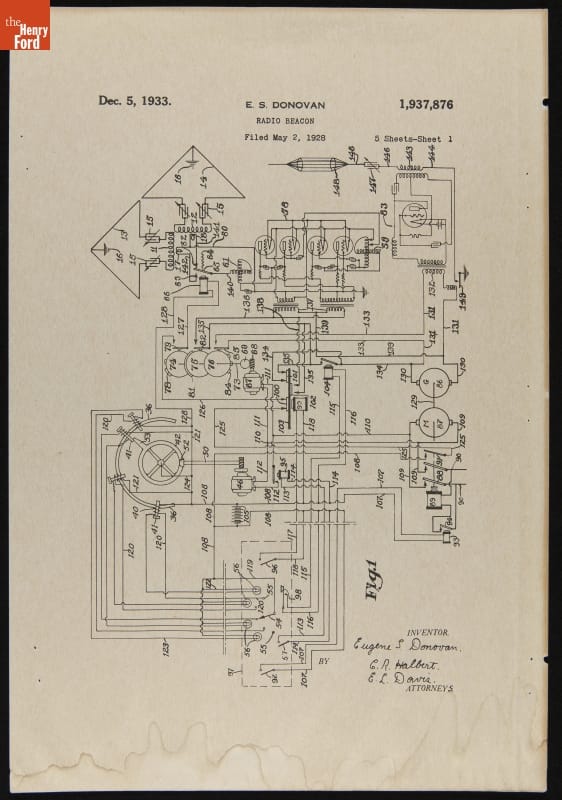
The radio beacon may be Henry Ford's most important contribution to aviation. Early pilots depended on landmarks, preventing reliable navigation in bad weather. Ford's engineers developed a radio beacon that simultaneously transmitted the Morse code letter "A" (dot-dash) in one direction and the letter "N" (dash-dot) in another. The pilot steered until the separate signals merged into a steady hum.