
Pulling Down the Dirigible Mooring Mast at Ford Airport, 1946
THF255305 / Pulling Down the Dirigible Mooring Mast at Ford Airport, 1946
01
Artifact Overview
Signals communicate messages from far away. They may take the form of a bonfire sending smoke signals, lanterns or maritime flags on a ship, or the tapped out sounds of Morse code. In this image, signaling flags are being used by men on the ground to guide a safe demolition of the airship mast at Ford Airport.
Artifact Details
Artifact
Photographic print
Date Made
26 October 1946
Place of Creation
Collection Title
Location
By Request in the Benson Ford Research Center
Object ID
64.167.833.P.83419.7
Credit
From the Collections of The Henry Ford. Gift of Ford Motor Company.
Material
Paper (Fiber product)
Linen (Material)
Technique
Gelatin silver process
Color
Black-and-white (Colors)
Dimensions
Height: 8.063 in
Width: 10.938 in
Keywords |
|---|
02
Related Content
 Set
SetAirships
- 15 Artifacts
"Airship" refers to any lighter-than-air craft that moves under its own power. Lift is achieved using a gas, like hydrogen or helium, that is less dense than surrounding air. Non-rigid airships — blimps — use the gas's pressure on the containment envelope to maintain their shape. Rigid airships — Zeppelins — support their gas cells with an internal framework. In peace and in war, airships have known triumph and tragedy.
 Set
SetSignals and Signs – Ground Communication
- 14 Artifacts
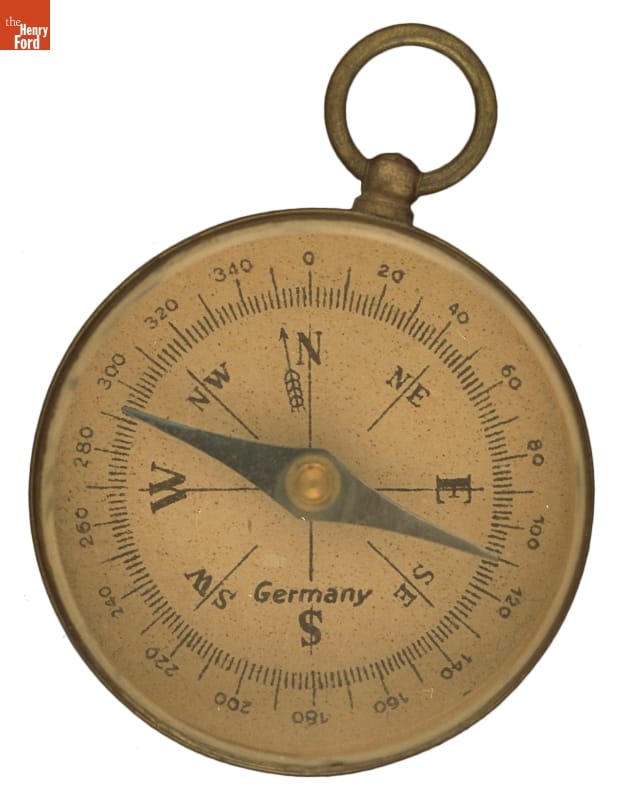
This early 20th-century compass uses a magnetized steel needle that rotates to align with the Earth's magnetic field. With the needle indicating north, users can reference markings around the dial to gain precise bearings. Despite modern GPS technology, compasses remain important navigational instruments for airplanes and ships and for casual use on small boats or recreational hikes.