
Flax Wheel, Made by Silas Barnum,1800-1828
THF171045 / Flax Wheel, Made by Silas Barnum,1800-1828
01
Artifact Overview
Spinning wheels come in a rich diversity of sizes and shapes depending on where and when they were developed and the fibers they were intended to spin. This upright wheel, made by Silas Barnum in Fairfield County, Connecticut, is an example of a compact, popular style of wheel for spinning flax fiber into linen yarn. It also features an innovative improvement called a double flyer, which allows the spinner to produce two yarns simultaneously.
Artifact Details
Artifact
Spinning wheel
Date Made
1800-1828
Creators
Place of Creation
Collection Title
Location
Not on exhibit to the public.
Object ID
2017.84.155
Credit
From the Collections of The Henry Ford. Gift of American Textile History Museum, donated to ATHM by Joan Whittaker Cummer.
Material
Wood (Plant material)
Metal
Leather
Technique
Turning (Shaping process)
Carving (Processes)
Dimensions
Height: 50 in
Width: 16.25 in
Length: 17.25 in
Inscriptions
on end of table:
S. BARNUM
Keywords |
|---|
02
Related Content
 Set
SetSpinning Highlights from the Collections of The Henry Ford
- 16 Artifacts
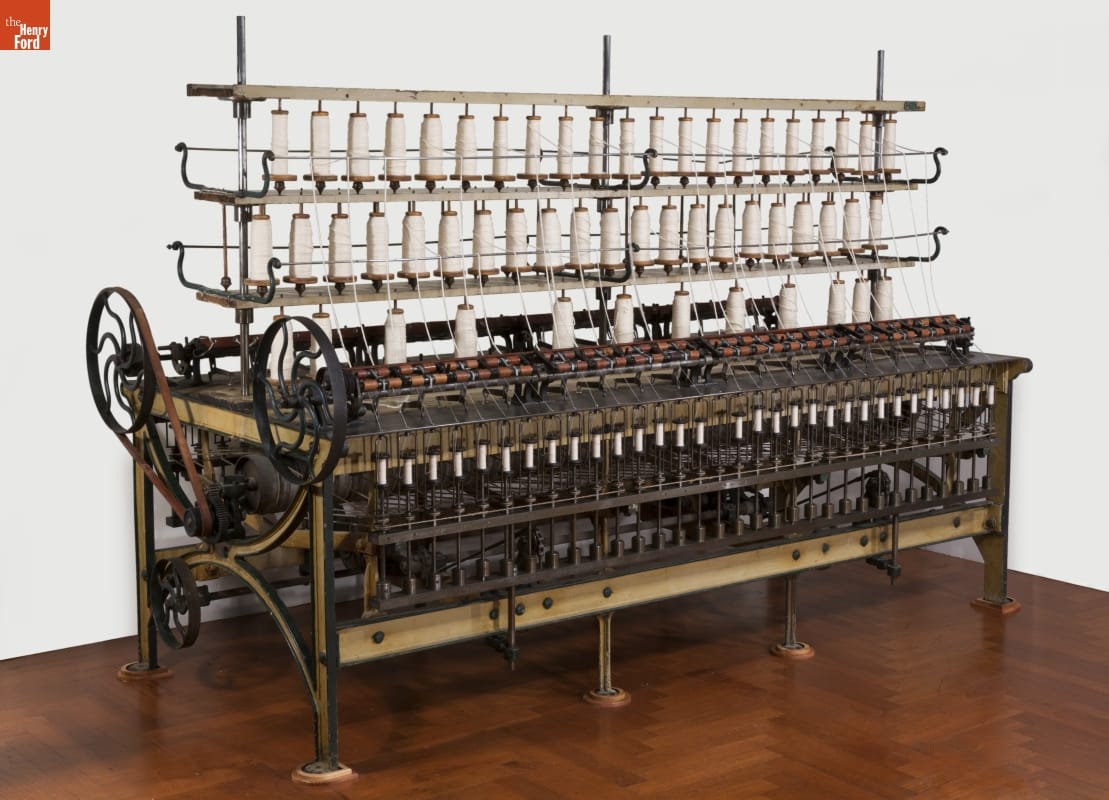
Spinning frames spin cotton fiber into yarn and then wind it onto a bobbin. This throstle spinning frame could simultaneously spin 64 strands of yarn. (Throstle -- an old name for a song thrush -- refers to the bird-like sounds the machine made.) Machines like this helped produce the large quantities of yarn that growing industrial weaving operations needed in the early and mid-1800s.