
The Samson Battery No. 2, 1916-1935
THF170750 / The Samson Battery No. 2, 1916-1935
01
Artifact Overview
In the late 19th and early 20th centuries, people used batteries to power telegraph and telephone systems, ring bells and alarms, or spark gasoline engines. The Samson Electric Company had made wet cell battery like this one for years before moving production to Canton, Massachusetts. The glass jar held a conductive solution surrounding the carbon and zinc elements that produced an electrochemical reaction.
Artifact Details
Artifact
Battery (Electrical)
Date Made
1916-1935
Creators
Place of Creation
Location
Not on exhibit to the public.
Object ID
2017.0.34.72
Credit
From the Collections of The Henry Ford.
Material
Glass (Material)
Porcelain (Material)
Color
White (Color)
Black (Color)
Gray (Color)
Dimensions
Height: 11.25 in
Width: 4.5 in
Length: 4.5 in
Inscriptions
on front label:
PATENTED / THE SAMSON BATTERY/ NO. 2 / Reg. U. S. Pat. Off. / GREAT STRENGTH. / LONG LIFE. / Samson Electric Co. / CANTON, MASS. / QUALITY GUARANTEED
on side label:
DIRECTIONS / FIRST - Clean out jar and pour in Samson Sal-Ammoniac. / SECOND - See that carbon and zinc are firmly secured to cover and that they are not in contact at any point. / THIRD - Insert elements being careful not to overflow jar. Set the battery in a dry place. See that connections are clean and firmly made. / FOURTH - Keep carbon element covered with solution by adding water when necessary. For best results the solution should be renewed at least once a year. / MANUFACTURED BY / Samson Electric Co. / Canton, Mass.
in raised letters on side:
SAMSON / ELEC Co / CANTON/ MASS
in raised letters on side:
THE SAMSON BATTERY/ No 2
on lid:
SAMSON BATTERY/ SAMSON ELECTRIC CO/ CANTON MASS
Keywords |
|---|
02
Related Content
 Set
SetExposed Collections—2017-2020 IMLS Grant Project
- 20 Artifacts
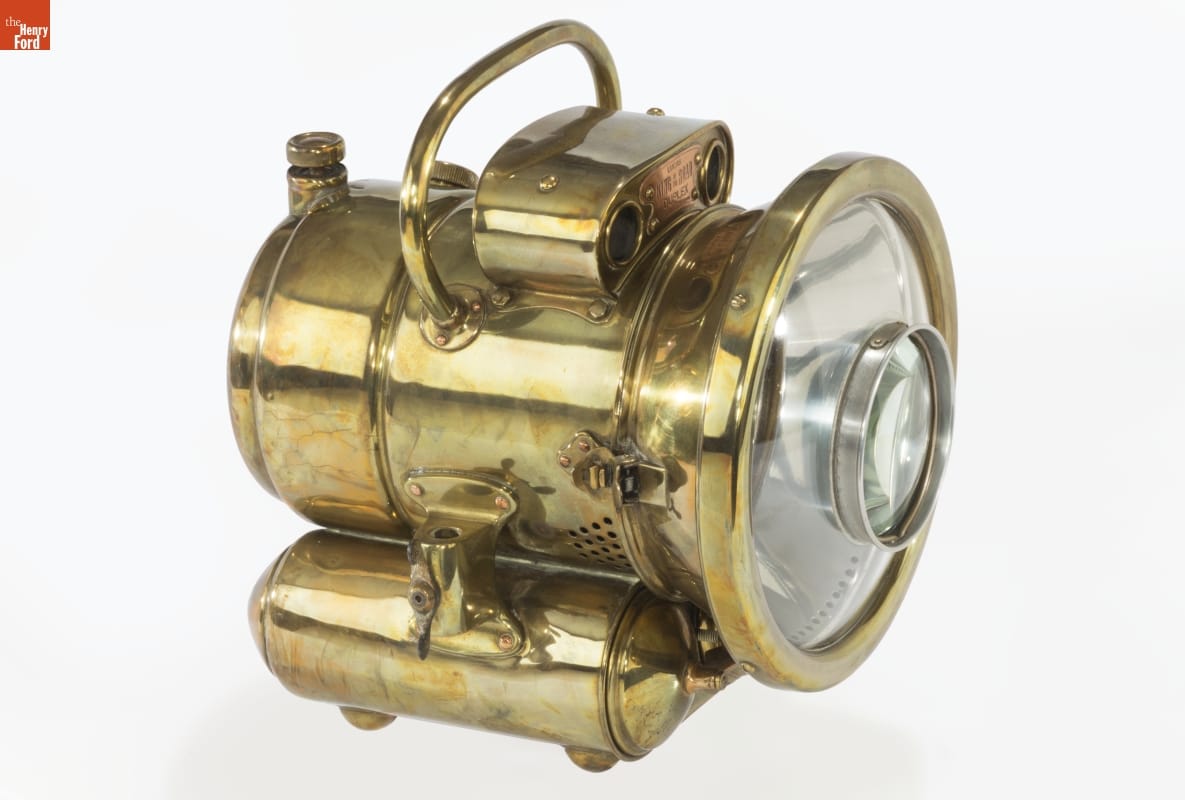
Drivers in the early 1900s attached headlights to their automobiles to help light their way at night. To use this "King of the Road" model, automobilists filled the chambers with calcium carbide and then added water creating acetylene gas. Igniting the gas burner produced a strong white light. The lamp's lens and parabolic reflector cast a broad beam lighting the road ahead.