
Design Drawing, "Triple Eyes," Designed by Alexander Girard for Herman Miller, 1971
THF170216 / Design Drawing, "Triple Eyes," Designed by Alexander Girard for Herman Miller, 1971
01
Artifact Overview
Alexander Girard, Herman Miller Textile Division's Director of Design, created a series of forty folk art-inspired graphic panels aptly named "Environmental Enrichment Panels" in 1972. They were meant to enrich the office environment, adorning the moveable walls of Robert Propst's Action Office II -- more commonly known as the cubicle. This drawing from 1971 laid out the design for the "Triple Eyes" panel.
Artifact Details
Artifact
Design drawing
Date Made
05 May 1971
Place of Creation
Creator Notes
Herman Miller Textiles. Designed by Alexander Girard.
Location
Not on exhibit to the public.
Object ID
92.48.6.1
Credit
From the Collections of The Henry Ford. Gift of Herman Miller, Inc.
Material
Paper (Fiber product)
Color
Black-and-white (Colors)
Multicolored
Dimensions
Height: 46.5 in
Width: 48.375 in
Inscriptions
on back:
UDF #21 "TRIPLE EYES" / DATE 5-15-71 SCALE: FS / ALEXANDER GIRARD ARCHITECT / ORIGINAL DESIGN / SANTA FE, NEW MEXICO
Keywords |
|---|
02
Related Artifacts
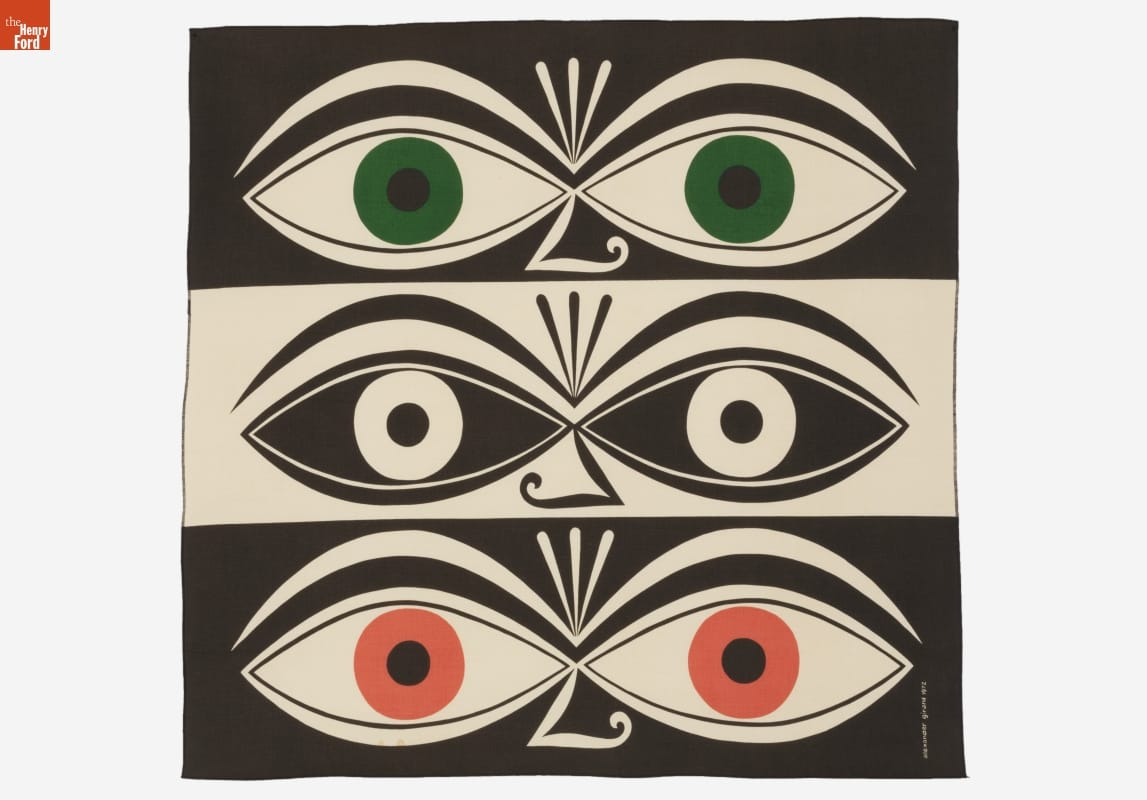 Artifact
Environmental Enrichment Panel, "Triple Eyes," Designed by Alexander Girard for Herman Miller, 1972
Alexander Girard, Herman Miller Textile Division's Director of Design, created a series of forty folk art-inspired graphic panels aptly named "Environmental Enrichment Panels" in 1972. They were meant to enrich the office environment, adorning the moveable walls of Robert Propst's Action Office II -- more commonly known as the cubicle.
03
Related Content
 Set
SetAlexander Girard Designs for Herman Miller
- 18 Artifacts
Early modernist design was starkly minimal, but mid-century modern designer Alexander Girard's work challenged and expanded the movement. Girard humanized modernism through his colorful and whimsical textile, furniture, graphic, and interior designs. As the Director of Design in Herman Miller's Textile Division from 1952 until 1973, Girard designed over 300 textiles, often using bold color combinations and abstract patterns.