
"Pennsylvania Turnpike" Souvenir Plate, 1946-1958
THF173591 / "Pennsylvania Turnpike" Souvenir Plate, 1946-1958
01
Artifact Overview
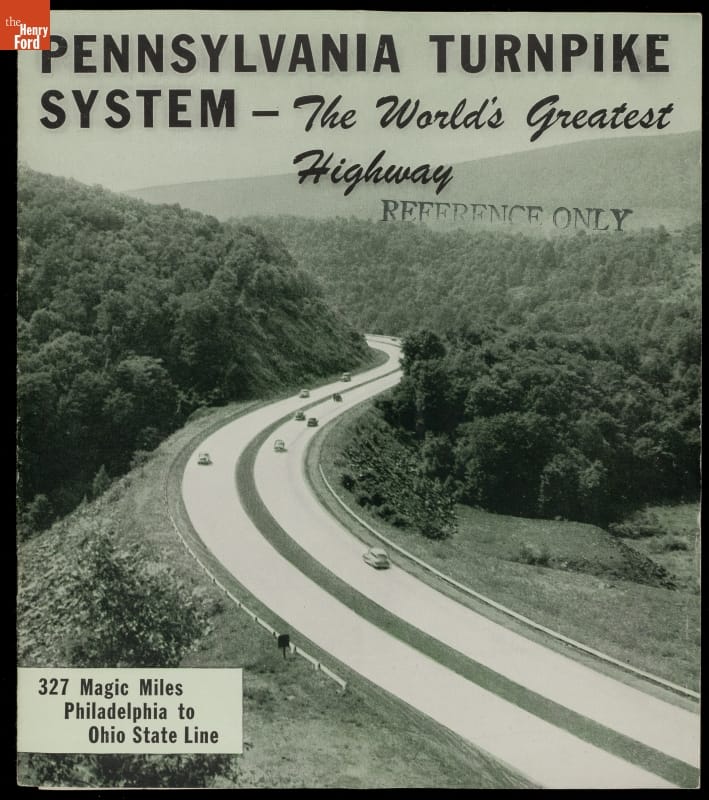
When the first segment of the Pennsylvania Turnpike opened in 1940, drivers appreciated its smooth pavement, gentle curves, and absence of stoplights. The toll road became the prototype for modern limited-access highways. It also became something of a tourist attraction, and drivers purchased souvenirs to commemorate their journeys along the route.
Artifact Details
Artifact
Plate (Dish)
Date Made
1946-1958
Place of Creation
Collection Title
Location
Not on exhibit to the public.
Object ID
2018.103.207
Credit
From the Collections of The Henry Ford.
Material
Ceramic (Material)
Color
Multicolored
Dimensions
Height: 1.125 in
Diameter: 10.5 in
Inscriptions
on top of plate:
PENNSYLVANIA TURNPIKE / Toll Gate / "Little Panama" / Blue Mountain Interchange / Susquehanna River Bridge / The Midway / Pennsylvania Columns, Valley Forge / Bedford Interchange Approach / West Portal, Kittatinny Tunnel
on back of plate:
The Pennsylvania Turnpike system was originally constructed to breach the Appalachian Mountain range and facilitiate the rapid movement of transportation between the great scenes of industry and population. It embodies the most modern principles of express highway design and reduces the limitations of distance and time now imposed on the motoring public by other routes. The world's greatest highway pierces the highest ridges of the Appalachian, with seven tunnels and spans 274 streams and rivers. Throughout the entire length of the Turnpike, 327 miles, service stations, restaurants, and gift shops are located at convenient intervals. / Made expressly for HOWARD JOHNSON'S PENN TURNPIKE SHOPS / Bedford, Pa. by Vernon Kilns U.S.A.
Keywords |
|---|
02
Related Content
 Set
SetThe Pennsylvania Turnpike
- 21 Artifacts
Opened in 1940, the Pennsylvania Turnpike was the prototype for modern limited-access American highways. Financed by user tolls, the turnpike initially ran 160 miles across the Keystone State, connecting Harrisburg with Pittsburgh. It was soon extended 100 miles east to Philadelphia. Drivers appreciated the smooth pavement, gentle curves, and lack of stoplights. The turnpike became a tourist attraction in its own right. article
John Margolies’ Roadside America
Beginning in 1972, John Margolies embarked on a 100,000-mile journey to “go everywhere and see everything” in order to document the fast-disappearing American roadside.