
In the Great Spinning Room - 104,000 Spindles - Olympian Cotton Mills, Columbia, South Carolina, 1903
THF621736 / In the Great Spinning Room - 104,000 Spindles - Olympian Cotton Mills, Columbia, South Carolina, 1903
01
Artifact Overview
Mill owners used the most up-to-date machines in their factories to increase production and cut labor costs, hiring children to tend some of them. A typical child's job was that of spinner, tending 6 or 7 rows of rotating bobbins and watching for breaks in the cotton--then quickly mending them. By 1900, laws in the North limited child labor to an extent, but the practice was widespread in the South, where much of the textile industry had moved.
Artifact Details
Artifact
Stereograph
Date Made
1903
Subject Date
1903
Creators
Collection Title
Location
Not on exhibit to the public.
Object ID
2020.0.1.76
Credit
From the Collections of The Henry Ford.
Material
Paper (Fiber product)
Technique
Gelatin silver process
Printing (Process)
Color
Gray (Color)
Black-and-white (Colors)
Dimensions
Height: 3.5 in
Width: 7 in
Keywords |
|---|
02
Related Content
 Set
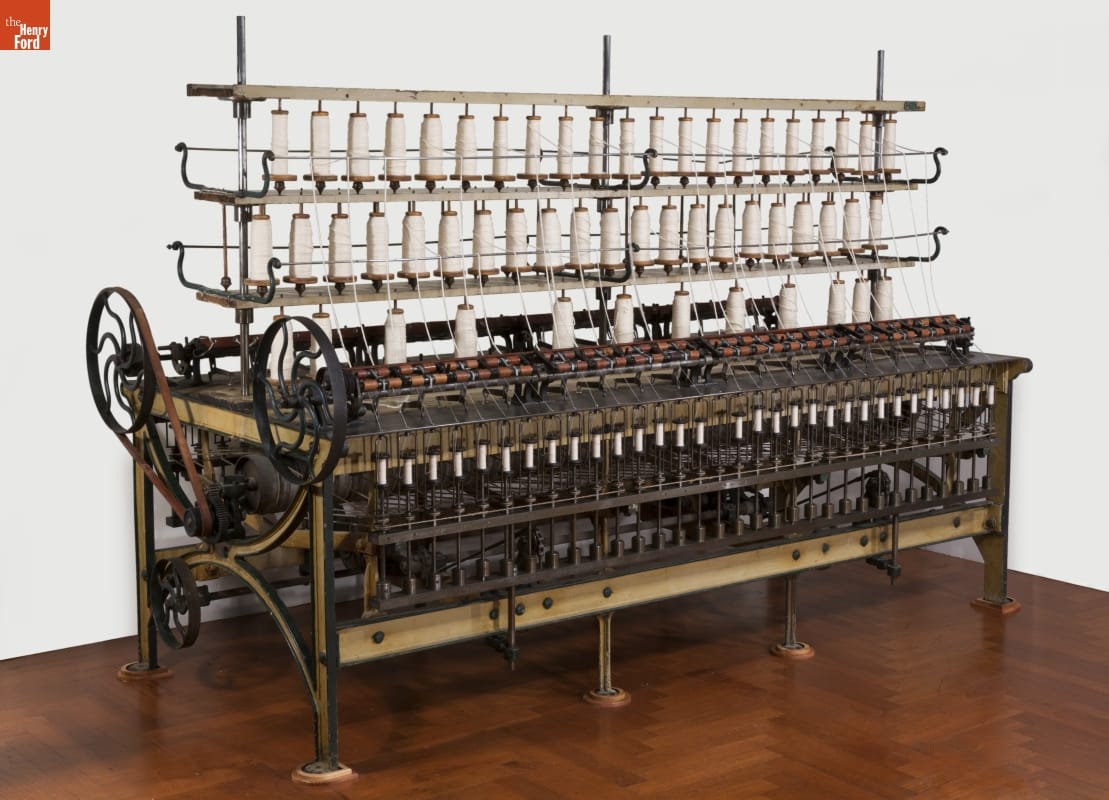
SetSpinning Highlights from the Collections of The Henry Ford
- 16 Artifacts
Spinning frames spin cotton fiber into yarn and then wind it onto a bobbin. This throstle spinning frame could simultaneously spin 64 strands of yarn. (Throstle -- an old name for a song thrush -- refers to the bird-like sounds the machine made.) Machines like this helped produce the large quantities of yarn that growing industrial weaving operations needed in the early and mid-1800s.