
Patent Model of Marine Signal Lantern, 1863
THF152244 / Patent Model of Marine Signal Lantern, 1863
01
Artifact Overview
This marine lantern was designed to burn oil. An opaque metal shade could be moved to expose and block its glow. Moveable red and green glass shades are its most innovative feature, which served two purposes. They allowed the lantern to act as a communications device, to send messages between ships--and as an anchor light, to avoid collisions between vessels.
Artifact Details
Artifact
Model (Patent)
Date Made
1863
Subject Date
21 July 1863
Creators
Place of Creation
Location
Not on exhibit to the public.
Object ID
26.160.26
Credit
From the Collections of The Henry Ford. Gift of the Smithsonian Institution
Material
Tin (Metal)
Glass (Material)
Dimensions
Height: 15.5 in
Diameter: 7.25 in
Inscriptions
Patent tag reads: NO. 39302 / J.J. MINER / SIGNAL LANTERN / PATENTED JULY 21st / 1863.
Keywords |
|---|
02
Related Content
 Set
SetThe Patent Process
- 20 Artifacts
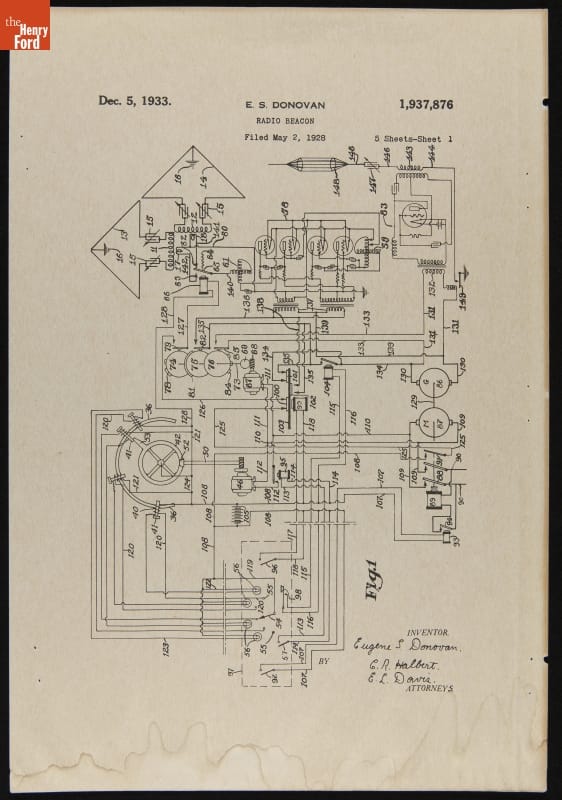
The radio beacon may be Henry Ford's most important contribution to aviation. Early pilots depended on landmarks, preventing reliable navigation in bad weather. Ford's engineers developed a radio beacon that simultaneously transmitted the Morse code letter "A" (dot-dash) in one direction and the letter "N" (dash-dot) in another. The pilot steered until the separate signals merged into a steady hum.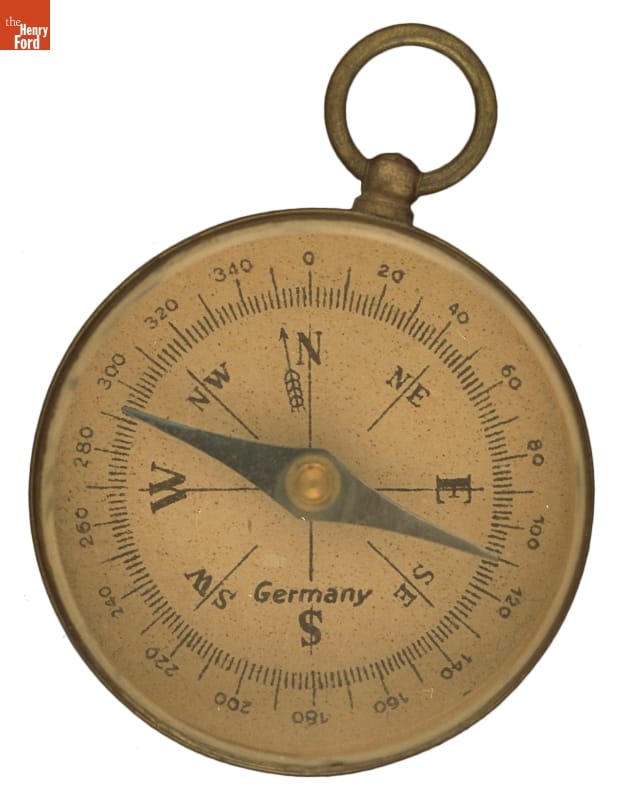 Set
SetSignals and Signs – Ground Communication
- 14 Artifacts
This early 20th-century compass uses a magnetized steel needle that rotates to align with the Earth's magnetic field. With the needle indicating north, users can reference markings around the dial to gain precise bearings. Despite modern GPS technology, compasses remain important navigational instruments for airplanes and ships and for casual use on small boats or recreational hikes.