
Wool Wheel, 1800-1820
THF91504 / Wool Wheel, 1800-1820 / Photographed by John Sobczak
01
Artifact Overview
Spinning fibers into yarn for weaving into cloth was an important task in many 17th and 18th century households. Spinning, often the work of young or unmarried women, was a skilled -- but often tedious -- task. The woman who operated this large wool wheel spent countless hours walking to and fro, alternately spinning the wool fibers into yarn and then winding it onto the spindle.
Artifact Details
Artifact
Spinning wheel
Date Made
1800-1820
Place of Creation
Creator Notes
Attributed to an unknown maker in Pennsylvania.
Location
at Henry Ford Museum in Home Arts
Object ID
24.57.24
Credit
From the Collections of The Henry Ford.
Material
Wood (Plant material)
Steel (Alloy)
Color
Brown
Dimensions
Height: 58.5 in
Width: 20.5 in
Length: 67 in
Keywords |
|---|
02
Related Content
 Set
SetAmerica's Industrial Revolution
- 61 Artifacts
The Model T's distinction as a landmark car design can be traced in large part to machines like this -- a high capacity precision machine tool that performed just two production steps on the car engine's cylinder block. The Model T as a design achievement is inseparable from many hundreds of engineering, materials, and production innovations.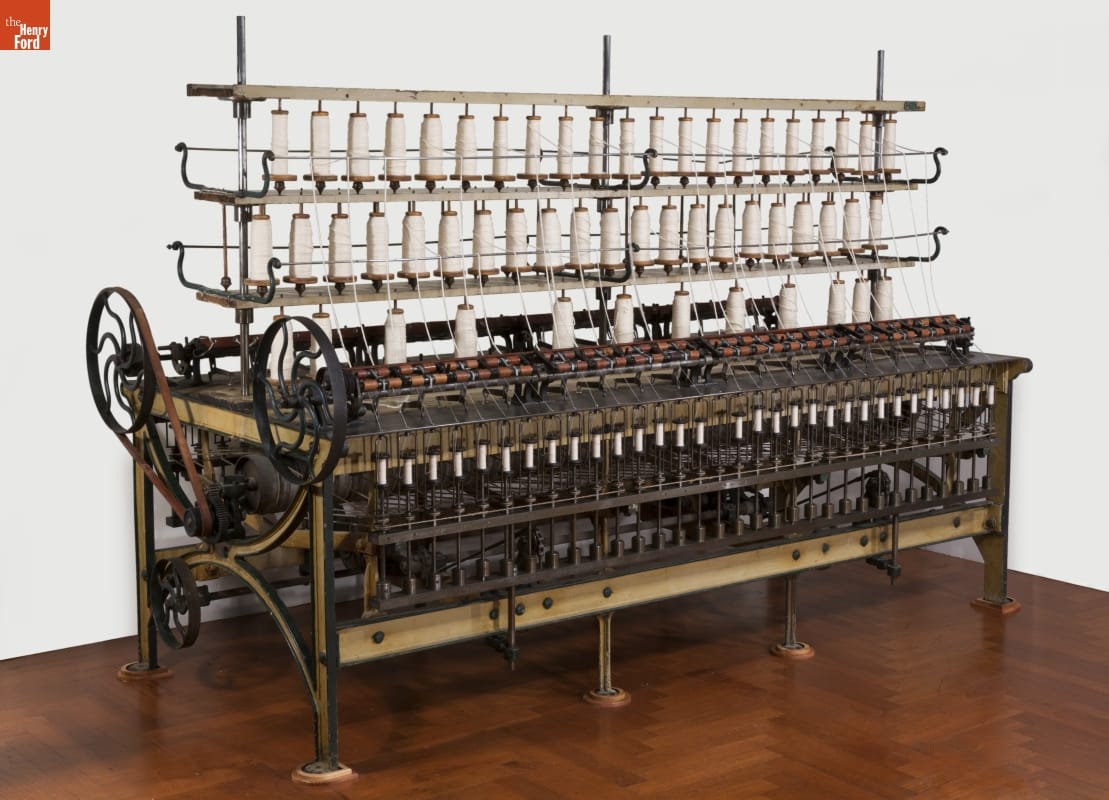 Set
SetSpinning Highlights from the Collections of The Henry Ford
- 16 Artifacts
Spinning frames spin cotton fiber into yarn and then wind it onto a bobbin. This throstle spinning frame could simultaneously spin 64 strands of yarn. (Throstle -- an old name for a song thrush -- refers to the bird-like sounds the machine made.) Machines like this helped produce the large quantities of yarn that growing industrial weaving operations needed in the early and mid-1800s.