
Gillette "Sensor for Women" Razor, 1992
THF803279 / Gillette "Sensor for Women" Razor, 1992 / view
01
Artifact Overview
Industrial designer Jill Shurtleff studied how, where, and why women shaved before creating the Sensor for Women, the first razor designed specifically for women, in 1992. Instead of a traditional thin T-shaped body, the Sensor had a wide handle for users to maintain their grip, and the blade-head was at a 46-degree angle to prevent cuts in hard-to-see areas like underarms.
Artifact Details
Artifact
Razor
Date Made
1992
Place of Creation
Creator Notes
Designed in 1992 by Jill Shurtleff. Manufactured by Gillette Company of Boston, Massachusetts.
Location
Not on exhibit to the public.
Object ID
2024.104.17
Credit
From the Collections of The Henry Ford. Gift of The Liliane and David M. Stewart Collection, acquired through the Dr. Michael Sze Fund, by exchange.
Material
Plastic
Stainless steel
Aluminum (Metal)
Color
Aqua (Color)
White (Color)
Silver (Color)
Dimensions
Height: 5.75 in (in packaging)
Width: 3 in (in packaging)
Length: 0.875 in (in packaging)
Inscriptions
on side of outer packaging:
Gillette(R) Sensor(R) / for Women Refillable Razor / THE RAZOR WORTH HOLDING ONTO / (c)1992 / The Gillette Copmpany (USA) / Box 61, Boston, Ma 02199 / (R) Registered Trademark / Made and Printed in the USA
on front of inner packaging:
Gillette(R) Sensor(R) / for Women / 1 Refillable / Razor / 1 / Cartridge with aloe / and moisturizers / NOT FOR RESALE
on back of inner packaging:
Gillette(R) Sensor(R) / for Women / Refillable / Razor / [...]
on front of instructions:
Congratulations! / You're about to use / the best razor ever / designed to meet / a woman's needs.
Keywords |
|---|
02
Related Content
 Set
SetSelections from the Stewart Collection
- 12 Artifacts
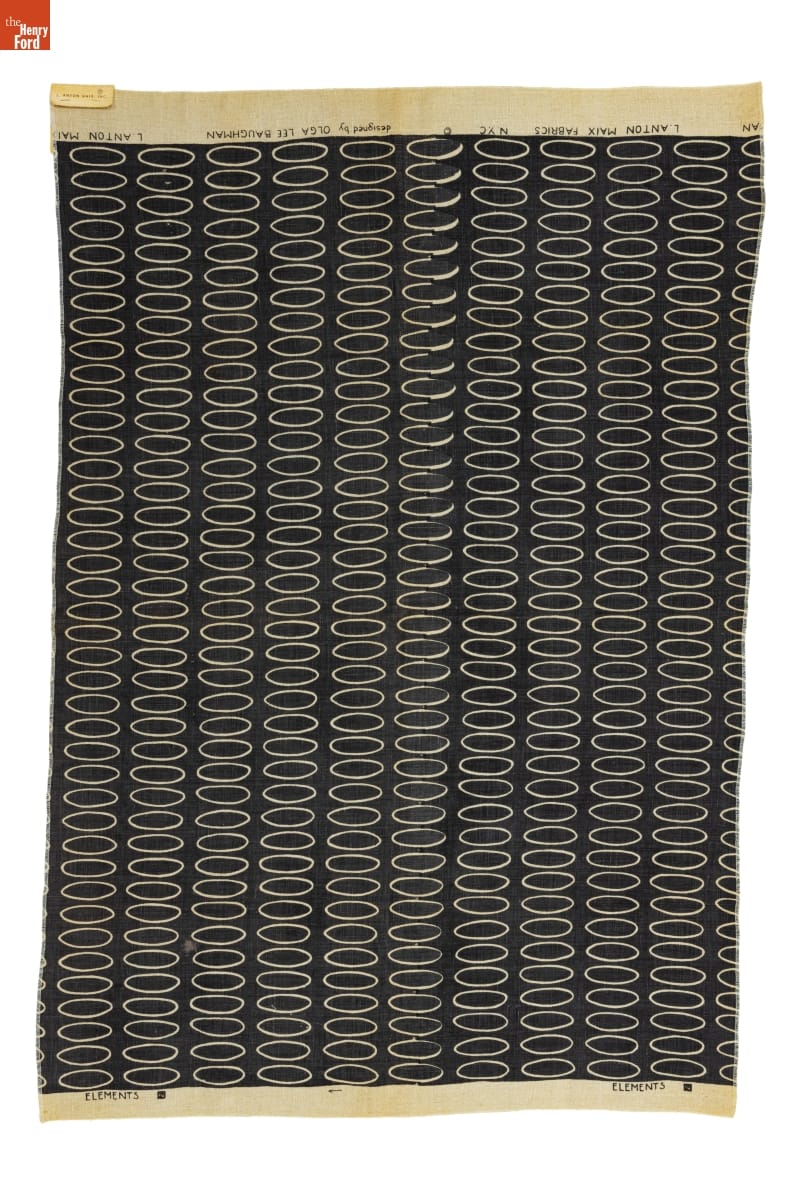
Olga Lee studied interior and industrial design at the prestigious Chouinard Art Institute in Los Angeles, where she met furniture designer Milo Baughman. They married in 1949 and divorced in 1954. She established herself as a leading designer and her designs for New York-based textile studio L. Anton Maix were especially successful. This variation of her "Elements" design features repeating, irregular ovals on linen.