
Ford Motor Company Clipping Book, Volume 2, January 6-10, 1914
THF96708 / Ford Motor Company Clipping Book, Volume 2, January 6-10, 1914
01
Artifact Overview
Henry Ford's office kept a file of newspaper articles from across the country that covered Ford Motor Company and other topics of interest to Henry. These pages are from the days following Ford's announcement of the $5 per day profit sharing plan in January 1914. While Ford's primary objective was to reduce employee turnover, the $5 day was also excellent publicity.
Artifact Details
Artifact
Scrapbook
Date Made
1914
Subject Date
03 January 1914-06 January 1914
Creators
Collection Title
Location
By Request in the Benson Ford Research Center
Object ID
64.167.7.2
Credit
From the Collections of The Henry Ford. Gift of Ford Motor Company.
Material
Paper (Fiber product)
Newsprint
Dimensions
Height: 16 in
Width: 12 in
Depth: 3.5 in
Keywords |
|---|
02
Related Content
 Set
SetHenry Ford
- 49 Artifacts
The Quadricycle was Henry Ford's first attempt to build a gasoline-powered automobile. It utilized commonly available materials: angle iron for the frame, a leather belt and chain drive for the transmission, and a buggy seat. Ford had to devise his own ignition system. He sold his Quadricycle for $200, then used the money to build his second car.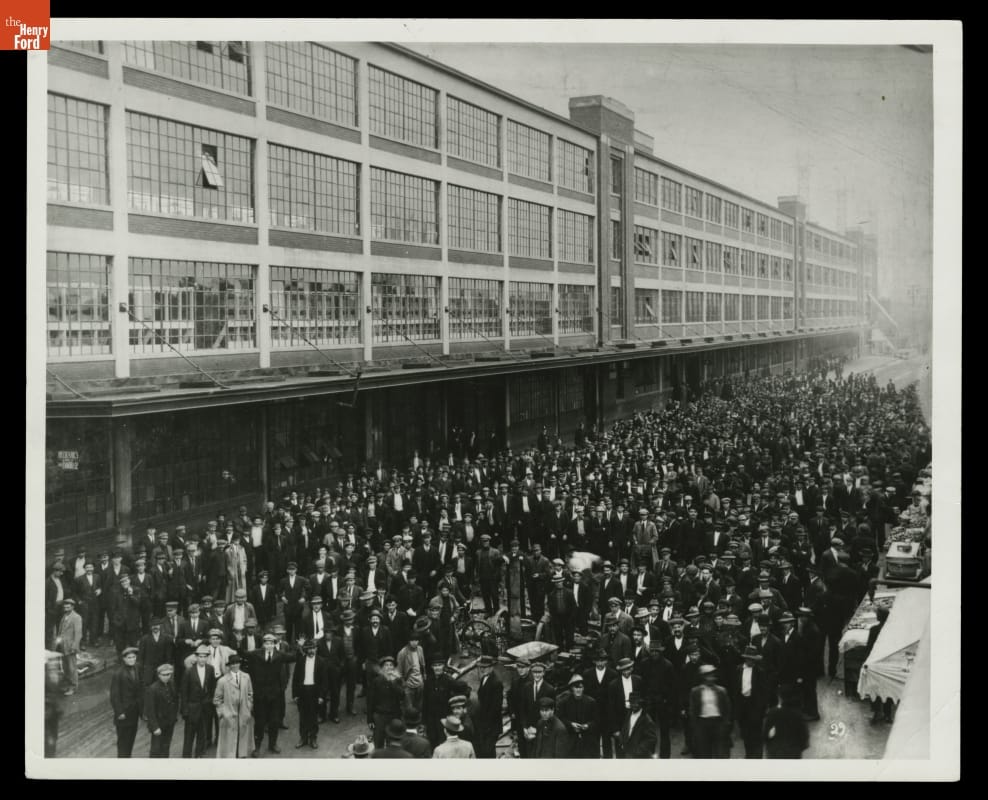 Set
SetHenry Ford: $5 Day
- 8 Artifacts
Ford workers disliked the new assembly line methods so much that by late 1913, labor turnover was 380 percent. The company's announcement to pay five dollars for an eight-hour day compared to the previous rate of $2.34 for a nine-hour day made many workers willing to submit to the relentless discipline of the line in return for such high wages.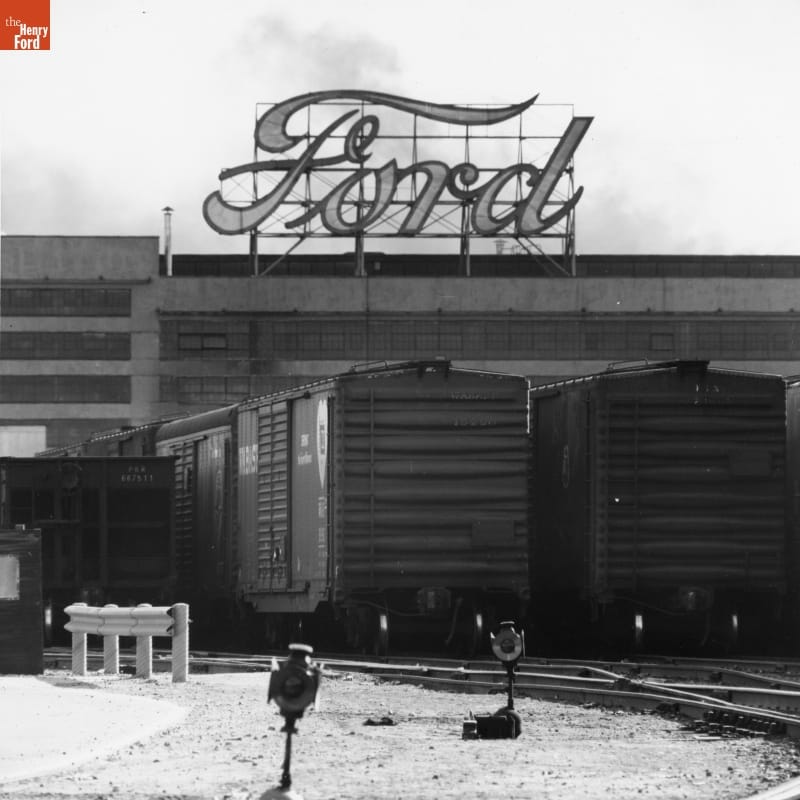 Set
SetLesson: Social Change - Mass Advertising -1920s
- 13 Artifacts
The River Rouge complex took raw materials, like iron ore, and converted them to refined materials for the creation of new automobiles. Ford strategically positioned the Rouge plant near the river to receive raw materials by boat, and it used the complex's railroad network to distribute them to the proper buildings for refinement. This strategy made Ford Motor Company more efficient and allowed for financial growth.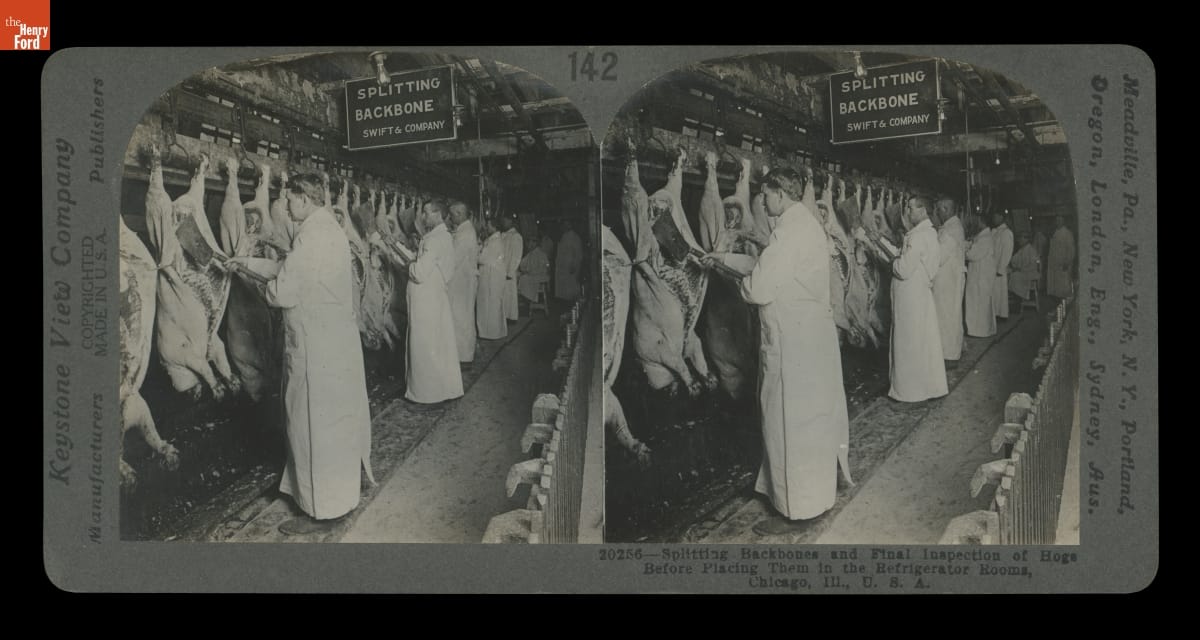 Set
SetLesson: The Moving Assembly Line and Work Force
- 5 Artifacts
At this meat packing operation, a conveyor moved hog carcasses past meat cutters, who then removed various pieces of the animal. To keep Model T production up with demand, Ford engineers borrowed ideas from other industries. Sometime in 1913 they realized that the "disassembly line" principle employed in slaughterhouses could be adapted to building automobiles -- on a moving assembly line.