
Patent Model of Railroad Signal Lantern, 1867
THF152198 / Patent Model of Railroad Signal Lantern, 1867
01
Artifact Overview
Flags and lanterns were the primary means of communication between conductors, brakemen, and engineers on American railroads. Different movements and colors indicated different instructions as crews assembled and operated trains. Lanterns with red globes typically were used to signal a train to stop at places like "flag" stations -- where trains did not regularly halt -- and crossings with other railroad lines.
Artifact Details
Artifact
Model (Patent)
Date Made
1867
Subject Date
16 April 1867
Creators
Place of Creation
Location
Not on exhibit to the public.
Object ID
26.160.27
Credit
From the Collections of The Henry Ford. Gift of the Smithsonian Institution
Material
Tin (Metal)
Glass (Material)
Dimensions
Height: 14.5 in
Diameter: 6.75 in
Inscriptions
Lantern marked on base: JESUP / MAKER'S / CHICAGO ILL. / L. HOVER'S / PAT.JAN.23.1855
Globe: C.B. & Q.R.R.
Patent tag marked: NO. 63820 / A.N. TOWNE / HANDLE FOR SIGNAL LANTERNS / PATENTED APRIL, 16th / 1867.
Keywords |
|---|
02
Related Content
 Set
SetThe Patent Process
- 20 Artifacts
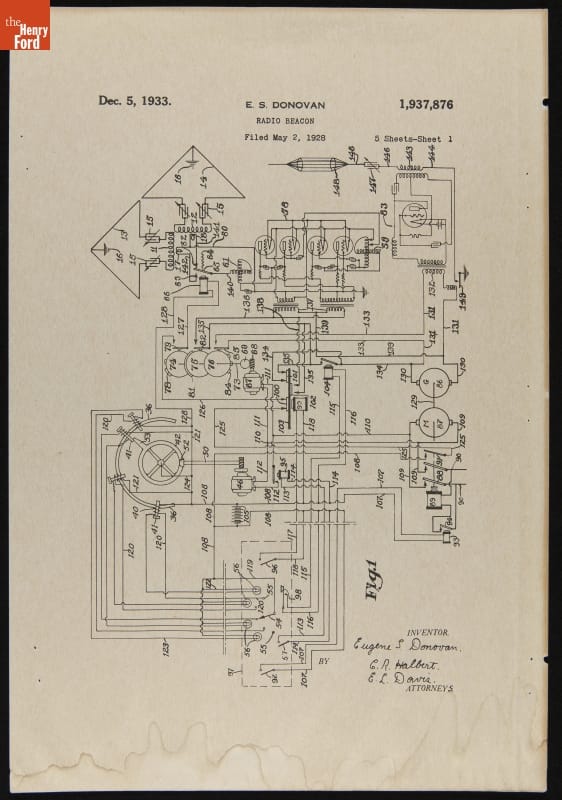
The radio beacon may be Henry Ford's most important contribution to aviation. Early pilots depended on landmarks, preventing reliable navigation in bad weather. Ford's engineers developed a radio beacon that simultaneously transmitted the Morse code letter "A" (dot-dash) in one direction and the letter "N" (dash-dot) in another. The pilot steered until the separate signals merged into a steady hum.