
Patent Model of Edmondson's Circular Calculating Machine, 1883
THF154094 / Patent Model of Edmondson's Circular Calculating Machine, 1883
01
Artifact Overview
Mechanical calculators used gears, cogs, levers, and rotating drums to solve mathematical problems indirectly. While Edmondson's Circular Calculator was rugged and reliable, its "stepped drum" system required people to slide plates and levers, making it difficult to master and time-consuming to operate. By the late 19th century, improved adding machines became popular, helping to reduce the common errors of human calculation.
Artifact Details
Artifact
Model (Patent)
Date Made
1883
Place of Creation
Creator Notes
Joseph Edmondson was awarded three British patents for his circular calculating machine in 1883; it was manufactured by Blakey, Emmott and Co., Ltd.
Location
Not on exhibit to the public.
Object ID
31.1217.110
Credit
From the Collections of The Henry Ford. Gift of Edison Laboratories.
Material
Wood (Plant Material)
Metal
Brass (Alloy)
Ceramic (Material)
Felt (Textile)
Paper (Fiber product)
Printed
Dimensions
Height: 5.5 in
Width: 17 in
Length: 19.25 in
Inscriptions
MADE FOR THE PATENTEE J. EDMONDSON. HALIFAX, ENGLAND, BY BLAKEY, EMMOTT & CO. LTD. [brass plaque]
EDMONDSON'S CIRCULAR CALCULATING MACHINE / NOTA BENE / (operating instructions) [inside case]
Keywords |
|---|
02
Related Content
 Set
SetThe Patent Process
- 20 Artifacts
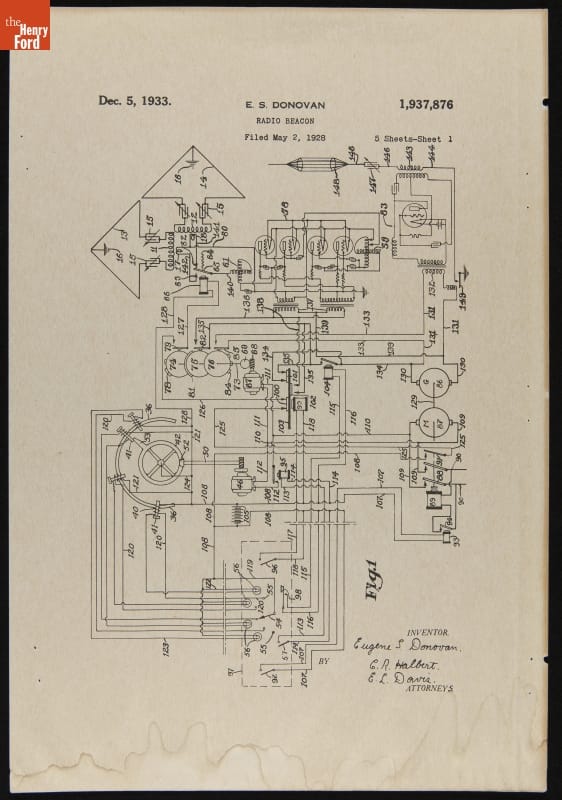
The radio beacon may be Henry Ford's most important contribution to aviation. Early pilots depended on landmarks, preventing reliable navigation in bad weather. Ford's engineers developed a radio beacon that simultaneously transmitted the Morse code letter "A" (dot-dash) in one direction and the letter "N" (dash-dot) in another. The pilot steered until the separate signals merged into a steady hum. article
Sparking Innovation: HP-35 Calculator
Learn the revolutionary story of the Hewlett Packard HP-35, the world’s first handheld scientific calculator.