
Celebrating 90 -- Collecting through the Decades: 1980s
Share
share
The Henry Ford marks its 90th anniversary in 2019. In celebration, The Henry Ford's curators have taken a decade-by-decade look at how our collections have grown -- through significant additions and evolving philosophies. This set looks at some of the objects and archives collected during the 1980s.
THF123814
Advertising Poster, "In 1939 The New York World's Fair"
Reflecting a new emphasis on social history, museum staff developed interpretive exhibits that integrated objects from across collections categories to examine special themes. "Streamlining America" explored an influential mid-20th-century ideology and design style. This striking poster, selected for the exhibit, embodies the streamlined environment of the 1939-40 New York World’s Fair. -Saige Jedele, Associate Curator, Digital Content
View ArtifactTHF28743
Christian Dior Dress, Worn by Elizabeth Parke Firestone to the Wedding of Martha Parke Firestone and William Clay Ford, 1947
Elizabeth Parke Firestone donated a large segment of her stunning wardrobe in 1989, including custom-made garments created for her by prominent American and European couturiers. Firestone was an early client of French designer Christian Dior. She visited Dior's Paris salon in 1946 and commissioned this dress, made for her daughter Martha’s wedding to William Clay Ford. -Jeanine Head Miller, Curator of Domestic Life
View ArtifactTHF175176
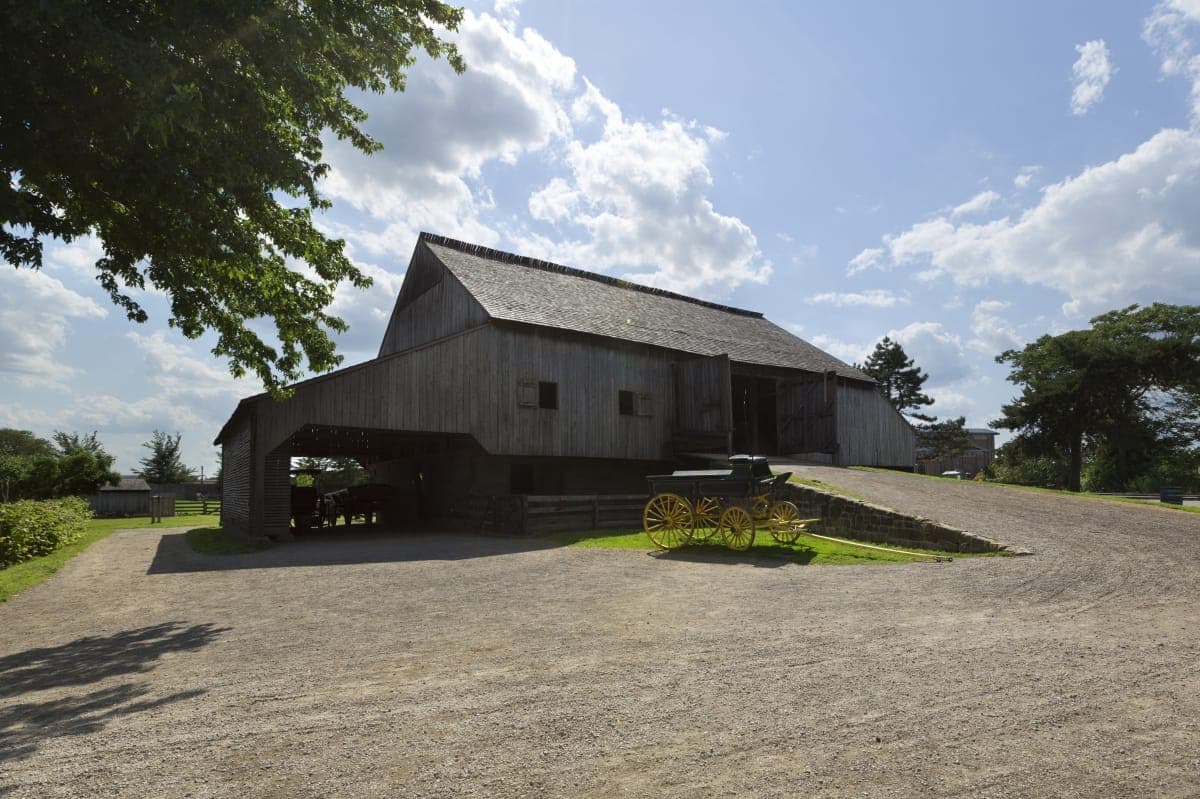
Firestone Barn
Harold K. Skramstad, Jr., president of The Edison Institute, considered the opening of Firestone Farm a "landmark event." Why? The house, barn, and outbuildings added a living historical farm to Greenfield Village, complete with wrinkly Merino sheep collected to sustain the type and increase interpretive potential. -Debra A. Reid, Curator of Agriculture and the Environment
View ArtifactTHF101941
Holiday Inn "Great" Sign, circa 1960
For 50 years the museum displayed artifacts in tightly packed rows with little supporting context. That changed in the 1980s with a new focus on social history. No exhibit signaled this shift like "The Automobile in American Life," opened in 1987. Cars were shown alongside related items like maps, fast food menus, and replica roadside lodgings. We acquired this Holiday Inn "Great Sign" for that exhibit. -Matt Anderson, Curator of Transportation
View ArtifactTHF204018
Advertisement from Newspaper, "For Millbury -This Day," 1829
In 1982, Henry Ford Museum & Greenfield Village purchased the Seymour Dunbar Collection from Chicago's Museum of Science & Industry. The collection consists of over 1,700 prints, drawings, maps, and other items documenting various modes of travel from 1680 to 1910. Dunbar compiled this material while researching his four-volume history of travel in the U.S., which was published in 1915. -Andy Stupperich, Associate Curator, Digital Content
View ArtifactTHF102580
Television Lamp, 1947-1960
This type of lamp is typically called a "Television Lamp." It was made to sit atop a television console and to provide a low level of illumination, sufficient to keep one's eyes from being "harmed" by watching the small TV screens of that time (1946-1960). This marks a change in collecting as curators sought out objects that provided insight into social history. -Charles Sable, Curator of Decorative Arts
View Artifact

