
Curators' Choice: Agriculture & the Environment
Share
share
Curators' picks in Agriculture & the Environment.
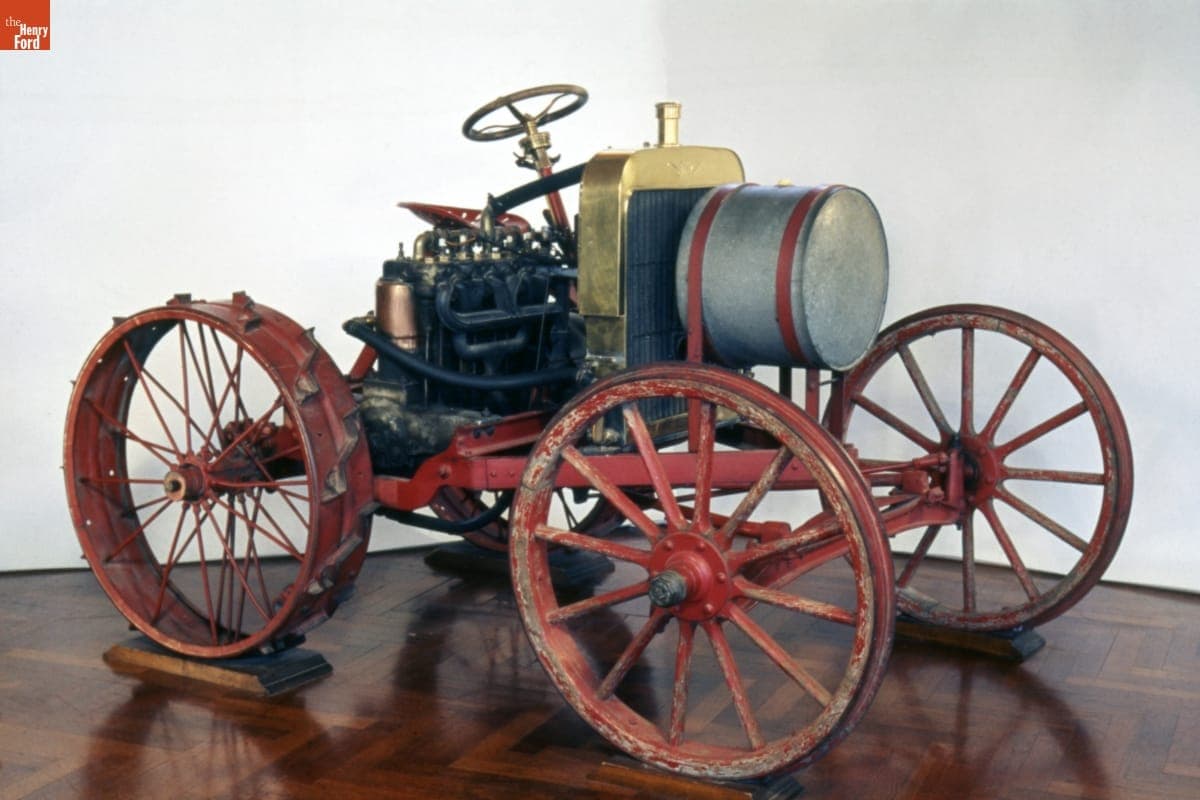
THF91784
Ford Experimental Lightweight Tractor, circa 1907
Calling it his "automotive plow," Henry Ford had Joseph Galamb and C.J. Smith construct this experimental machine. It is powered by a 1905 Ford Model B engine with copper water jackets. This tractor represents either the first or, more probably, the second of several experimental lightweight tractor designs which culminated in the production of the Fordson tractor for U.S. markets in 1918.
View ArtifactTHF95492
Porcupine Thresher, circa 1820
This conical "porcupine" thresher beat the grain with the blunt wooden pegs as it was pulled around in a circle on a barn's threshing floor. The small end of the thresher was attached to a pivot, and the horse pulled the large end. It was used by Dutch and German farmers in the Mohawk Valley west of Albany, New York.
View ArtifactTHF173322
Ford Model 9N Prototype Tractor, 1939
This is the first prototype of the Model 9N tractor. This tractor marked the first practical hydraulic three-point hitch on a tractor, a feature standard on all tractors today. Henry Ford helped debut this machine when he demonstrated its versatility on April 1, 1939 at a media event on the property of his Dearborn home.
View ArtifactTHF93025
Avery Steam Traction Engine, circa 1916
Massive steam engines like the Avery were generally used on the large farms of the Great Plains, though this engine was used on Ford Farms in Dearborn, Michigan. It generated 30 horsepower, but weighed 23 tons! More efficient tractors, like the Fordson, which could generate 20 horsepower but weighed just over one ton, soon replaced these dinosaurs of the farm.
View ArtifactTHF32612
Prairie Breaking Plow, circa 1860
The thick, root-bound sod of the American prairies was too tough for regular plows. Huge steel plows, drawn by many oxen, were specially developed to break through the unplowed prairie soils. This is a smaller version of those sod-busting plows, made possible by improved casting techniques which made the plow share smoother and easier to pull through the soil.
View ArtifactTHF72058
Fordson Tractor, 1917-1918, Used by Luther Burbank
The Fordson tractor, manufactured by Henry Ford and Son, Inc., was the first lightweight, mass-produced tractor that was affordable to the average farmer. Through this and other efforts, Henry Ford sought to relieve farmers of the burden of heavy labor. Ford gave this Fordson, the first production model, to fellow innovator Luther Burbank, creator of hundreds of new plant varieties.
View ArtifactTHF734909
New York Dutch or Hog Plow, circa 1780
This light-draft, single-handle plow was used by Dutch farmers of the Hudson Valley of New York well into the 1800s, despite being surrounded by English communities. A key feature of this traditional plow, the distinctive pyramidal plowshare, was adapted by English neighbors to create the "Carey" or "Connecticut" plow, which became popular across the new American nation.
View ArtifactTHF37619
Oliver Chilled Cast Iron Plow, circa 1895
The high-quality Oliver Chilled Plow dominated the market during the late 19th and early 20th centuries. Its creator, James Oliver, perfected "chilling," a casting process that created durable iron moldboards and shares that retained a smooth surface during heavy use. Farmers relied on dependable plows like the Oliver when preparing soil prior to planting crops.
View ArtifactTHF140104
Westinghouse Portable Steam Engine No. 345, Used by Henry Ford
Portable steam engines like this powered grain threshers, sawmills, or corn shellers. Horses pulled them from farm to farm. In 1882, 19-year-old Henry Ford was able to make this engine run well when an older man could not; his first accomplishment in the adult world. Thirty years later Ford tracked down the engine, bought it, and returned it to operating condition.
View ArtifactTHF173881
Ambler's Mowing Machine, circa 1836
This is probably the oldest surviving American harvester. Enoch Ambler, a resident of Montgomery County, New York, patented this machine in 1834 and demonstrated it by cutting about 100 acres of grass in 1835. Interest in the mower led Beale & Griswold of Spencertown, New York, to buy Ambler's patent and attempt commercial production for the 1836 and 1837 seasons.
View ArtifactTHF95493
Manny's Combined Reaper and Mower, circa 1854
John Manny developed this reaper in 1853 in Rockford, Illinois. It was the first to successfully challenge the Cyrus McCormick Company's dominance in reaper manufacture. Sued for patent infringement by McCormick in 1854, Manny won, paving the way for other manufacturers, and a broad expansion of the industry. Included in Manny's legal team was a young Illinois lawyer, Abraham Lincoln.
View ArtifactTHF189117
Luther Burbank Garden Office
Luther Burbank (1849-1926), an American horticulturalist and author, gained a reputation for selective breeding that yielded more than 800 new fruits, vegetables, flowers, and other plants. He opened this Bureau of Information in 1910 at the corner of his 40-acre experimental garden in Santa Rosa to sell seeds and souvenirs. It served various purposes over the years until Burbank's widow offered it to Henry Ford in 1928.
View ArtifactTHF95494
Zenith Radio Wincharger, 1935-1937
Radio connected Americans to the larger world in many ways. However, most rural Americans were not on the limited power grid of the 1930s so could not use radios. Portable wind generators, like this Wincharger, were developed to power radios, continuing a long tradition of local power production on farms--by horse, steam and wind power.
View ArtifactTHF80599
Fish Brothers Farm Wagon, 1895-1902
Farm wagons were all-purpose vehicles that could haul crops from the field to the barn or to market. This wagon body was used in the field for harvesting corn by hand, but it could be changed for other purposes, such as hauling hay or gravel. Franz Eilerman of Shelby County, Ohio, bought this farm wagon in 1902 for his son, Henry.
View ArtifactTHF133854
Massey-Harris Model 20 Self-Propelled Combine, 1938
"Combines" combine the major tasks of grain harvest: cutting and gathering the crop, threshing and separating the kernels from the chaff, and disposing of the straw. The Massey-Harris Model 20, introduced in 1938, culminated over 100 years of mechanical improvements. One driver operated the self-propelled machine, which reduced the need for hired help during the labor shortages of World War II.
View ArtifactTHF151663
Self-Propelled Cotton Picker, 1950
This is the first commercially successful self-propelled cotton picker. The inventor, John Rust, worked for decades to develop a machine that would end the back-breaking labor of picking cotton that he experienced in his youth. The machine reduced the labor required to pick cotton by 80%, contributing to the Great Migration from the rural south to northern cities in the 1950s.
View ArtifactTHF93045
Concrete Silo, 1914
Silos were developed in the 1870s as a way to preserve feed crops for dairy cattle and other livestock, in an air-tight environment. Early silos were built of stone, brick or wood. In 1909, Hiram Smith of Paw Paw, Michigan, developed an innovative technique of building silos, such as this, like a barrel, with concrete staves and steel cables.
View ArtifactTHF175176
Firestone Barn
The Firestone barn is a Pennsylvania-German bank barn, an American barn type with Swiss origins. They are called bank barns because the barn is built into a bank, allowing wagons to be driven into the upper floor. Bank barns combined multiple farm functions under a single roof. Livestock were kept in the lower floor, crops on the upper floor.
View ArtifactTHF153893
Model of Soybean Oil Extractor, circa 1935
Henry Ford had a vision of farmers being part of the industrial process -- an idea he called "chemurgy." This idea was most completely played out in his experimentation with soybeans, a versatile crop that could be used for industrial products as well as food. This model demonstrates how oil could be extracted from soybeans and converted into many plastic-like products.
View ArtifactTHF374008
FMC Tomato Harvester, 1969
Tomatoes need careful handling. Growers who contract with processors used to rely on human laborers. The quest to plant and harvest more, faster, gave mechanical engineers and plant geneticists incentive to design a machine and a tomato it could harvest. The FMC Cascade Harvester carried 10-12 laborers who sorted debris out of the crop, fewer laborers than growers had needed for handpicking.
View ArtifactTHF81864
Poster, "Farm Work: Rural Electrification Administration," 1935
The struggles of the Great Depression caused old ideas to be cast aside for new approaches. The modern design of this poster supports the message promoting the newly formed Rural Electrification Administration. The REA brought power to rural areas, transforming rural life, reducing isolation, and making a range of new products available for the farm and home.
View ArtifactTHF89810
International Harvester Manure Spreader, circa 1905
Spreading manure to rejuvenate the soil is one of the most important, but least popular jobs on the farm. Mechanical manure spreaders made an awful job slightly less so. This circa 1905 International Harvester Manure Spreader No. 3 is a very rare survivor and an excellent example of the prevailing manure spreader design of the early 1900s.
View ArtifactTHF373910
John Deere 7000 No-Till Planter, 1978
Deere and Company introduced their first commercially successful no-till or minimum tillage planter in 1978. Rolling disks open a furrow for a seed, and another set of rolling disks cover the seed. Conservation tillage reduces wind and water erosion, but no-till does not mean no chemicals. Farmers may apply commercial fertilizers, herbicides to control weeds, and insecticides to control pests.
View ArtifactTHF163071
Microscope Used by George Washington Carver, circa 1900
By 1900, cotton production had depleted Southern soils, so George Washington Carver (1864-1943) developed nutritious crops like peanuts that nurtured the soil and could be sold to make industrial products. He used this microscope in his laboratory at the Tuskegee Institute in Alabama.
View Artifact

