
Electric Stories - 2015-2017 IMLS Grant Project II
Share
share
In 2015, The Henry Ford received a grant from the Institute of Museum and Library Services (IMLS) to digitize a selection of artifacts related to electric power generation and distribution. Many hidden stories came to light as staff cataloged, photographed, and conserved these objects. This expert set (the second in the series) presents just another small sampling of those artifacts and their stories preserved by The Henry Ford.
THF166885
Fuller Electrical Company Dynamo, 1879
In the late 1800s, arc lamps provided lighting for mills, factories, city streets and large public areas. The Fuller Electric Company produced this dynamo in 1879 to generate electricity for these lighting systems. Its design -- from the patent of James J. Wood, a Fuller employee -- was an improvement over previous dynamos and helped spread the use of arc-lamp lighting.
View ArtifactThomas Edison 73rd Birthday Luncheon Souvenir Lamp, 1920
The Edison Pioneers was an association initially composed of former employees who had worked for Thomas Edison. The group, organized in 1918, gathered each year on February 11 to celebrate the birthday of the famous inventor. In 1920, members gathered and lunched with Edison in West Orange, New Jersey. Attendees received this commemorative gift as a remembrance of the day.
View ArtifactWestinghouse Wurts Circuit Breaker, circa 1896
In the late 1800s, as companies began producing electricity to light cities, run streetcars, and power factories, homes and offices, new apparatus was needed to safely deliver and use electricity. Excess current in a circuit could damage electric lines and equipment. Circuit breakers protected electrical circuits by automatically interrupting the power flow during an event overload.
View ArtifactSplitdorf Dixie Magneto, 1915-1925
Magnetos served as simple, reliable ignition systems for internal combustion engines in early automobiles, motorcycles, and airplanes. Modern ignition magnetos are still found in lawn mowers and chainsaws, and aircraft use magnetos as an independent electrical system. Auto manufacturers, however, found other methods to keep engines turning.
View Artifact"The Bosch Ford Attachments," circa 1914
Bosch's "Red Devil," created in the early 1900s to promote the company's ignition components, was based on racer Camille Jenatzy. The red-haired Belgian driver was noted for his flamboyant appearance including a pointed beard, flowing duster, and goggles pushed atop his head. Jenatzy's daring driving won the 1903 Gordon Bennett Cup race -- with a Bosch ignition system in his car.
View ArtifactBosch Type ARN Magneto, Used by Orville Wright at Fort Myer, Virginia, 1909
Orville Wright used this magneto, which generated spark for his airplane's engine, during demonstration flights for the U.S. Army at Fort Myer, Virginia, in July 1909. Fort Myer represented tragedy and triumph. Orville was seriously injured, and passenger Thomas Selfridge was killed, during initial demonstrations there in September 1908. Ten months later, Orville returned and completed the demo flights successfully.
View ArtifactEdison General Electric Company Edison System Ampere Meter, 1889-1892
In the late 1800s and early 1900s, companies that supplied electricity to consumers needed a variety of instruments to regulate and monitor electrical output. These instruments were vital to the operation of power stations and needed to be accurate and rugged. Ammeters--used to measure the current in a circuit--could be found on switchboards or connected to motors and generators.
View ArtifactWeston Voltmeter, Used at the Pontiac State Hospital, Pontiac, Michigan, 1901-1910
In 1898, a modern electric light and power plant was completed at the Eastern Michigan Asylum in Pontiac. Inside, a range of engines, motors, machines and meters helped power the institution's growing infrastructure. This voltmeter was part of the improvements. In 1929, hospital administrators funded a new power plant and this voltmeter was donated to The Henry Ford.
View ArtifactPontiac State Hospital Dynamo Room, Pontiac, Michigan, 1898
This photograph shows the interior of the dynamo room at the Eastern Michigan Asylum in Pontiac. When hospital administrators funded a new power plant in 1929, some of the meters and other equipment from the old plant were donated to The Henry Ford. The voltmeter seen on the switchboard in this photograph may be the one listed above.
View ArtifactSwinburne Hedgehog Transformer, circa 1890
In 1889, Scottish-born James Swinburne designed a transformer with a core of prickly iron wires. Swinburne claimed his open-circuit "hedgehog" transformer was more efficient than closed-circuit transformers for voltage regulation. Scientists and electrical engineers disputed his assertions and found his innovation was less efficient. Swinburne, however, remained a well-respected member of the engineering field.
View ArtifactSangamo Electric Company Type H Wattmeter, 1911-1914
In the late 1800s, companies that supplied electricity to consumers needed a way to measure how much customers used--and then charge them accordingly. Induction-type wattmeters proved reliable and would become the industry standard, but until 1910 Westinghouse held the patent rights. Sangamo Electric Company introduced this induction-type meter -- the smallest model on the market at the time -- in 1911 after the patents had expired.
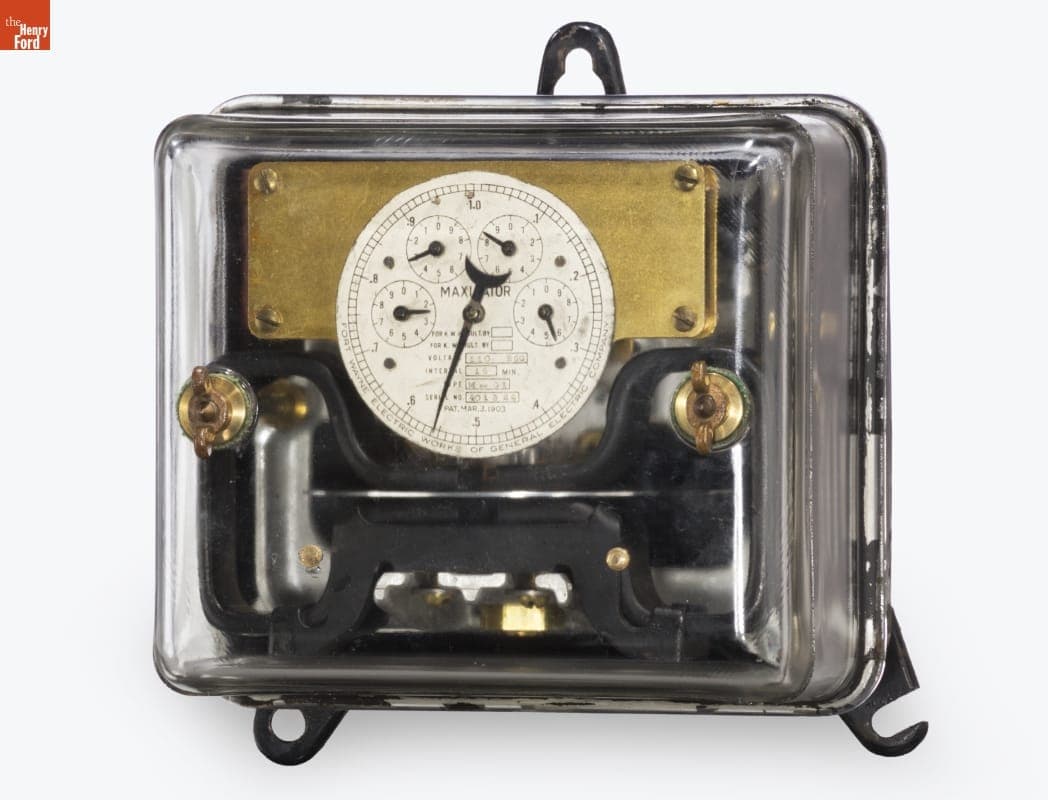
View ArtifactFort Wayne Maxicator Type M Demand Indicator, circa 1915
Consumers' demand for electricity fluctuates. A maxicator (similar to a wattmeter) records the maximum electrical power used during a reoccurring set period of time (for example every 30 minutes). The large pointer records a consumer's peak usage on the external scale. Armed with this information, companies that supply electricity can provide power efficiently and economically when usage varies.
View ArtifactEmerson Motor, 1898-1908
Emerson Electric Manufacturing Company was founded in 1890 in St. Louis, Missouri. In its early years, the company manufactured fan motors, but by 1900, Emerson built a range of fractional horsepower motors. These portable motors powered a variety of small household appliances and specialized trade machinery, including fans, lathes, pumps, washing and sewing machines, dental drills, jewelry grinders, and furnace blowers.
View ArtifactRobbins & Myers Motor, circa 1912
In the late-19th and early-20th centuries, American companies began producing electric motors to power factory machinery, business equipment and household appliances. Robbins and Myers (R&M) originally made castings for agricultural tools and machinery when it formed in the late 1870s, but two decades later it began making fan motors. R&M success led it to manufacture motors of various sizes and horsepower.
View ArtifactMeyrowitz Brothers Portable Electro-Surgical Motor, circa 1891
In 1891, Emil B. Meyrowitz and Ferdinand Buchhop developed this metal sphere-encased motor to power electric drills used for nasal and dental surgeries. The motor was small and portable. Physicians could suspend this uniquely shaped motor in the operating room close to the patient's bedside.
View Artifact"Crocker-Wheeler Perfected Electric Motors," circa 1890
Francis Crocker teamed up with Schuyler Wheeler to form Crocker-Wheeler Electric Motor Company in 1888-89. Their company manufactured motors for use in factories, small shops, offices and homes. Their motors powered lathes, presses, and drills and ran elevators, fans, and sewing machines. The two men were well-respected engineers, both serving as president of the American Institute of Electrical Engineers.
View ArtifactVictor Electric Company Motor, 1905-1915
In the late 19th and early 20th centuries, American companies began producing electric motors to power factory machinery, business and medical equipment, as well as household appliances. Victor Electric Company, founded in 1893, specialized in electrical medical equipment, especially that related to X-ray machines. Victor merged with General Electric in 1920.
View ArtifactStarting Rheostat
Rheostats vary the amount of electrical resistance in a circuit. They proved beneficial as the use of electrical power expanded in the late 1800s. Among their many applications, rheostats helped motors start safely, controlled motor speed, maintained a constant current in battery chargers, and adjusted volume and light levels. This rheostat was used as part of Edison's first three-wire distribution system in Sunbury, Pennsylvania.
View ArtifactGeneral Electric Type P Overload Relay, 1910-1920
As the electrical industry expanded, companies created equipment to protect valuable infrastructure used to generate and transmit electricity. Engineers developed relays to protect against service interruptions and keep equipment safe from abnormal current loads. These unassuming devices control the path of electricity, directing it to different circuit paths when needed.
View ArtifactH. Aron Meter, Used by the Budapest General Electric Company, 1899
Hermann Aron, a German physicist and lecturer-turned-manufacturer, developed a pendulum watt-hour meter in the 1880s for companies that supplied electricity to consumers in Europe's growing urban areas. Swinging pendulums turned hands on dials that accurately registered how much electricity customers used--so companies could charge appropriate rates. Aron's pendulum meters remained practical until less expensive motor meters became standard.
View Artifact

