
Henry Ford: Tractors
Share
share
This Expert Set was compiled in 2013 to commemorate the 150th anniversary of Henry Ford’s birth.
THF132898
Workers on Cylinder Head Assembly Line in the Fordson Tractor Plant, Cork, Ireland, January 1929
By 1928, Henry Ford's innovative Fordson tractor had become obsolete in the American market. But Ford Motor Company recognized a continuing need for a small, affordable tractor in the British Isles and consolidated Fordson production at its Cork, Ireland, plant. The Fordson tractor was assembled there until 1932, when production moved to England.
View ArtifactFord-Ferguson Model 9N Tractor, 1940
The Ford Motor Company re-entered the U.S. tractor business in 1939 with the 9N, a Ford tractor with a 3-point hydraulic hitch-and-lift system invented by Harry Ferguson. The system kept the implement in line with the tractor and helped stabilize both. Ford moved from zero to nearly 8 percent of U.S. tractor sales by 1940, behind International Harvester, John Deere, Massey-Ferguson, and Allis Chalmers.
View ArtifactPoster, "History of Ford Tractors," 1917-1983
Cutaway of Fordson Tractor, 1926
The Ford Motor Company used cutaways to educate customers about internal combustion, power generation, and transmission. Antonio Stabile, a Ford distributor in Rosario, Argentina, instructed his service department manager, Bernardo Paglini, to make this cutaway of a 1926 Fordson tractor to display in his showroom and at exhibitions. Model changes made the cutaway obsolete and Mr. Stabile shipped it to Ford in late 1931.
View ArtifactFordson Tractor with Mower Attachment, circa 1924
Ford Model 9N Prototype Tractor, 1939
This is the first prototype of the Model 9N tractor. This tractor marked the first practical hydraulic three-point hitch on a tractor, a feature standard on all tractors today. Henry Ford helped debut this machine when he demonstrated its versatility on April 1, 1939 at a media event on the property of his Dearborn home.
View ArtifactFord Experimental Lightweight Tractor, circa 1907
Calling it his "automotive plow," Henry Ford had Joseph Galamb and C.J. Smith construct this experimental machine. It is powered by a 1905 Ford Model B engine with copper water jackets. This tractor represents either the first or, more probably, the second of several experimental lightweight tractor designs which culminated in the production of the Fordson tractor for U.S. markets in 1918.
View ArtifactFordson Tractor, 1917-1918, Used by Luther Burbank
The Fordson tractor, manufactured by Henry Ford and Son, Inc., was the first lightweight, mass-produced tractor that was affordable to the average farmer. Through this and other efforts, Henry Ford sought to relieve farmers of the burden of heavy labor. Ford gave this Fordson, the first production model, to fellow innovator Luther Burbank, creator of hundreds of new plant varieties.
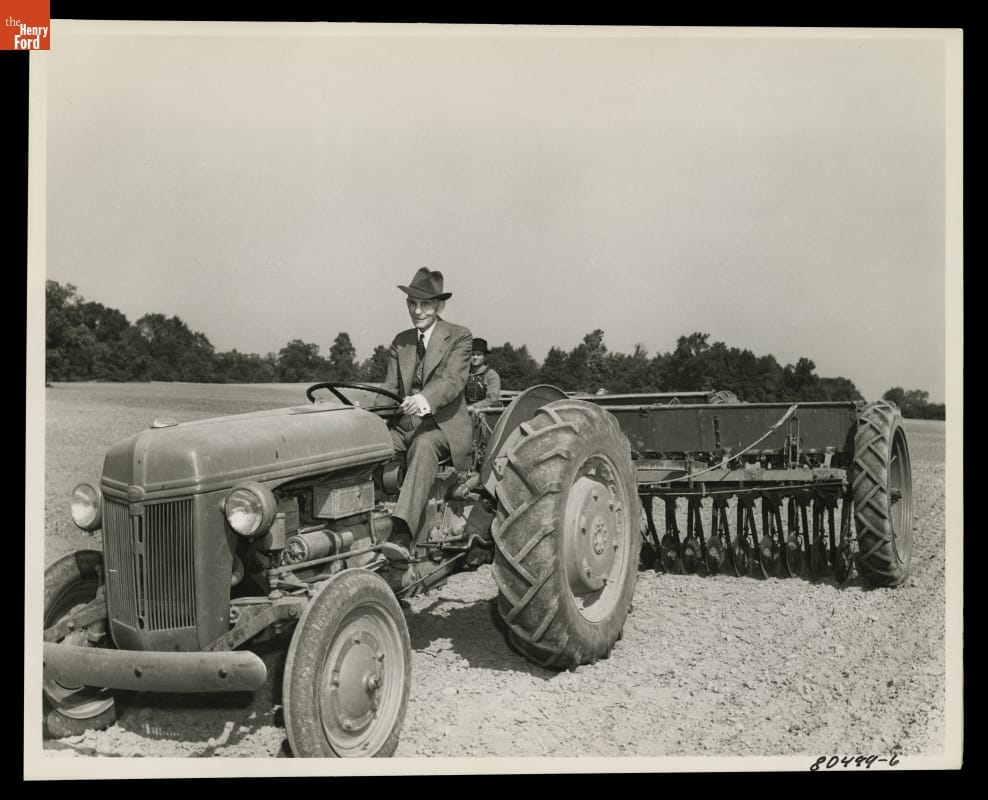
View ArtifactHenry Ford Driving a Ford Tractor, 1939
100,000th Fordson Tractor on Final Assembly Line, February 21, 1920
Henry Ford developed the first mass-produced and inexpensive lightweight tractor to meet the needs of small farmers. The Fordson, introduced in 1917, rapidly became the most popular tractor in America. This photograph shows the 100,000th Fordson tractor being assembled in 1920. That year, the United States Census Bureau began recording enormous declines in the population of farm horses.
View ArtifactHenry Ford and Edsel Ford with Fordson Tractor, 1921
Henry Ford wanted to develop a tractor for the small farmer. Ford Motor Company stockholders initially rejected this idea, so Ford incorporated a new company, Henry Ford and Son, to assemble the first Fordson tractor in 1917. Lightweight, inexpensive Fordsons quickly became the most popular tractors in America. Here, Henry and his son Edsel pose with their successful agricultural innovation.
View ArtifactFordson Tractor Assembly Line at the Ford Rouge Plant, 1921
Henry Ford developed the Fordson tractor to meet the needs of small farmers. Its lightweight, unit-body design was well-suited for the assembly line, and production began in 1917. The inexpensive Fordson quickly became the most popular tractor in America. Here, Fordson tractors are lined up for wheel installation in Dearborn, Michigan.
View ArtifactWorkers on Transmission Gear Line in the Fordson Tractor Plant, Cork, Ireland, March 1929
By 1928, Henry Ford's innovative Fordson tractor had become obsolete in the American market. But Ford Motor Company recognized a continuing need for a small, affordable tractor in the British Isles and consolidated Fordson production at its Cork, Ireland, plant. The Fordson tractor was assembled there until 1932, when production moved to England.
View ArtifactWorkers on Clutch Housing Rear Assembly Line in the Fordson Tractor Plant, Cork, Ireland, February, 1929
By 1928, Henry Ford's innovative Fordson tractor had become obsolete in the American market. But Ford Motor Company recognized a continuing need for a small, affordable tractor in the British Isles and consolidated Fordson production at its Cork, Ireland, plant. The Fordson tractor was assembled there until 1932, when production moved to England.
View ArtifactHenry Ford Driving an Experimental Tractor, 1906-1907
Henry Ford expressed an early interest in power farming. He and two associates married parts from the 1905 Model B and 1907 Model K, added rear wheels from a grain binder, and built the lightweight "automotive plow" seen here. This early experimental tractor was one in a series of designs culminating in the production of the Fordson tractor in 1917.
View ArtifactHenry Ford Driving Ford-Ferguson Model 9N Tractor at Hayden Mills, Tecumseh, Michigan, 1944
Railroad Cars and Fordson Tractor Parts at Rouge Plant, 1921
Ford's River Rouge Plant was conceived as a site for the mass manufacture of Fordson tractors. For a time, it was actually called the Fordson Plant. This photograph of the Rouge's "B" Building craneway shows tractor parts awaiting assembly. To make way for the Model A in 1928, tractor production was discontinued and relocated to Cork, Ireland.
View ArtifactFordson Tractor Assembly Line at the Ford Rouge Plant, May 1923
Ford Motor Company's River Rouge Plant was conceived as a site for the mass manufacture of Fordson tractors. For a time, it was actually called the Fordson Plant. This photograph shows a tractor assembly line at the Rouge in 1923. To make way for production of the Model A in 1928, tractor assembly was discontinued and relocated to Cork, Ireland.
View Artifact

