
JFK Remembered: Space Program
Share
share
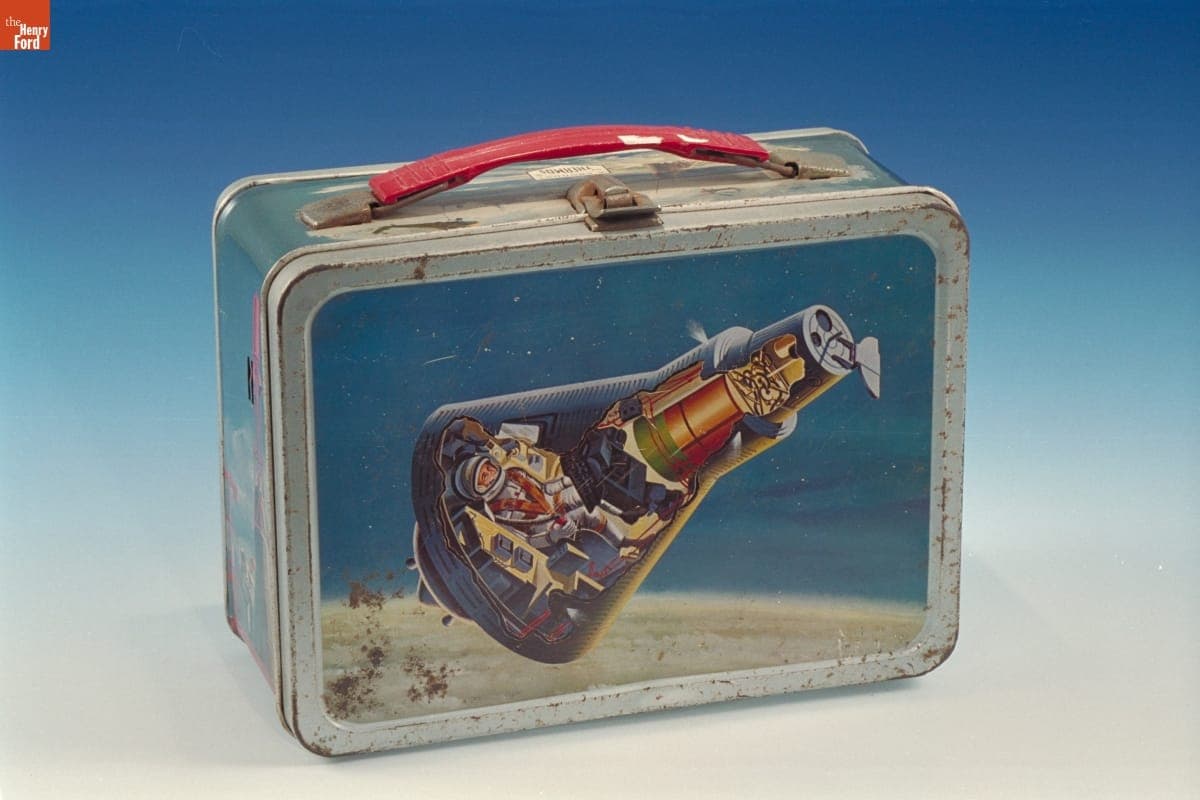
President John F. Kennedy's vision to explore the "new frontier" of outer space was an overt Cold War strategy against the Soviet Union, which had launched the first man into outer space on April 12, 1961. Kennedy's bold vision for a stepped-up space program -- that would land a man on the moon before the decade was out -- ignited the public's imagination. Americans cheered every new achievement.
THF92297
Lunchbox with Space Theme, 1963
The first pictorial lunchboxes, introduced in 1950, featured Hopalong Cassidy. Since then, generations of children have proudly sported pictorial images of their favorite interests on the sides of their school lunchboxes. The 1960s were an age of space exploration, beginning with the Soviet Union's launch of Sputnik in 1957 through the landing of Apollo 11 on the moon in 1969.
Lunchbox & Thermos, The Astronauts, 1969
The first pictorial lunchboxes, introduced in 1950, featured Hopalong Cassidy. Since then, generations of children have proudly sported pictorial images of their favorite interests on the sides of their school lunchboxes. The 1960s were an age of space exploration, beginning with the Soviet Union's launch of Sputnik in 1957 through the landing of Apollo 11 on the moon in 1969.
Record Album, "Man on the Moon," Narrated by Walter Cronkite, 1969
The 1960s were an age of space exploration, beginning with the Soviet Union's launch of Sputnik in 1957 through the landing of America's Apollo 11 on the moon in 1969. CBS news anchorman, Walter Cronkite narrates this history of the U.S. space program. President John F. Kennedy provided the major boost to the program by requesting increased funding on May 25, 1961.
Life Magazine for May 12, 1961, "'AOK!' The U.S. is in Space"
President John F. Kennedy's vision to explore the "new frontier" of space was an overt Cold War strategy against the Soviet Union which launched the first man in space April 12, 1961. This cover story featured the first U.S astronaut in space, Alan Shepard. His Freedom 7 capsule reached 116.5 miles above the earth before splashing down on May 5, 1961.
Life Magazine for February 2, 1962, "Making of a Brave Man"
President John F. Kennedy's vision to explore the "new frontier" of space ignited the public's imagination. It was also an overt Cold War strategy against the Soviet Union which launched the first man in space April 12, 1961. This cover story featured the third U.S. astronaut John Glenn and his preparations for America's first orbital space flight in early 1962.
Life Magazine for March 2, 1962, "The Glenn Story Nobody Saw"
President John F. Kennedy's vision to explore the "new frontier" of space ignited the public's imagination. It was also an overt Cold War strategy against the Soviet Union which launched the first man in space April 12, 1961. This cover story featured U.S. astronaut John Glenn's first orbital space flight February 20, 1962. His Friendship 7 capsule flew around the earth three times.
Time Magazine for May 12, 1961, "Astronaut Shepard"
President John F. Kennedy's vision to explore the "new frontier" of space was an overt Cold War strategy against the Soviet Union which launched the first man in space April 12, 1961. This cover story featured the first U.S astronaut in space, Alan Shepard. His Freedom 7 capsule reached 116.5 miles above the earth before splashing down on May 5, 1961.
Time Magazine for March 2, 1962, "Spaceman Glenn"
President John F. Kennedy's vision to explore the "new frontier" of space ignited the public's imagination. It was also an overt Cold War strategy against the Soviet Union which launched the first man in space April 12, 1961. This cover story featured U.S. astronaut John Glenn's first orbital space flight February 20, 1962. His Friendship 7 capsule flew around the earth three times.
Time Magazine for July 25, 1969, "Man on the Moon"
This milestone in space exploration began with President John F. Kennedy's request to increase funding for the U.S. space program on May 25 1961, "Special Message to Congress on Urgent National Needs." He stated, "I believe this nation should commit itself to achieving the goal, before this decade is out, of landing a man on the moon and returning him safely to the earth."
Advertisement for Tang, "Chosen for the Gemini Astronauts," 1966
President John F. Kennedy's vision to explore the "new frontier" of space ignited the public's imagination. General Foods Corporation marketed Tang, a fruit flavored powdered drink, in 1959. Sales were poor until NASA selected it for use on John Glenn's 1962 Mercury flight and subsequent missions.
Souvenir Card, Astronaut Alan Shepard Receiving Distinguished Service Medal from President Kennedy, 1961
President John F. Kennedy's vision to explore the "new frontier" of space ignited the public's imagination. It was an overt Cold War strategy against the Soviet Union which launched the first man in space April 12, 1961. Here, President Kennedy awards NASA's Distinguished Service Medal to first U.S. astronaut, Alan Shepard, three days after his successful space flight on May 5, 1961.
Topps Astronaut Trading Card, "Final Checkup," 1963
President John F. Kennedy's vision to explore the "new frontier" of space ignited the public's imagination. Pictorial souvenir cards like this helped generate excitement about the latest achievements in the space program. The U.S. astronauts and their accomplishments dominate the card fronts, while the backs show drawings that blend elements of science fiction and fantasy-requiring 3-D glasses to view.
Topps Astronaut Trading Card, "Grissom Blasts Off," 1963
President John F. Kennedy's vision to explore the "new frontier" of space ignited the public's imagination. Pictorial souvenir cards like this helped generate excitement about the latest achievements in the space program. The U.S. astronauts and their accomplishments dominate the card fronts, while the backs show drawings that blend elements of science fiction and fantasy-requiring 3-D glasses to view.
Topps Astronaut Trading Card, "Astronaut John Glenn," 1963
President John F. Kennedy's vision to explore the "new frontier" of space ignited the public's imagination. Pictorial souvenir cards like this helped generate excitement about the latest achievements in the space program. The U.S. astronauts and their accomplishments dominate the card fronts, while the backs show drawings that blend elements of science fiction and fantasy-requiring 3-D glasses to view.
Topps Astronaut Trading Card, "Glenn and the F-106," 1963
President John F. Kennedy's vision to explore the "new frontier" of space ignited the public's imagination. Pictorial souvenir cards like this helped generate excitement about the latest achievements in the space program. The U.S. astronauts and their accomplishments dominate the card fronts, while the backs show drawings that blend elements of science fiction and fantasy-requiring 3-D glasses to view.
Topps Astronaut Trading Card, "1st Man in Orbit," 1963
President John F. Kennedy's vision to explore the "new frontier" of space ignited the public's imagination. Pictorial souvenir cards like this helped generate excitement about the latest achievements in the space program. The U.S. astronauts and their accomplishments dominate the card fronts, while the backs show drawings that blend elements of science fiction and fantasy-requiring 3-D glasses to view.
Topps Astronaut Trading Card, "Astronauts in Flight Suits," 1963
President John F. Kennedy's vision to explore the "new frontier" of space ignited the public's imagination. Pictorial souvenir cards like this helped generate excitement about the latest achievements in the space program. The U.S. astronauts and their accomplishments dominate the card fronts, while the backs show drawings that blend elements of science fiction and fantasy-requiring 3-D glasses to view.
Topps Astronaut Trading Card, "Getting into the Suit," 1963
President John F. Kennedy's vision to explore the "new frontier" of space ignited the public's imagination. Pictorial souvenir cards like this helped generate excitement about the latest achievements in the space program. The U.S. astronauts and their accomplishments dominate the card fronts, while the backs show drawings that blend elements of science fiction and fantasy-requiring 3-D glasses to view.
Topps Astronaut Trading Card, "Glenn & Grissom," 1963
President John F. Kennedy's vision to explore the "new frontier" of space ignited the public's imagination. Pictorial souvenir cards like this helped generate excitement about the latest achievements in the space program. The U.S. astronauts and their accomplishments dominate the card fronts, while the backs show drawings that blend elements of science fiction and fantasy-requiring 3-D glasses to view.
Topps Astronaut Trading Card, "Glenn in Space," 1963
President John F. Kennedy's vision to explore the "new frontier" of space ignited the public's imagination. Pictorial souvenir cards like this helped generate excitement about the latest achievements in the space program. The U.S. astronauts and their accomplishments dominate the card fronts, while the backs show drawings that blend elements of science fiction and fantasy-requiring 3-D glasses to view.
Topps Astronaut Trading Card, "Inside the Test Chamber," 1963
President John F. Kennedy's vision to explore the "new frontier" of space ignited the public's imagination. Pictorial souvenir cards like this helped generate excitement about the latest achievements in the space program. The U.S. astronauts and their accomplishments dominate the card fronts, while the backs show drawings that blend elements of science fiction and fantasy-requiring 3-D glasses to view.
Topps Astronaut Trading Card, "Our 1st Spacemen," 1963
President John F. Kennedy's vision to explore the "new frontier" of space ignited the public's imagination. Pictorial souvenir cards like this helped generate excitement about the latest achievements in the space program. The U.S. astronauts and their accomplishments dominate the card fronts, while the backs show drawings that blend elements of science fiction and fantasy-requiring 3-D glasses to view.
Topps Astronaut Trading Card, "Posing for Photographers," 1963
President John F. Kennedy's vision to explore the "new frontier" of space ignited the public's imagination. Pictorial souvenir cards like this helped generate excitement about the latest achievements in the space program. The U.S. astronauts and their accomplishments dominate the card fronts, while the backs show drawings that blend elements of science fiction and fantasy-requiring 3-D glasses to view.
Topps Astronaut Trading Card, "Space Hero," 1963
President John F. Kennedy's vision to explore the "new frontier" of space ignited the public's imagination. Pictorial souvenir cards like this helped generate excitement about the latest achievements in the space program. The U.S. astronauts and their accomplishments dominate the card fronts, while the backs show drawings that blend elements of science fiction and fantasy-requiring 3-D glasses to view.
Topps Astronaut Trading Card, "Taking a Break," 1963
President John F. Kennedy's vision to explore the "new frontier" of space ignited the public's imagination. Pictorial souvenir cards like this helped generate excitement about the latest achievements in the space program. The U.S. astronauts and their accomplishments dominate the card fronts, while the backs show drawings that blend elements of science fiction and fantasy-requiring 3-D glasses to view.
Children's Book, "I Want to be a Space Pilot," 1961
President John F. Kennedy's vision to explore the "new frontier" of outer space ignited the public's imagination. For children in the 1960s, the idea of space flight was wondrous. This book's introduction begins "Kip, the son of a jet pilot, wants to be a space pilot and go to the moon." This shows the aviation roots of aeronautics and the aspirations of different generations.
Record Album, "We Came in Peace for All Mankind," 1969
This milestone in space exploration began with President John F. Kennedy's request to increase funding for the U.S. space program on May 25, 1961, "Special Message to Congress on Urgent National Needs." He stated, "I believe this nation should commit itself to achieving the goal, before this decade is out, of landing a man on the moon and returning him safely to the earth."
Souvenir Bank Commemorating "First U.S. Astronaut Space Flights," 1963
This souvenir bank, shaped like a space capsule, commemorated the U.S. flights of astronauts Alan Shepard (May 5, 1961) and John Glenn (February 20, 1962). President John F. Kennedy's vision to explore the "new frontier" of space ignited the public's imagination. For children in the 1960s, the idea of space flight was wondrous. For parents, it had the added value of encouraging children to save money.


