
Lesson: Examining Primary Sources
Share
share
Lesson 6 of "Early 20th-Century Migration"
THF68290
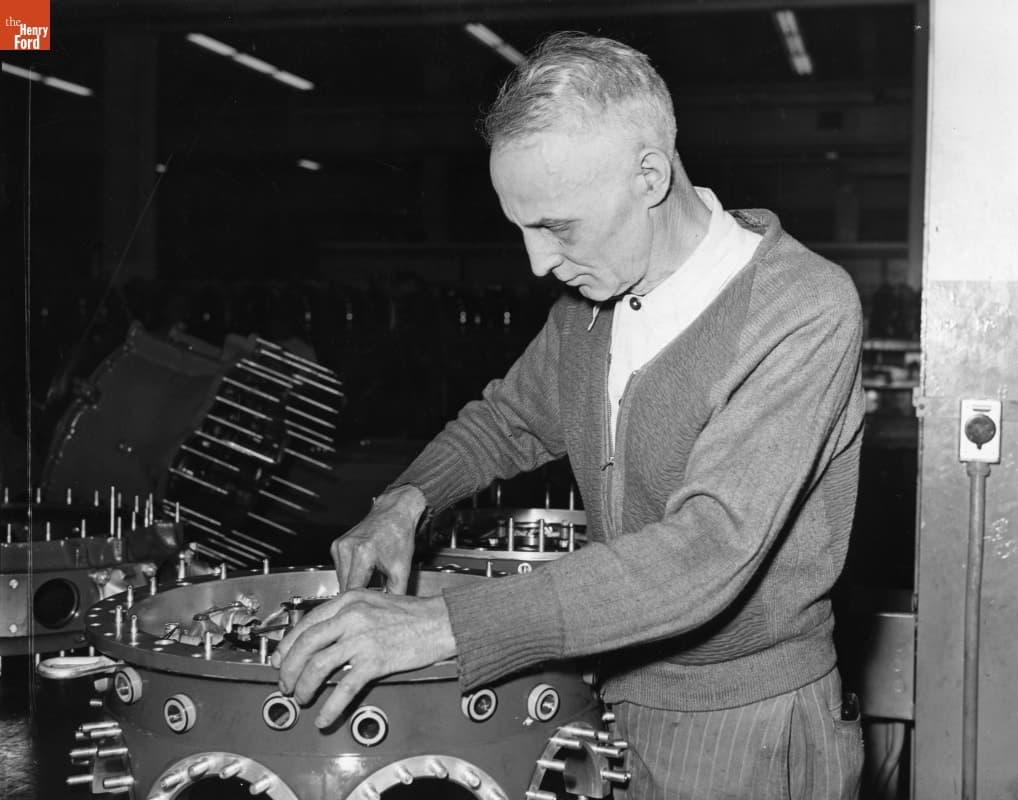
Byron Moore, Head of Ford Rouge Plant Aircraft Engine Inspection and Repair, 1943
Mr. Byron (Ben) Moore is pictured at work in the Aircraft Building at the Ford Rouge Plant during World War II. Before war production started, Moore oversaw motor assembly repairs at the Highland Park Plant and the Rouge. Like many during the early 20th-century's urbanization, Moore grew up on a rural farm but moved to work in Detroit's industries.
View ArtifactTHF68288
Short Biography of Ford Motor Company Employee Byron Moore, circa 1943
Byron Moore grew up on a farm in rural Utica, Michigan, and came to work for Ford Motor Company. This biography describes his positions at the Piquette Plant, the Grand Boulevard and Woodward sales branch office, the Highland Park Plant, and the Rouge Plant. Moore also remarks on Henry Ford's theories about agriculture and advancements in safety on the farm.
View ArtifactTHF143937
Ford Motor Company Designer Joseph Galamb Working in the Dearborn Engineering Laboratory, July 1943
Joseph Galamb came to the United States from his native Hungary in 1903. The trained engineer made his way to Detroit and joined Ford Motor Company in 1905. Galamb played a vital role in the design of the Model T. He later worked on tractors, experimental engines, and the Model A. Galamb retired in 1944 after 39 years with Ford.
View ArtifactTHF68285
Short Biography of Ford Motor Company Industrial Designer Joseph A. Galamb, circa 1943
Joseph Galamb was an engineer from Hungary who immigrated to the United States in 1903. Galamb was part of the Ford Motor Company team that produced the 1909 Ford Model T. This biography explains how Galamb came to the United States and includes his memories of looking for work, his first job, and finally finding the right fit at Ford.
View ArtifactTHF132225
Workers in Ford Rouge Plant Cyanide Foundry, 1931
By 1931, Ford Motor Company was the largest employer of African-American workers in the country. Henry Ford was closely tied to leaders in Detroit's African-American community, especially with the pastors of two of the city's largest churches, Rev. Robert Bradby of 2nd Baptist and Rev. Everard Daniel of St. Matthew's Episcopal Church. Through these men, many recent arrivals were directed to the Ford Employment Office. Although Ford employed large numbers of African Americans, there were limits to how far most could advance. Many African-American workers spent their time in lower paying, dirty, dangerous, and unhealthy jobs in places like this Cyanide Foundry that used potassium cyanide, a key material in hardening steel.
View Artifact

