
Lesson: Funding Public Goods
Share
share
Lesson 3 of "Transportation Systems"
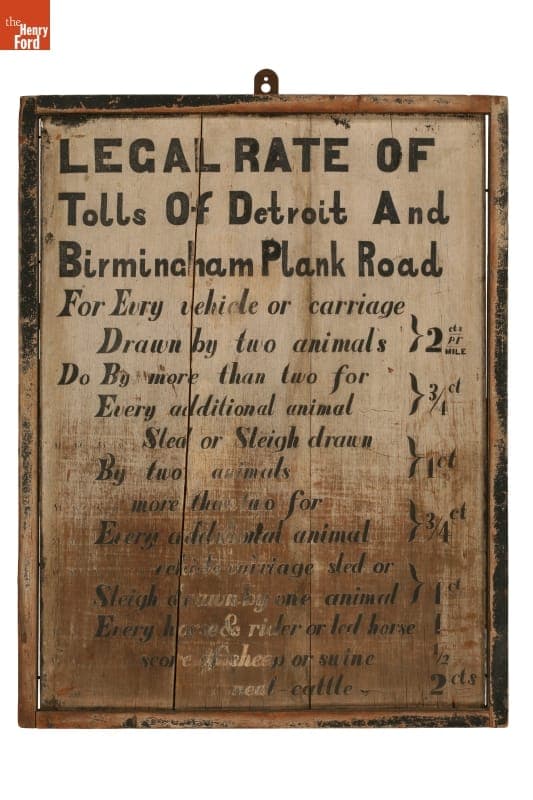
THF69356
Sign Noting Toll Rates for the Detroit and Birmingham Plank Road, 1844-1850
In the mid-19th century, road builders experimented with "plank roads" consisting of wood planks laid across longitudinal wood beams. Wood provided a smoother surface than dirt or gravel, especially in wet weather, but it deteriorated quickly. Maintenance costs, financed by user tolls, were prohibitively expensive and most plank roads were gradually resurfaced with gravel.
View ArtifactTHF68308
Poster, "Proclamation of the Route of the Lincoln Highway," 1913
This poster details the planned route of the Lincoln Highway, the first improved transcontinental road. The road was planned by a private group of auto industry magnates, politicians and other big thinkers -- not by the federal government, as interstate highways are today. The poster asked for the assistance of states, counties and individuals along the road as well as monetary donations.
View ArtifactTHF73389
"The Old Pike: A History of The National Road and Incidents, Accidents, and Anecdotes Thereon," 1894
The Cumberland Road (also known as the National Road) was the first highway built entirely with federal funds. It ran from Cumberland, Maryland, to Vandalia, Illinois. Its construction began in 1811 and ended in 1839. This book tells the road's story: the politics of creating the road, its building, and everyday life on and along the road.
View Artifact

