
Lesson: The Moving Assembly Line and Work Force
Share
share
Lesson 3 of "Impact of the Model T - Then and Now"
THF145200
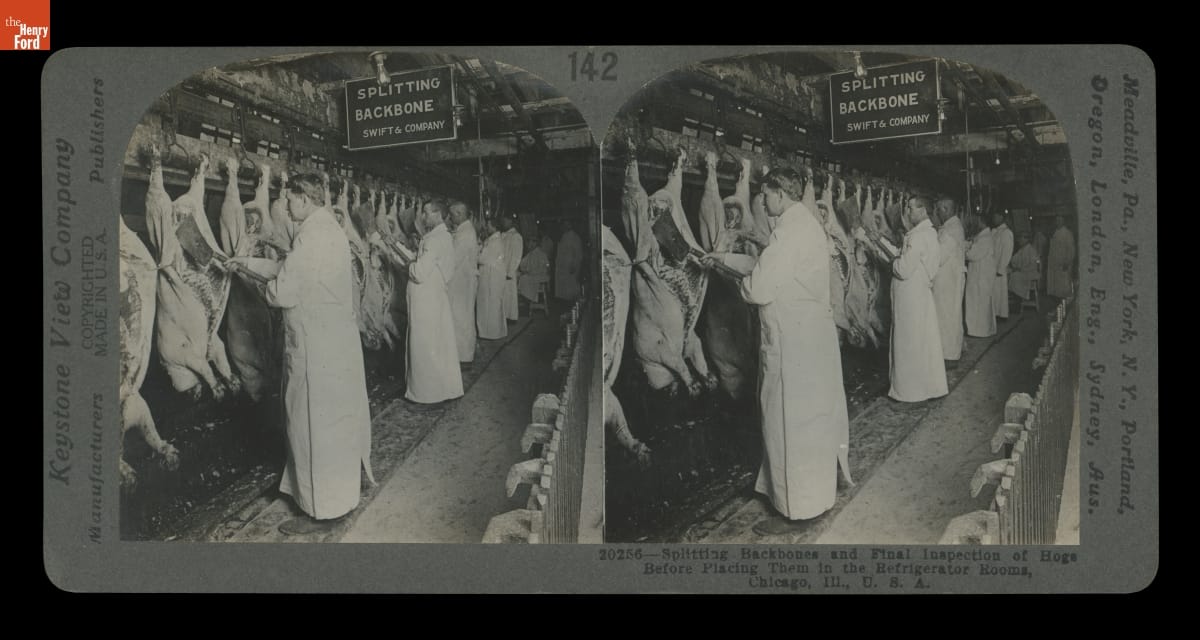
Swift & Company's Meat Packing House, Chicago, Illinois, "Splitting Backbones and Final Inspection of Hogs," 1910-1915
At this meat packing operation, a conveyor moved hog carcasses past meat cutters, who then removed various pieces of the animal. To keep Model T production up with demand, Ford engineers borrowed ideas from other industries. Sometime in 1913 they realized that the "disassembly line" principle employed in slaughterhouses could be adapted to building automobiles -- on a moving assembly line.
View Artifact1924 Ford Model T Cars on Assembly Line at the Highland Park Plant, October 1923
Henry Ford and his engineers constantly searched for ways to speed up car production and hold down costs. The integration of a moving assembly line in the Highland Park plant allowed Ford's company to do just that. From 1908-1927, Ford Motor Company produced over 15 million Model T cars and the price dropped from $850 to as little as $260.
View ArtifactLetter to Henry Ford from the Wife of an Assembly Line Worker, 1914
Letter written to Henry Ford from the wife of an assembly line worker, January 23, 1914. The woman writes asking Henry Ford to investigate the situation on the assembly lines in the factories with regard to working conditions. She is angry about the treatment her husband receives on the job.
View ArtifactWomen Workers Assembling Magnetos at the Highland Park Plant, circa 1913
Ford's Model T flywheel magneto generated the electricity that ignited the gasoline-air mixture inside the engine's cylinders. At the Highland Park plant, the coil-manufacturing department employed some women for the assembly of magnetos. The workers wound wire around the iron cores and placed the assembled parts into wooden boxes.
View ArtifactFord Motor Company Clipping Book, Volume 2, January 6-10, 1914
Henry Ford's office kept a file of newspaper articles from across the country that covered Ford Motor Company and other topics of interest to Henry. These pages are from the days following Ford's announcement of the $5 per day profit sharing plan in January 1914. While Ford's primary objective was to reduce employee turnover, the $5 day was also excellent publicity.
View Artifact

