
Lesson: Using Human Resources on the Assembly Line
Share
share
Lesson 4 of "You Can Be an Innovator. . . "
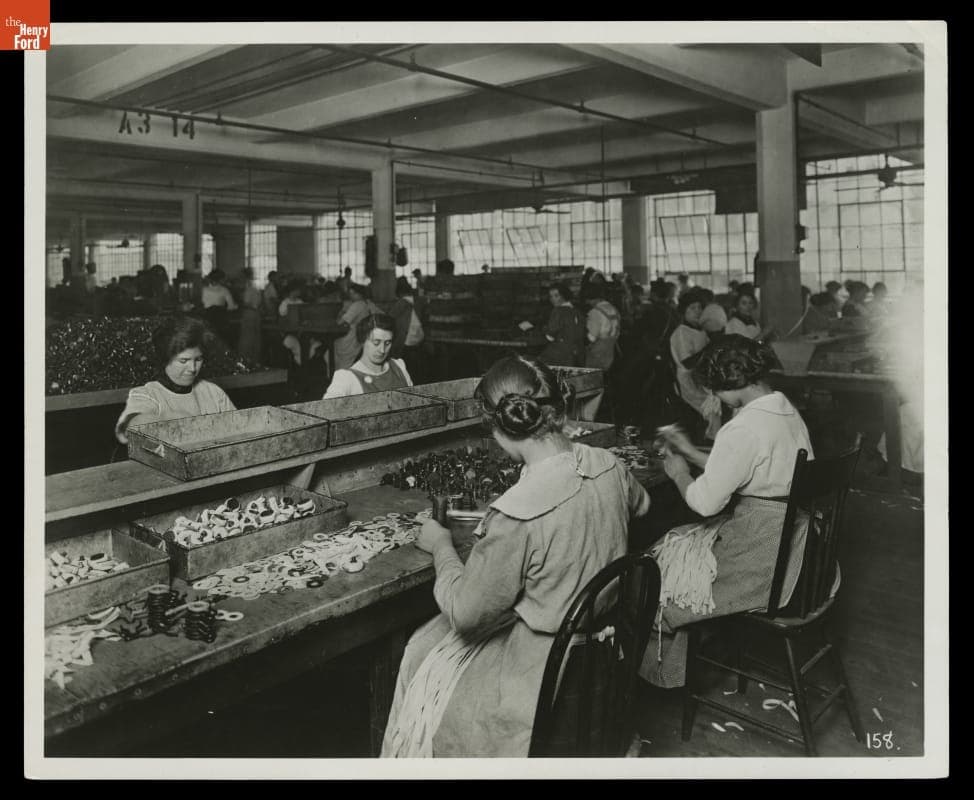
THF99642
Women Workers Assembling Magnetos at the Highland Park Plant, circa 1913
Ford's Model T flywheel magneto generated the electricity that ignited the gasoline-air mixture inside the engine's cylinders. At the Highland Park plant, the coil-manufacturing department employed some women for the assembly of magnetos. The workers wound wire around the iron cores and placed the assembled parts into wooden boxes.
Workers Assembling Car Bodies at Ford Rouge Plant, 1932
Henry Ford's River Rouge Plant, developed between 1917 and 1928, employed more than 100,000 people at its peak in the 1930s. The Rouge Plant started with raw materials and rolled a completely new vehicle off the line every 49 seconds. In this image, workers on the assembly line at the Rouge Plant join an automobile body with its chassis.
Swift & Company's Meat Packing House, Chicago, Illinois, "Splitting Backbones and Final Inspection of Hogs," 1910-1915
At this meat packing operation, a conveyor moved hog carcasses past meat cutters, who then removed various pieces of the animal. To keep Model T production up with demand, Ford engineers borrowed ideas from other industries. Sometime in 1913 they realized that the "disassembly line" principle employed in slaughterhouses could be adapted to building automobiles -- on a moving assembly line.
1924 Ford Model T Cars on Assembly Line at the Highland Park Plant, October 1923
Henry Ford and his engineers constantly searched for ways to speed up car production and hold down costs. The integration of a moving assembly line in the Highland Park plant allowed Ford's company to do just that. From 1908-1927, Ford Motor Company produced over 15 million Model T cars and the price dropped from $850 to as little as $260.


