
Lesson: Work Changes Again, 21st Century
Share
share
Lesson 3 of "Moving to Michigan: Migration, Immigration and Transportation"
THF131131
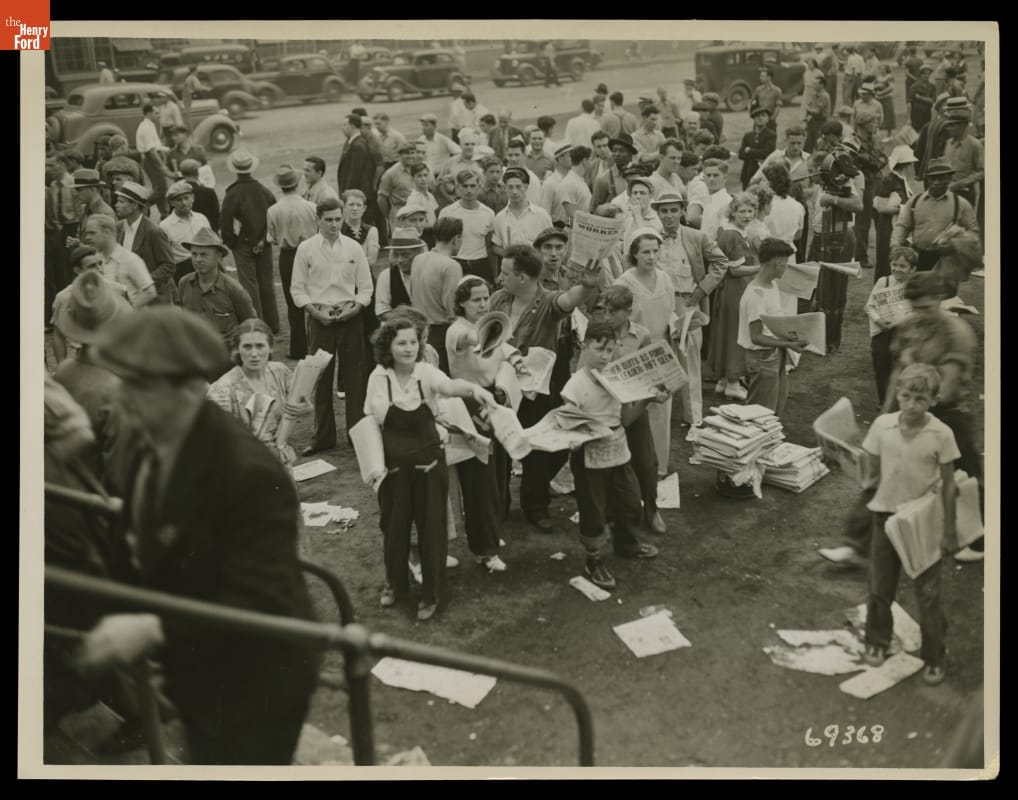
Union Representatives Handing out Literature at Ford Rouge Plant, 1937
The image shows continuing United Auto Workers activity outside the Ford Rouge plant less than three months following the "Battle of the Overpass," in which Ford Motor Company security men beat labor organizers Walter Reuther, Richard Frankensteen, Richard Merriweather, and Ralph Dunham. Men and women hand out special editions of the United Auto Worker UAW newspaper while boys sell Detroit Free Press newspapers.
View ArtifactWorkers in Ford Rouge Plant Cyanide Foundry, 1931
By 1931, Ford Motor Company was the largest employer of African-American workers in the country. Henry Ford was closely tied to leaders in Detroit's African-American community, especially with the pastors of two of the city's largest churches, Rev. Robert Bradby of 2nd Baptist and Rev. Everard Daniel of St. Matthew's Episcopal Church. Through these men, many recent arrivals were directed to the Ford Employment Office. Although Ford employed large numbers of African Americans, there were limits to how far most could advance. Many African-American workers spent their time in lower paying, dirty, dangerous, and unhealthy jobs in places like this Cyanide Foundry that used potassium cyanide, a key material in hardening steel.
View ArtifactRobot, First Unimate Robot Ever Installed on an Assembly Line, 1961
Unimate robots were the world's first successful industrial robots. The units, designed by Unimation Inc., could perform tasks in manufacturing facilities that were difficult, dangerous, or monotonous for human workers. This is the first Unimate ever used on an assembly line. It was installed at the General Motors plant in Trenton, New Jersey, in 1961 to unload a die-casting press.
View Artifact

