
Lillian Schwartz: Remixing Art History
Share
share
Lillian Schwartz was a pioneer of computer art. She experimented with art of the past, bridging the gap between traditional techniques and computing technology. She learned from and remixed other artists' works and built upon the art of her peers, producing fun and innovative creations. From digital forensics to optical illusions, Lillian added a unique twist to the "canon" of art history.
THF628991
"Mona-Leo" by Lillian F. Schwartz, 1988
Throughout her career, Lillian explored the possibilities of computing in imaginative ways. One of Lillian's inspirations was Leonardo DaVinci. Testing Gerard Holzmann's early digital photo-editing program, "Pico," she merged DaVinci's self-portrait with Mona Lisa. To her surprise, their eyebrows, lips, and noses aligned. She had to ask: did DaVinci use himself as the model for his most famous painting?
View Artifact"Piero/Arezzo Restored" by Lillian F. Schwartz, 1989
Lillian believed art historians should use computers as tools to analyze art -- and to help conserve it. Using the Symbolics computer program, she predicted what Piero Della Francesca's frescoes from the Cycle of the True Cross in Arezzo, Italy, would look like after restoration. She fused the colors from nearby pixels to digitally seal cracks and fissures.
View Artifact"Homage to Duchamp (Nude Ascending Staircase)" by Lillian F. Schwartz with Robert J. Tatem, circa 1975
At the New York Armory show in 1913, Marcel Duchamp was mocked by fellow artists. They laughed at his Modernist painting, Nude Descending a Staircase, for depicting motion with abstract shapes. Almost 70 years later, Lillian Schwartz generated computer art in honor of Duchamp. Gold triangles cut across a black background. This time, the nude walks upstairs instead of down.
View ArtifactPrint from "Beyond Picasso" by Lillian F. Schwartz, 1986
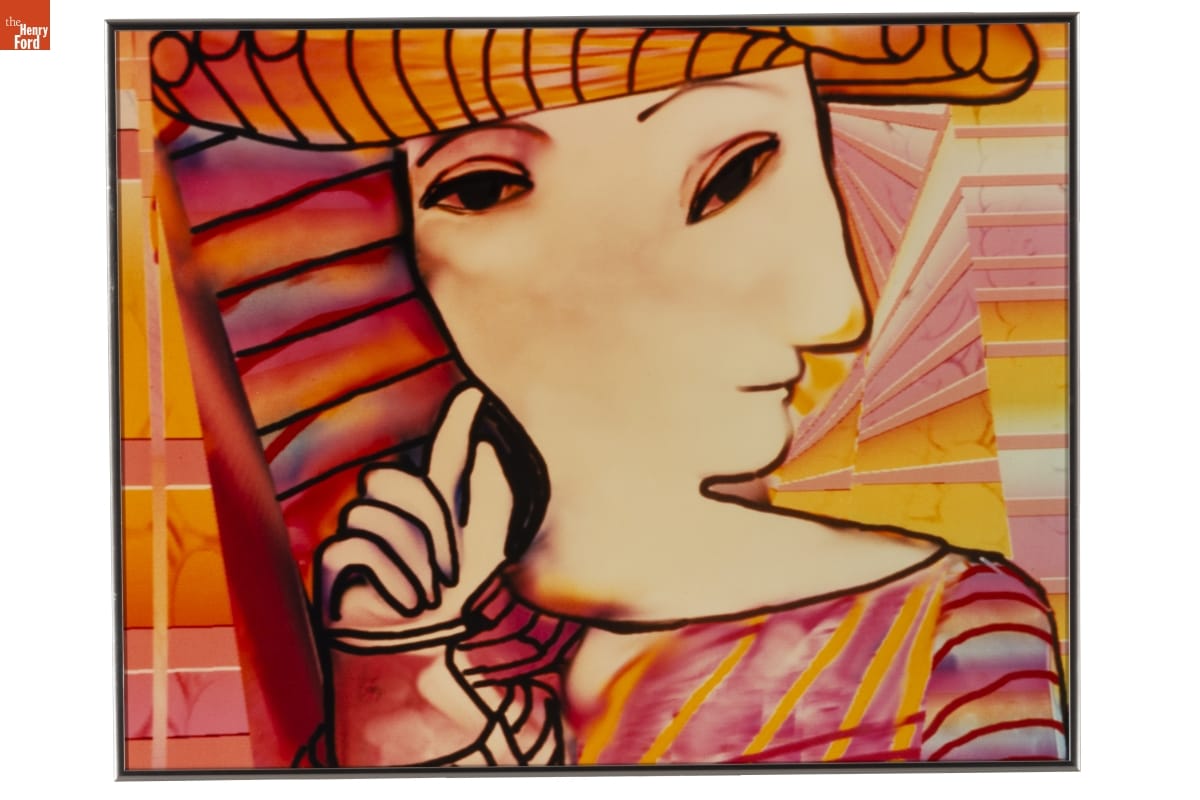
During his career, artist Pablo Picasso manipulated shapes, light, and colors in different ways. Examining Picasso's unique style — or the "artist's hand" — Lillian Schwartz recreated his brush strokes on her computer. The result is an amorphous face, captured mid-motion from Lillian's animated film. Combining his style with her computer techniques, Lillian celebrated Picasso's legacy through her own experimentation.
"BIG MOMA" by Lillian F. Schwartz, 1984
In 1982, the Museum of Modern Art commissioned Lillian to create a television commercial announcing their reopening after a substantial renovation. She also made this poster, choosing images of famous art from the museum's collection. Images fill the outline of Gaston Lachaise's Standing Woman sculpture -- just like paint fills a canvas. Warping the images simulated the texture of a paintbrush.
View Artifact"Studies in Perception I (Computer Nude)" by Kenneth C. Knowlton and Leon D. Harmon, 1967
Kenneth Knowlton and Leon Harmon created Studies in Perception I at Bell Laboratories, where Lillian was a resident visitor. Up close, this "photomosaic" reveals tiny mathematical symbols in ordered rows. Farther away, it becomes a nude of dancer Deborah Hay. Knowlton and Harmon hung the image in a colleague's office. It was banished to the basement, but critics soon deemed it a work of art.
View ArtifactUntitled Homage to "Computer Nude" by Lillian F. Schwartz with Kenneth C. Knowlton, 1969
Although they all worked at Bell Laboratories, Lillian first saw Knowlton and Harmon's Studies in Perception I at the Museum of Modern Art. Lillian was displeased with Deborah Hay's incomplete form, so she created her own computer nude. Her smaller figures recline in a different pose. Instead of mathematical symbols, they're built from glyphs that look like computer circuits.
View Artifact"Hockney Illusion" by Lillian F. Schwartz, 1993
A scientific interest in perception inspired Lillian Schwartz as she concocted this portrait. In 1988, she met David Hockney, an English painter well-known for his Pop Art. As a gift, Lillian transformed a photograph of Hockney into an optical illusion. Un-focus the eye and concentric circles of black and gray merge into Hockney's recognizable face.
View Artifact

