
Migration & Immigration
Share
share
THF211626
Letter by California Gold Rush Venturer Charles A. Wood, Written from Acapulco, Mexico, February 10, 1850
Letter from Charles A. Wood to his wife, Caroline Wood in Neponsett, Massachusetts, dated Acapulco, Mexico, February 10, 1850, describing his voyage from Panama to Acapulco undertaken as part of his journey to California. He describes in detail his voyage including the outbreak of seasickness among the passengers; gives the latest word from the California gold fields which was received from the steamship California out of the port of San Francisco; and describes the city of Acapulco.
View ArtifactRed River Cart Replica, circa 1925
From the 1820s to the 1850s, hundreds of these simple, rugged carts transported annual supplies to the Red River Valley settlements of Minnesota and Manitoba, Canada. On return trips, the carts -- each drawn by a single ox -- carried meat, furs, and skins to St. Paul. This replica was probably built for exhibition by the Great Northern Railway.
View Artifact"Looking Up Broadway from Dey Street, New York City," 1900
Launched in the late 1890s, the Detroit Photographic Company (renamed the Detroit Publishing Company in 1905) obtained the rights to use a process known as "Photochrom," developed by the Swiss in which black-and-white photographs were converted into color images. This New York City streetscape was just one example of the many new perspectives Americans gained because of the Detroit Photographic Company.
View ArtifactIllustrated Historical Atlas of the County of Wayne, Michigan, 1876
In the 19th century, publishers produced atlases for counties all over the United States. One of the illustrations in this atlas is an aerial view of the William Ford Farm in Springwells Township -- now Dearborn, Michigan. Industrialist Henry Ford, William and Mary Ford's eldest son, was born in the farmhouse on July 30, 1863, and he grew up on this farm.
View ArtifactWestinghouse Portable Steam Engine No. 345, Used by Henry Ford
Portable steam engines like this powered grain threshers, sawmills, or corn shellers. Horses pulled them from farm to farm. In 1882, 19-year-old Henry Ford was able to make this engine run well when an older man could not; his first accomplishment in the adult world. Thirty years later Ford tracked down the engine, bought it, and returned it to operating condition.
View ArtifactIntersection of Electric Railroad Lines at Fort and Dearborn Streets, Detroit, Michigan, 1918
Streetcar tracks laid on roads and electric trolley wires running overhead formed key infrastructure for the urban public transportation network in the late 19th and early 20th centuries. This photoprint shows the intersection of Fort Street and Dearborn Street in Detroit, Michigan, in 1918. The streetcar lines helped people, including Ford Motor Company workers, travel easily without a car.
View ArtifactSign Noting Toll Rates for the Detroit and Birmingham Plank Road, 1844-1850
In the mid-19th century, road builders experimented with "plank roads" consisting of wood planks laid across longitudinal wood beams. Wood provided a smoother surface than dirt or gravel, especially in wet weather, but it deteriorated quickly. Maintenance costs, financed by user tolls, were prohibitively expensive and most plank roads were gradually resurfaced with gravel.
View ArtifactTicket for Railroad, Coach and Boat Travel from New York to Buffalo, circa 1835
The Erie Canal, completed in 1825, helped New York City become America's leading commercial port and aided thousands of travelers in their journey west. By 1835, railroads were already making this journey faster and cheaper. The bearer of this ticket would have taken a steamer up the Hudson River to Albany, then traveled by rail and canal boat to Buffalo.
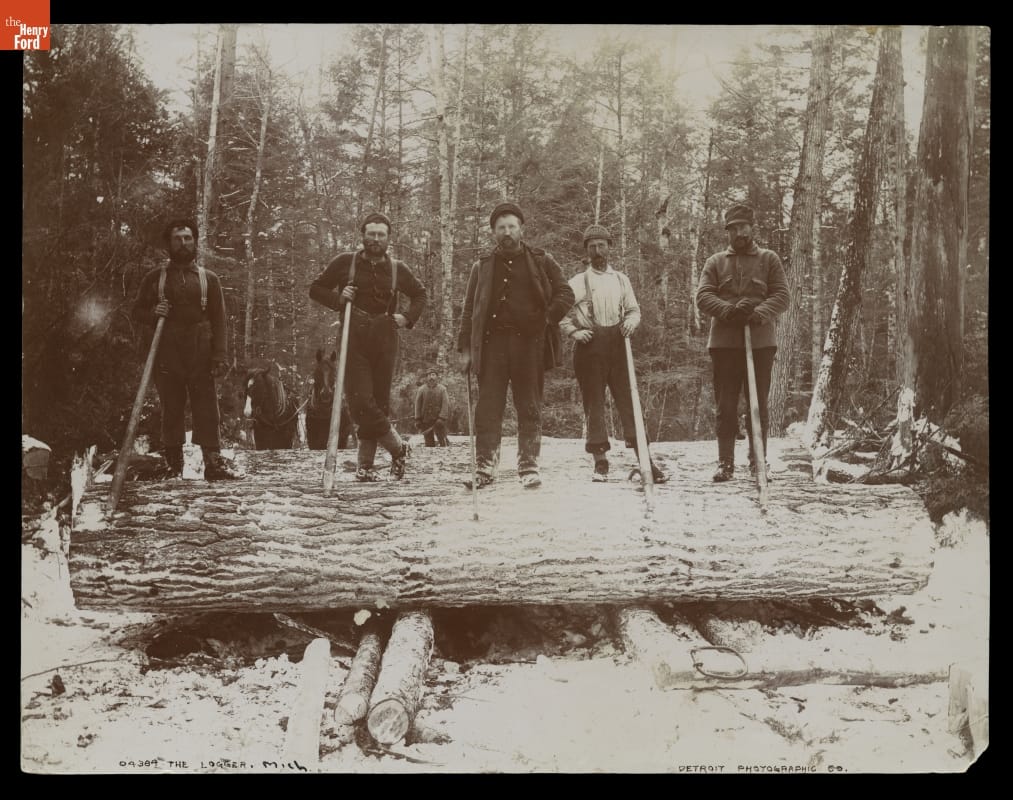
View Artifact"The Logger," Michigan, 1880-1900
A group of five men posed for a picture on top of a large log with their "cant hooks," a common logging tool used to maneuver logs, in the late nineteenth century. When Maine and New York were unable to supply the growing demand for lumber, Michigan became the next logical lumbering destination as part of the northern pine belt.
View ArtifactD. M. Ferry & Company Headquarters and Warehouse, Detroit, Michigan, circa 1880
Before the automobile, Detroit had a diversified industrial economy that included one of the world's leading seed production companies. In 1879, Dexter Mason Ferry (1833-1907) founded D. M. Ferry & Company. D. M. Ferry produced high quality flower and vegetable garden seeds on the company's 850 acre seed farm north of Detroit and germinated them at one of five warehouses in Detroit.
View Artifact

