
Portraits of Abraham Lincoln
Share
share
This selection shows the variety of portraits of President Lincoln made during his lifetime. They range from political cartoons and prints to photographs and sculpture. These examples give us insight into the life of this famous president.
THF60037
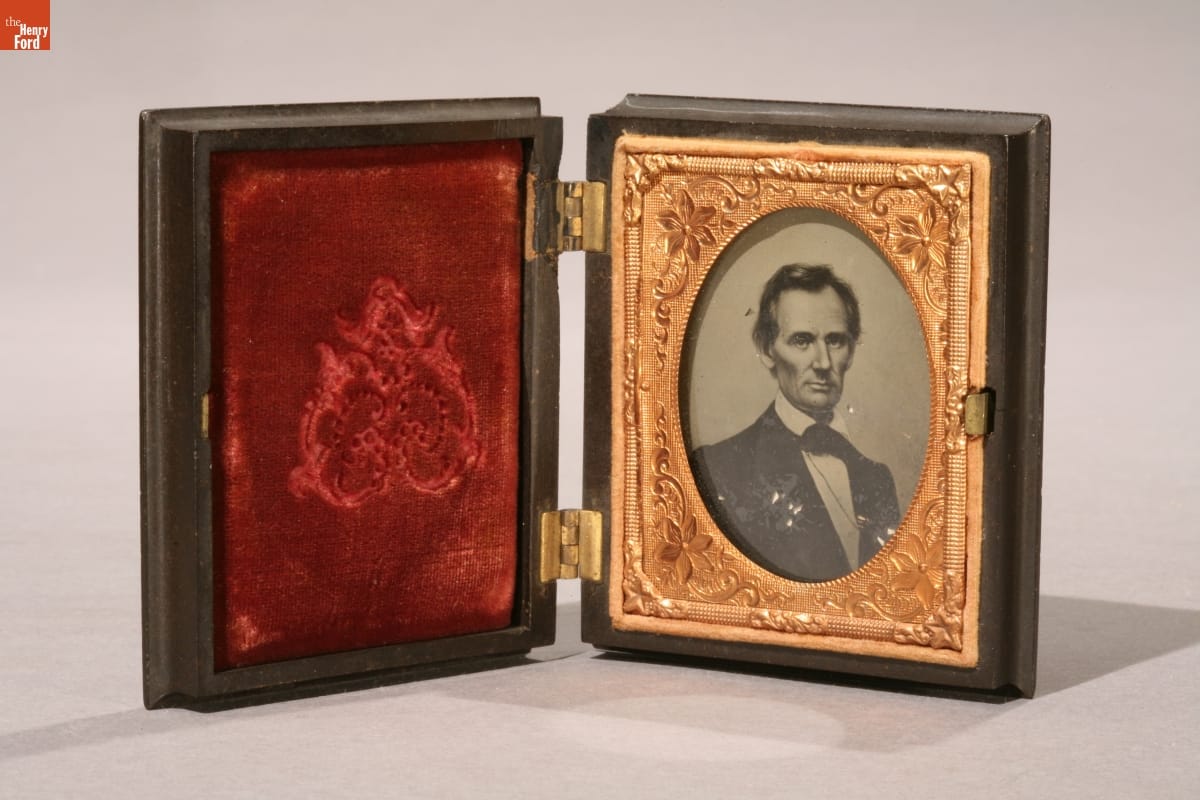
Abraham Lincoln Ambrotype Portrait and Presidential Election Campaign Badge, 1860
This portrait of Abraham Lincoln was used as a campaign badge during the 1860 presidential election. It was originally housed in an oval brass frame and pinned to one's clothing. The ambrotype is based on a photograph of Lincoln taken by Mathew B. Brady on February 27, 1860. Lincoln was in New York City to give a speech at Cooper Union.
View ArtifactPlaster Bust of Abraham Lincoln, 1865
Many sculptors made terra-cotta, plaster or bronze statues of Abraham Lincoln to honor him during his life time or after his death. Usually based on existing lithograph, engraving or photographic portraits and made for mass market sales, these artists have left a large and varied sculptural legacy. This plaster example was made after the president's death in 1865 by an artist in Paris, France.
View ArtifactPortrait of Abraham Lincoln Taken on February 9, 1864
President Abraham Lincoln made himself readily available to many photographers of the era, leaving a large and varied photo legacy. This photograph is one in a series made on February 9, 1864, by Anthony Berger at Mathew Brady's Washington, D.C., gallery. Starting in the 1860s people exchanged and collected card photographs like this to help them remember family and celebrities.
View ArtifactAbraham Lincoln and His Son, Tad, 1864
This portrait shows President Abraham Lincoln and his youngest son, Tad. The original photograph was taken by Anthony Berger in the Mathew Brady studio in Washington, D.C., on February 9, 1864. The maker of this carte-de-visite is unknown. Because of its appealing subject of Abraham Lincoln as a father, it was a popular image to purchase and place in albums.
View ArtifactLife Mask of Abraham Lincoln by Clark Mills
Abraham Lincoln allowed two sculptors to make life masks of his face - first in 1860 and then in 1865. These life masks were reproduced and several sculptors used them as the basis for statues. Clark Mills made this cast of Lincoln's face on February 11, 1865, sixty days before the president was assassinated. In 1867, Mills proposed using this life mask for a Lincoln memorial, but it was never made.
View ArtifactPortrait of Abraham Lincoln, Taken by Alexander Gardner, Washington, D.C., November 8, 1863
President Abraham Lincoln made himself readily available to many photographers of the era, leaving a large and varied photo legacy. This unusual full-length portrait of Lincoln was taken by Alexander Gardner in his Washington, D.C., studio on Sunday, November 8, 1863. This contact print was made by Frederick Hill Meserve in the early 20th century from the original 1863 glass plate negative, which measured 20x16 inches.
View ArtifactPortrait of Abraham Lincoln, 1863
President Abraham Lincoln made himself readily available to many photographers of the era, leaving a large and varied photo legacy. This photolithograph copy made in the early twentieth century, beautifully reproduces the original photo made by Alexander Gardner in his Washington, D.C., studio on Sunday, November 8, 1863. This close-up view of Lincoln's head and shoulders is considered by many to be the greatest portrait of President Lincoln.
View Artifact"Hon. Abraham Lincoln, Our Next President," 1860
This lithograph portrait of President-elect Abraham Lincoln was based on a photograph taken by Mathew B. Brady on February 27, 1860. Lincoln had been in New York City to give a speech at Cooper Union. He is depicted beardless as he was during the election campaign. By the time he traveled to Washington, D.C., for his inauguration on March 4, 1861, he had grown a full beard.
View ArtifactPolitical Cartoon, "Honest Abe Taking Them on the Half Shell," 1860
This political cartoon for the 1860 presidential campaign depicts Abraham Lincoln, the fledgling Republican Party presidential candidate, handily taking on rival candidates while eating at the "Political Oyster House." He was facing three other presidential hopefuls. Northern Democrats turned to Stephen Douglas of Illinois, while southern Democrats selected John C. Breckenridge of Kentucky. In addition, John Bell of Tennessee was a third-party choice.
View ArtifactEngraving, Portrait of Abraham Lincoln, 1864
During the American Civil War, this print commemorated a crucial event and became popular for home and classroom display across the country. President Lincoln is shown in this engraving with a draft of the Emancipation Proclamation. Publicly announced by Lincoln in September 1862 to become law on January 1, 1863, it was the essential first legal step in eliminating slavery.
View ArtifactChromolithograph Portrait of Abraham Lincoln, 1865
Following the American Civil War, this print commemorated President Abraham Lincoln and became popular for home and classroom display across the country. This chromolithograph production method--using oil inks and canvas on a wooden stretcher--was meant to be framed, in imitation of painted portraits of famous people. Prints like this one helped people to honor Lincoln's accomplishments.
View ArtifactStereograph, Portrait of Abraham Lincoln,1863
This portrait of Abraham Lincoln was originally photographed by Alexander Gardner on Sunday August 9, 1863. Gardner had just opened his new studio and President Lincoln agreed to be the first customer. This stereograph was made between 1864 and 1866 by an unidentified photographer. It contains two side-by-side albumen photographic prints mounted onto cardstock and made a 3-D image when viewed through a stereoscope.
View ArtifactTintype of Abraham Lincoln, Made from an Earlier Portrait Taken about 1858-1860
This tintype portrait of Abraham Lincoln was probably copied from a readily available presidential campaign button for the 1860 Republican Party candidate. The campaign button itself was a copy of an 1858 ambrotype portrait taken by Roderick M. Cole, of Peoria, Illinois. The City Art Gallery of Moawequa, Illinois, may have made this copy tintype to honor President Lincoln during his life time or after his death.
View Artifact

