
The Curved Dash Oldsmobile
Share
share
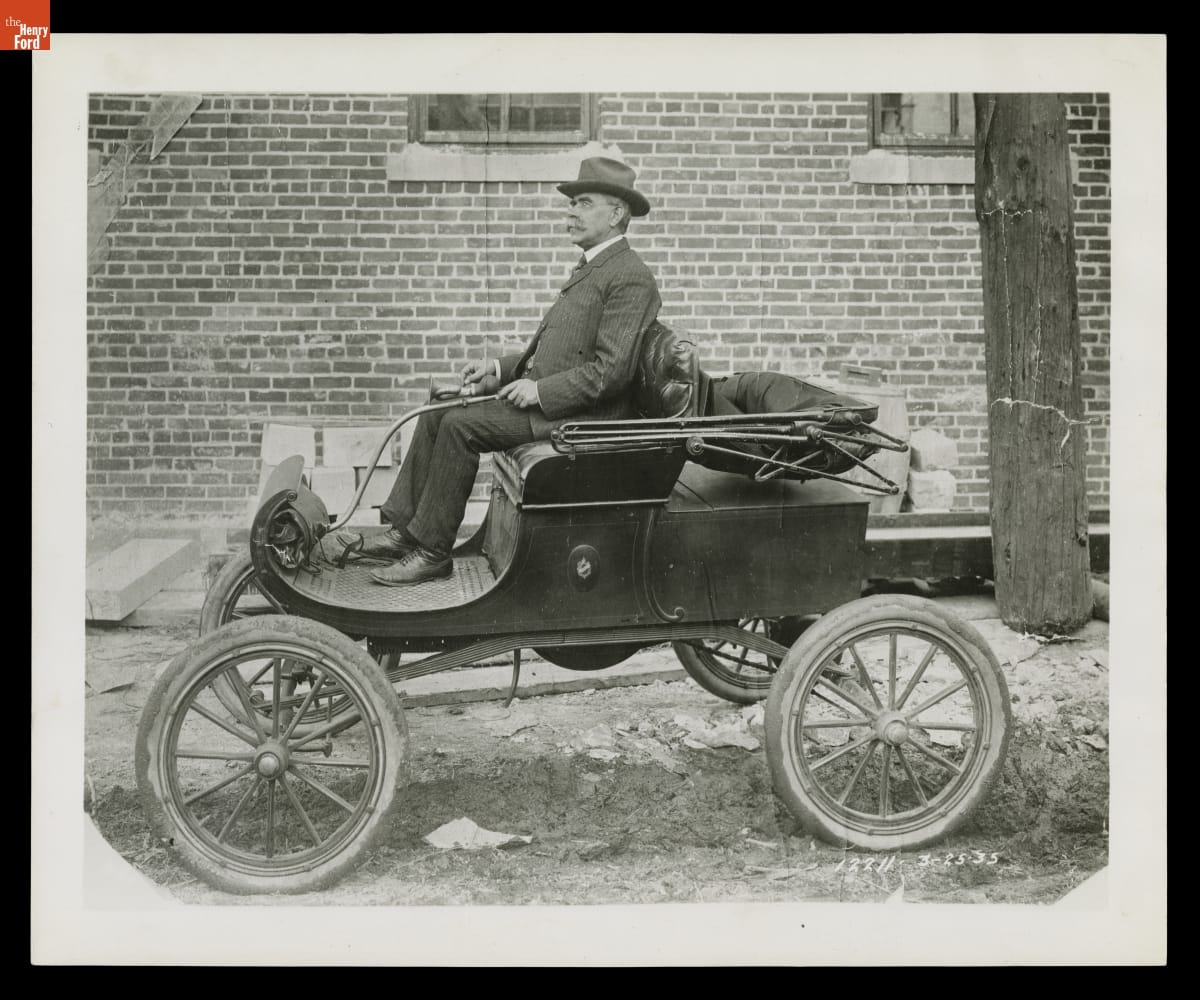
In the early 1900s, automobiles were new and exciting. But many consumers were already demonstrating a preference for practicality and affordability. Olds Motor Works’ well-priced, reliable runabout was the bestselling car in America from 1902-1905.
THF120780
Building Contractor Albert A. Albrecht Seated in 1902 Curved-Dash Oldsmobile, circa 1920
Detroit contractor Albert Albrecht posed in a 1902 Oldsmobile circa 1920. Twenty years after its debut, the Curved Dash Olds was an antique with its tiller steering, chain drive and 4.5-horsepower engine hopelessly out of date. But the affordable Curved Dash had pointed toward a day when automobile ownership would be commonplace -- a day that had arrived by 1920.
View Artifact1903 Oldsmobile Curved Dash Runabout
When it inspires a song, you know it's popular. This Olds was the bestselling car in America from 1902 to 1905. Automobiles had an emotional appeal. A driver in 1901 said that controlling a car satisfied "an almost universal sense, the love of power." Despite the attraction, cars were not a significant player in the transportation world. In 1903 some 4,000 people bought Oldsmobiles, but more than 900,000 bought buggies and carriages.
View ArtifactDiagram of a 1902 Curved-Dash Oldsmobile
Shortly after the company moved to Detroit, a fire destroyed the Olds Motor Works factory in 1901. Several prototype automobiles were lost and only the Curved Dash survived. Left with no other options, Olds put the small, inexpensive car into production. The little runabout became the bestselling car in the United States, and that fire became the happiest of accidents.
View ArtifactCurved Dash Oldsmobile Carburetor, 1903
Carburetors mix fuel and air in the correct proportion to make the car's engine operate smoothly. Early carburetors needed frequent adjustment because of inconsistent fuel quality and changing weather conditions. For convenience, some cars had a knob that allowed the driver to adjust the carburetor as they drove -- much easier than climbing out and opening the hood to make the adjustment.
View ArtifactEngineers M. S. Loomis and C. Wilson in Curved-Dash Oldsmobile outside Olds Motor Works Factory, Detroit, Michigan, 1901
Shortly after the company moved to Detroit, a fire destroyed the Olds Motor Works factory in 1901. Several prototype automobiles were lost and only the Curved Dash survived. Left with no other options, Olds put the small, inexpensive car into production. The little runabout became the bestselling car in the United States, and that fire became the happiest of accidents.
View ArtifactJonathan D. Maxwell Driving a Curved-Dash Oldsmobile on Rough Terrain, circa 1901
With its one-cylinder engine and horseless-carriage looks, the Oldsmobile Curved Dash didn't seem particularly rugged. Olds Motor Works proved the runabout's mettle through elaborate stunts. Here the car is driven up a steep hill, over uneven ground. Far more extravagant was Roy D. Chapin's 820-mile drive, from Detroit to New York, in an Oldsmobile in 1901.
View ArtifactMan and Woman in Curved-Dash Oldsmobile, 1901
While other carmakers concentrated on large, high-priced automobiles, Ransom E. Olds introduced his simple little Curved Dash Oldsmobile in 1901 and sold it for a relatively inexpensive $650. Olds was among the first to realize the potential in an affordable automobile for the masses, and his Curved Dash runabout put car ownership within the means of the middle class.
View ArtifactR. E. Olds in a Curved-Dash Oldsmobile near the Pavilion on Belle Isle, Detroit, Michigan, January, 1902
Ransom E. Olds, born in Ohio in 1864, moved to Lansing, Michigan, as a young man and became fascinated with automobiles. He established his own car company in 1897. Olds's Curved Dash runabout (1901-1907) became a bestseller, but Olds left his firm during a management dispute. General Motors bought the company in 1908 and kept the Oldsmobile brand alive until 2004.
View ArtifactRoy D. Chapin Seated in Curved-Dash Oldsmobile, "First Car to Travel from Detroit to New York--Syracuse, 1901"
Olds Motor Works sent Roy Chapin, Sr., on a promotional trip from Detroit to New York City in a small Curved Dash Olds in 1901. The trip took the car and driver, seen in this photograph, through Canada, along the Erie Canal, down Fifth Avenue, and finally to the Waldorf-Astoria Hotel. The eventful trip took over a week.
View ArtifactOldsmobile 1-cylinder Engine, circa 1903
This single-cylinder, four-horsepower engine powered the Oldsmobile Curved Dash runabout. It has one cylinder, one piston, one connecting rod and crank, one balance wheel, and two valves. The complications of larger multi-cylinder engines were eliminated. The engine's simplicity and the vehicle's affordable $650 price made the Curved Dash runabout America's first car produced in large numbers.
View ArtifactSales Brochure for the 1903 Oldsmobile, Olds Motor Works, "The Oldsmobile Ahead"
Olds Motor Works introduced its Curved Dash automobile in 1901. The one-cylinder runabout wasn't particularly powerful or robust, but at $650 it was relatively cheap. The car was a hit and Oldsmobile was building 5,000 units a year by 1904, making the Curved Dash the first mass-produced car in the United States -- if not the world.
View Artifact"Makes Everyone Your Neighbor--the Oldsmobile" Olds Motor Works Advertisement, 1905
From the beginning, carmakers directed some advertisements specifically to women. This 1905 Oldsmobile ad promoted the car's reliability and ease of operation. But it also advertised a more fundamental benefit for female drivers. With an automobile, women could escape the dull drudgery of the home and connect with friends anywhere. The Oldsmobile "makes everyone your neighbor."
View ArtifactAdvertisement for Olds Motor Works, "District Chief Gaylord of the Boston Fire Department on Duty in His Oldsmobile," 1906
Carmakers sought customers beyond private owners. They saw lucrative potential in motorizing police departments, fire departments, and other municipal agencies. This 1906 advertisement from Oldsmobile promotes the car's use by the Boston Fire Department. There is an implied message too: If the Oldsmobile can handle rugged fire service, think how well it can serve your everyday needs.
View ArtifactAdvertisement for the 1905 Oldsmobile, "You See Them Wherever You Go"
The Curved Dash runabout made Oldsmobile a success, but some customers wanted something more modern than the little runabout's decidedly carriage-inspired look. Oldsmobile's "French Front" touring model featured a long hood out front, just like sophisticated import automobiles. But the Olds hood was largely for show -- the one-cylinder engine still sat under the seat.
View ArtifactDwight B. Huss Driving Oldsmobile "Old Scout" on Cross-Continental Tour, May-June 1905
In 1905, two Oldsmobiles competed in an east to west transcontinental race from New York City to Portland, Oregon. In this photograph Dwight B. Huss navigates "Old Scout" through Iowa's flooded Skunk River. Old Scout won the race over his competitor "Old Steady" reaching Portland in forty-four days.
View ArtifactWinners of the 1905 Oldsmobile Transcontinental Race
In 1905, two Oldsmobiles raced from New York City to Portland, Oregon for the Lewis and Clark Centennial Exposition. Driver Dwight Huss and mechanic and relief driver Milford Wigle piloted "Old Scout" ahead of "Old Steady," reaching Portland in forty-four days. Upon their arrival - seen here - the winning trio delivered a greeting to the president of the exposition.
View ArtifactToy Automobile, 1903-1905
It's a safe bet that the first toy automobile appeared not long after the first real one. The Curved Dash Oldsmobile, arguably the world's first mass-produced car, made for a particularly appealing toy. Oldsmobile built more than 19,000 Curved Dash models between 1901 and 1907. Toymakers made sure that children could have their own merry Oldsmobiles too.
View Artifact

