
Stories of Long-Distance Human Voice Transmission
| Written by | Andy Stupperich |
|---|---|
| Published | 8/27/2025 |
Stories of Long-Distance Human Voice Transmission
| Written by | Andy Stupperich |
|---|---|
| Published | 8/27/2025 |
Objects and their histories can sometimes be inadvertently separated or lost — especially in long-lived institutions and museums. Recently, staff at The Henry Ford rediscovered a simple, unassuming object with its history literally attached to it — a history that pointed to early voice transmission. A history once lost that had to be pieced together again, some one hundred years later. Research connected with this object is an ongoing rediscovery to present a story of invention, innovation, and resourcefulness.
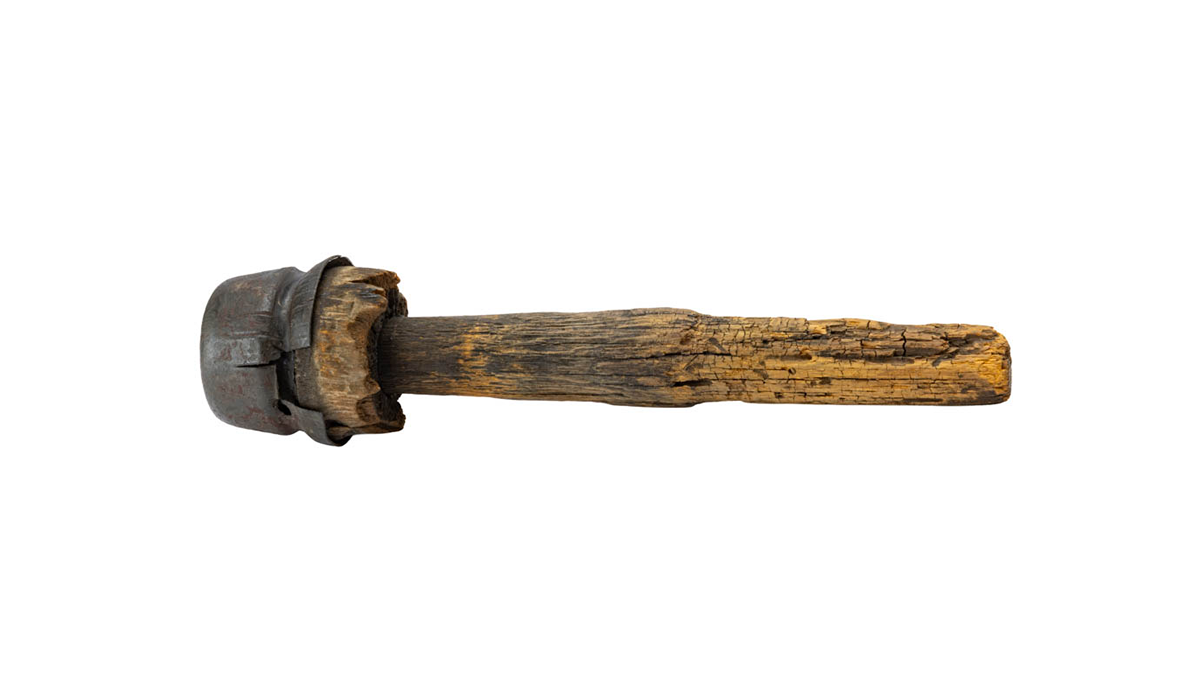 A telephone insulator with possible links to early voice transmission experiments. / THF805303
The Object
The object is a piece of wood, a little over ten inches long, with a metal cap around a shaped end. Staff found this club-like object as part of our 2024–2026 IMLS grant project (a two-year federally funded grant to clean, rehouse, and create digital records for artifacts related to power and energy, mobility and transportation, and communications and information technology). It was found in a storage box with other unassociated communications bits and pieces — unnumbered. The object looked like an early telegraph insulator, which had been around for decades before the invention of telephone. However, an attached tag specified a "Telephone Insulator." Also, this insulator is not much to look at, and it easily could have been disregarded as an unremarkable communication insulator and bracket — reminiscent of other objects in The Henry Ford's collection.
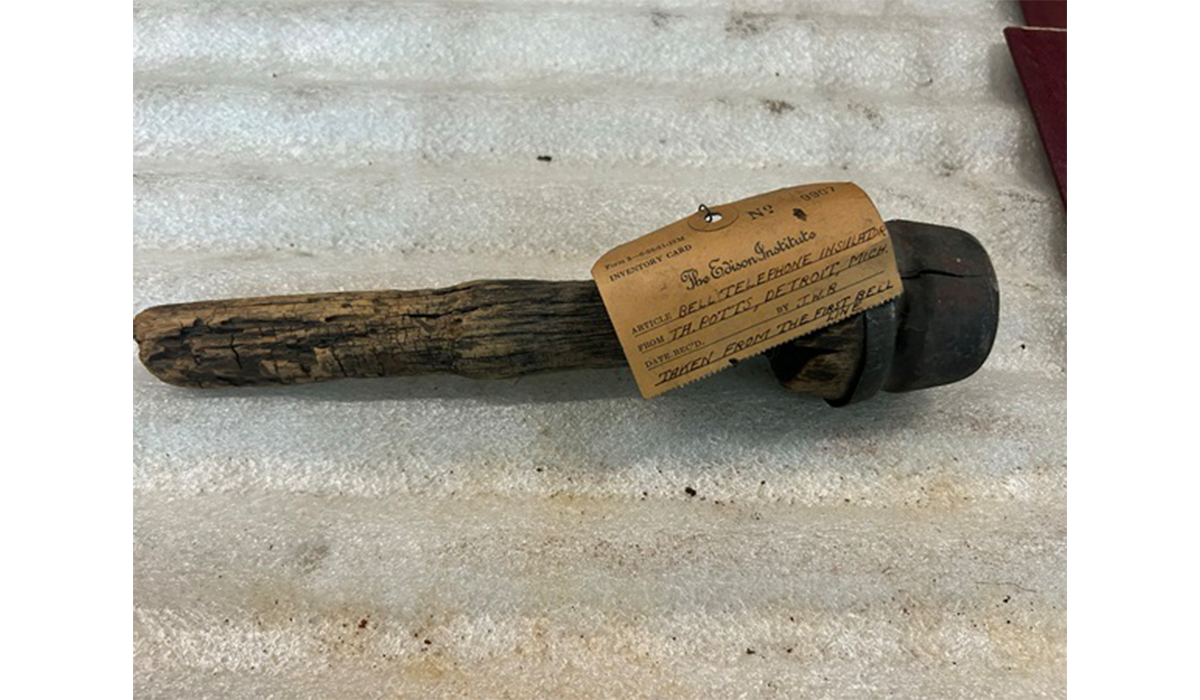 The telephone insulator soon after it was found with the letter and map/drawing removed. Photo by Colleen Sikorski.
But something set this object apart from the rest. It had information, usually found in museum files, wrapped around the bracket body: an old Edison Institute tag and two pieces of paper with a map. After reading the tag and unrolling the pages to find the original donation letter and a hand-drawn map, our staff recognized that this object held more significance than once believed. This piece of wood possibly had a connection to Alexander Graham Bell, early voice transmission, and the invention of the telephone.
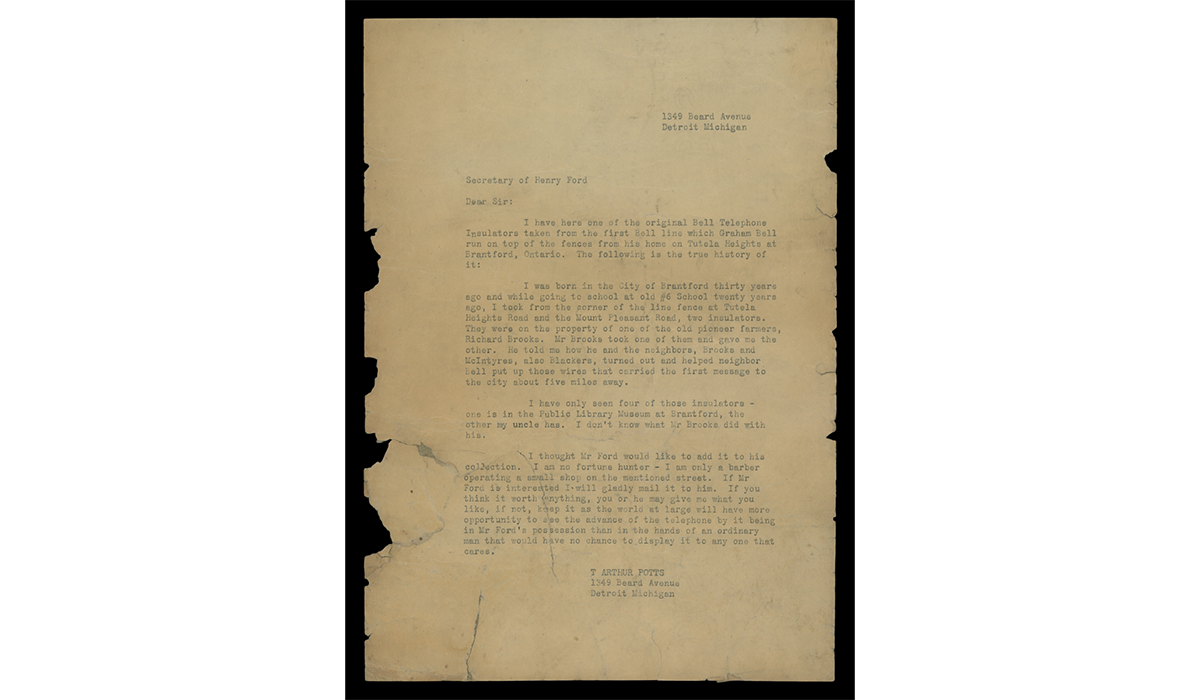 Typed letter from Thomas Potts to the secretary of Henry Ford. / THF727164
The Story Attached
The Edison Institute tag contained a somewhat cryptic message: this object was a "Bell telephone insulator … taken from the first Bell line," but there was no explanation of what the "first Bell line" was. The attached letters and map provided more information and posed additional questions. The donor, T. Arthur Potts, wrote to the secretary of Henry Ford, offering Ford one of the "original Bell Telephone Insulators taken from the first Bell line which Graham Bell run [sic] on top of the fences from his home on Tutela Heights at Brantford, Ontario." If true, the object was not simply an ordinary insulator but one connected to Alexander Graham Bell and the early history of the telephone.
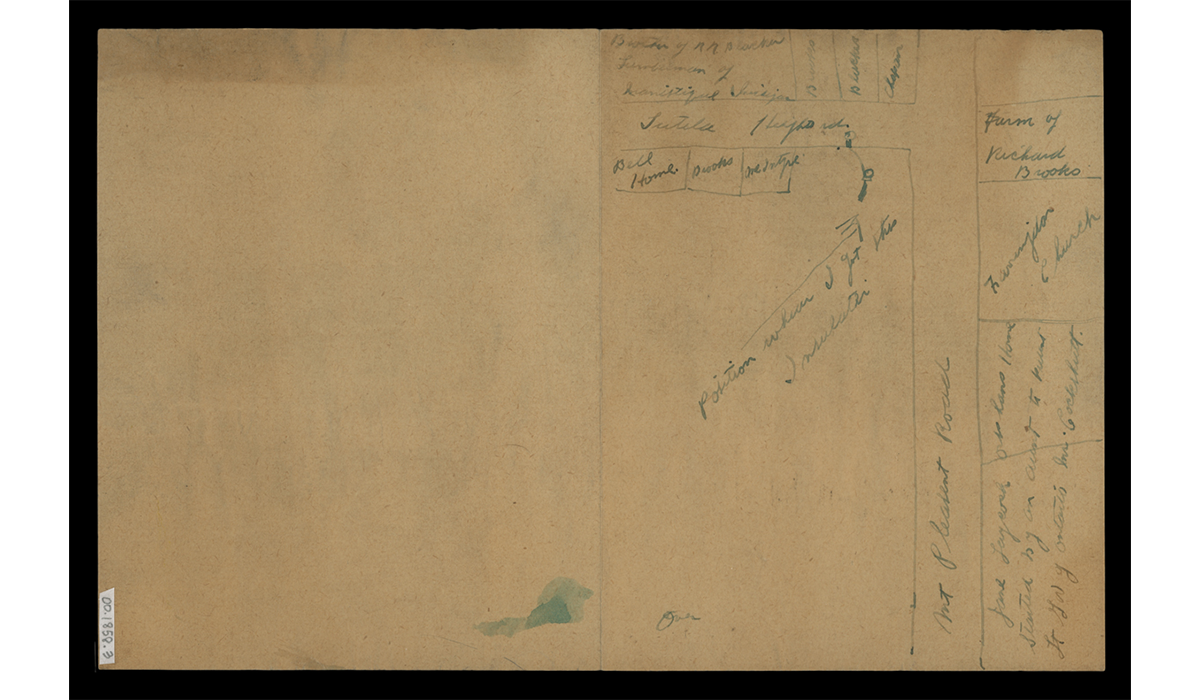 "Thomas Potts' hand drawn map. / THF727167
Mr. Potts then related how he acquired the insulator (where it was found and what happened to the other recovered insulators) and offered this one to Henry Ford. Potts added a hand-drawn map (noting the location of Bell's home and Bell's neighbors and indicating the insulator's initial location) and provided a drawing of the insulator on a separate page.
At face value, this is an intriguing story. But as many historians understand, some stories do not live up to their histories. There may be truth in this unsubstantiated story, or it may be just that — a story. As curators, we began to piece back together the history — one hundred years lost.
A History Uncovered
The undated letter provided a starting point. In it, T. Arthur Potts mentioned he was born in Brantford, Ontario, "thirty years ago," and that he received the insulator "twenty years ago." But when was that? The tag on the insulator came from the Edison Institute (established in 1929), but Henry Ford had been collecting before that. The letter could date from 1920 up into the mid-to-late 1930s. Genealogy research provided some answers.
According to census and other records, Thomas Arthur Potts was born in 1896 in Brantford, Ontario. Other documents reveal that Potts emigrated to the United States at the end of 1923; he then shows up in the 1924–1925 Polk's Detroit city directory living at the address indicated in the letter. This information places the letter sometime in the mid-1920s. Potts, then, would have received the insulator about 1906.
But is there a connection to Alexander Graham Bell and the early history of the telephone? My understanding of the invention of the telephone was limited. I knew Bell received the first patent for the telephone, but I thought he made the first "call" somewhere in the United States. Potts lived in Canada and mentioned that the insulator was "from the first Bell line." Through some quick online searches, I found references to the "first long-distance" phone call made from Brantford to Paris (Ontario) on August 10, 1876 (months after Bell's call to his assistant Thomas Watson on May 6, 1876, in Boston, Massachusetts). Could this insulator have something to do with the supposed "first long-distance" phone call? Reading more about Alexander Graham Bell and the history of the telephone, then contacting other experts, provided more answers.
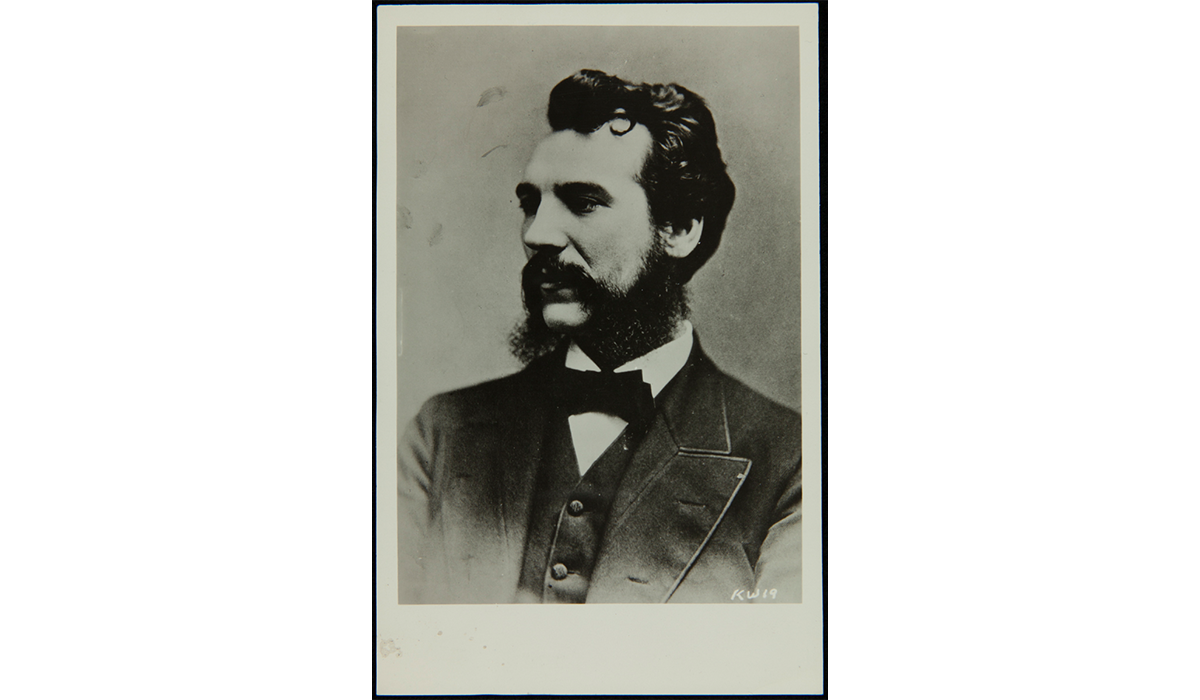 Alexander Graham Bell. / THF253967
Alexander Graham Bell's family lived on Tutela Heights Road near Brantford, Ontario. The home is now the Bell Homestead National Historic Site. When the question of whether this insulator could be associated with that historic "first long-distance" phone call, the Bell Homestead curator doubted the connection. This one-way, "long-distance" call, with the transmitter in Brantford and the receiver in Paris, Ontario, used the existing telegraph lines that already had insulators — and certainly not like the one that The Henry Ford had. And through other research I discovered that the first long-distance two-way call where people could receive and transmit voice messages happened a few months later in October 1876, between Boston and Cambridge, Massachusetts, far from where Mr. Potts had resided. Was this a dead end? Was it time to move on? Was this just an object with a story — a lost history? It appeared so.
A few last-minute searches proved fortuitous. The famed "long-distance call" from Brantford to Paris, Ontario, happened in August 1876 and was made over existing telegraph lines. I did not yet fully realize that Alexander Graham Bell conducted other voice transmission experiments at the same time until I saw a copy of Bell's address at the unveiling of the Bell Memorial in Brantford in 1917. In the speech, Bell mentioned "[t]here were also other experiments that some of the older residents of Brantford may remember, in which the receiving instrument was placed on the porch of my father's house at Tutela Heights…" He continued: "… we got stove-pipe wire in Brantford… and tacked it along the fences from the corner of the Mount Pleasant Road to Tutela Heights - and it worked." Was it possible that this telephone insulator donated by Potts was part of these additional experiments?
Another source provided further confirmation. In the 1926 publication, Pioneering the Telephone in Canada, William Patten related the same story and added key pieces of information that meshed with the Potts letter. Patten wrote that Bell made notes of these experiments, and when "[s]peaking at the annual banquet of the Brantford Board of Trade in 1906 … Dr. Bell said that his memory had come back very clearly to him, in driving out to his father's old homestead at Tutelo [Tutela] Heights, and on his way there he was pleased and proud to meet the two men who had helped him put up the first telephone line in Canada, Mr. McIntyre and Mr. Brooks." (p. 16) These were two of the three names mentioned in the letter by Thomas Potts. And the 1906 date is telling. That was around the time when Thomas Potts states he received this insulator as a ten-year-old boy. Was Potts there when the three old neighbors met, and did he listen to their reminiscences? For a young boy, this would have been a memorable event, to see and hear from Brantford's renowned inventor and one-time resident. Unfortunately, Potts' letter is silent on whether this occurred, only that he received this insulator around that time.
Yet, even with more questions, we have a link to the August 1876 experiments by Alexander Graham Bell to refine his invention that linked friends and families together — not with the taps and clicks of a telegraph key, but the sounds of their own voices — an initial step to communicate across town, city, country, and the world.
Story or History
A telephone insulator wrapped with an old, undated letter could easily have been overlooked and its history disregarded. However, deciphering the clues found in bits of human memory has begun to restore its once-lost history. Piecing together the information — placing people and names in context, asking the right questions, and learning from knowledgeable sources and colleagues — may not reveal its complete history, as some things remain hidden. But even what we have already uncovered can help us tell fuller stories. How complexities of human memory mesh with stories of invention, innovation, and resourcefulness run through wire strung along a fence line attached to an unassuming piece of wood to bring human voice transmission to the world, transforming communication.
Sources consulted in this (re)discovery of the history of the telephone insulator, include:
Brantford Public Library and the Brant County Board of Education. Brantford Honours Alexander Graham Bell, 1874-1974. (Brantford, Ontario): Brantford Public Library and the Brant County Board of Education, 1974.
Bruce, Robert V., Alexander Graham Bell and the Conquest of Solitude. Ithaca and London: Cornell University Press, 1990 [1973].
Patten, William. Pioneering the Telephone in Canada. Montreal: Privately Printed, 1906.
Andy Stupperich is an Associate Curator at The Henry Ford.
Keywords | |
|---|---|
Themes |