
The Early History of Hip-Hop in Three Flyers
| Written by | |
|---|---|
| Published | 8/7/2025 |
The Early History of Hip-Hop in Three Flyers
| Written by | |
|---|---|
| Published | 8/7/2025 |
New York City was experiencing a time of turmoil from the late 1960s through the 1970s. The city, especially in the outer boroughs, was in depth of recession; urban renewal policies had harmed predominantly Black and Hispanic neighborhoods. Youth gangs took to the street as the result of a lack of community resources, jobs, or third spaces for leisure. Out of this chaos, hip-hop rose from the Bronx. Young people created this culture at block parties, parks, and clubs. These gatherings were usually advertised with homemade street art-inspired flyers like the ones recently acquired by The Henry Ford. They offer a glimpse into the history of not just a musical genre but a movement.
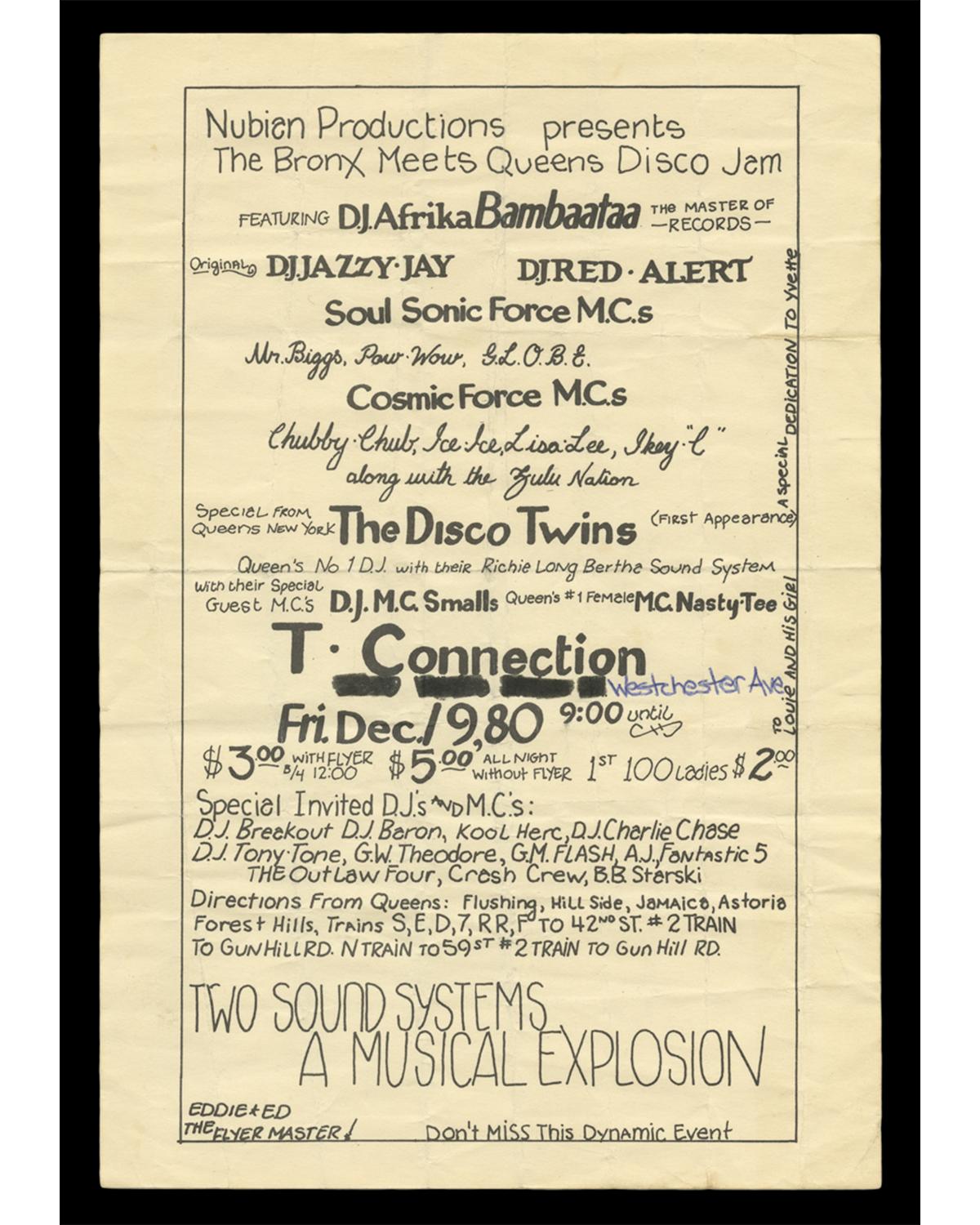 "The Bronx Meets Queens Disco Jam Featuring DJ Afrika Bambaataa," 1980. / THF721980
In the early days of hip-hop, the disk jockey, or DJ, was the star of the show; their ability to create the atmosphere for a party is what made them, and hip-hop itself, unique. As hip-hop grew in popularity, DJs who were fixtures at neighborhood gatherings were invited to play in clubs for special nights. Among the most prominent of these clubs was a discotheque in the Williamsbridge neighborhood of the Bronx called T-Connection. DJ Flame, who performed as DJ La Spank in the 1980s, called the T-Connection the Apollo Theater of hip-hop in a 2023 interview. To her, T-Connection was a training ground for young DJs to hone their craft in front of audiences who expected greatness. T-Connection also featured hip-hop luminaries. DJ Kool Herc, who is considered one of the founders of hip-hop, often played there with his emcees, the Herculoids. DJ Afrika Bambaataa and the Zulu Nation were considered the unofficial in-house crew of T-Connection due to their frequent performances.
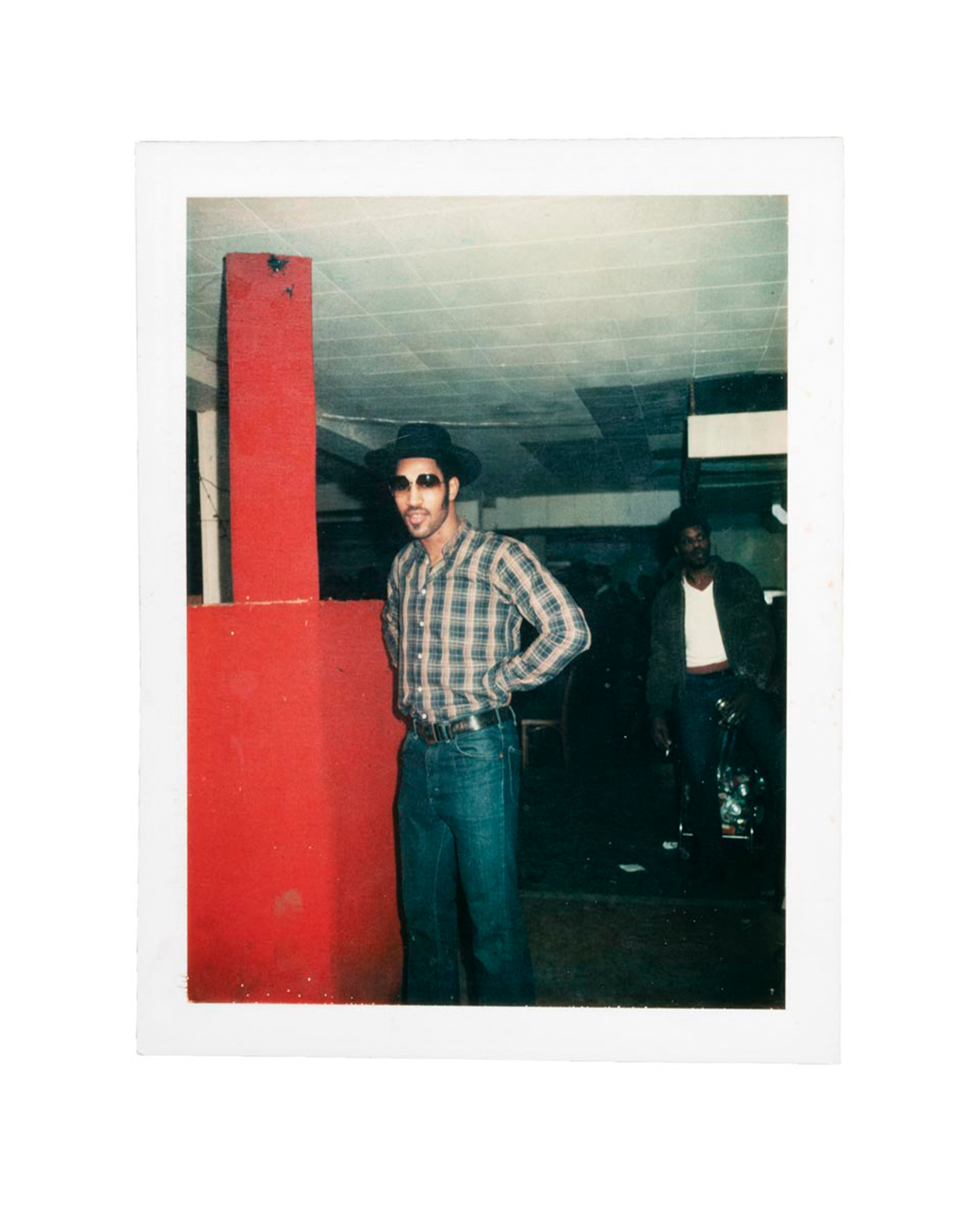 DJ Kool Herc at a nightclub, Bronx, New York, circa 1981. He is pictured in a nightclub, possibly T-Connection. / THF191960
To be the center of a party, DJs cultivated large and mostly secretive libraries of vinyl records spanning soul, funk, disco, electronic, and rock music genres. Early hip-hop DJs focused on the breakdown or "breaks," the portions of a song where the percussion or rhythm sections of a band would do a solo. This was considered by many to be the most danceable part of a song. Some DJs, like Kool Herc or Grandmaster Flash, would extend the "breaks" in songs using two copies of the same records and playing them in succession, sometimes called the "merry-go-round" technique. You can hear the T-Connection audience’s response to DJs' hard work in surviving bootleg recordings of performances. At clubs like T-Connection, DJs demonstrated their prowess on the turntables and spread hip-hop across New York City and the world.
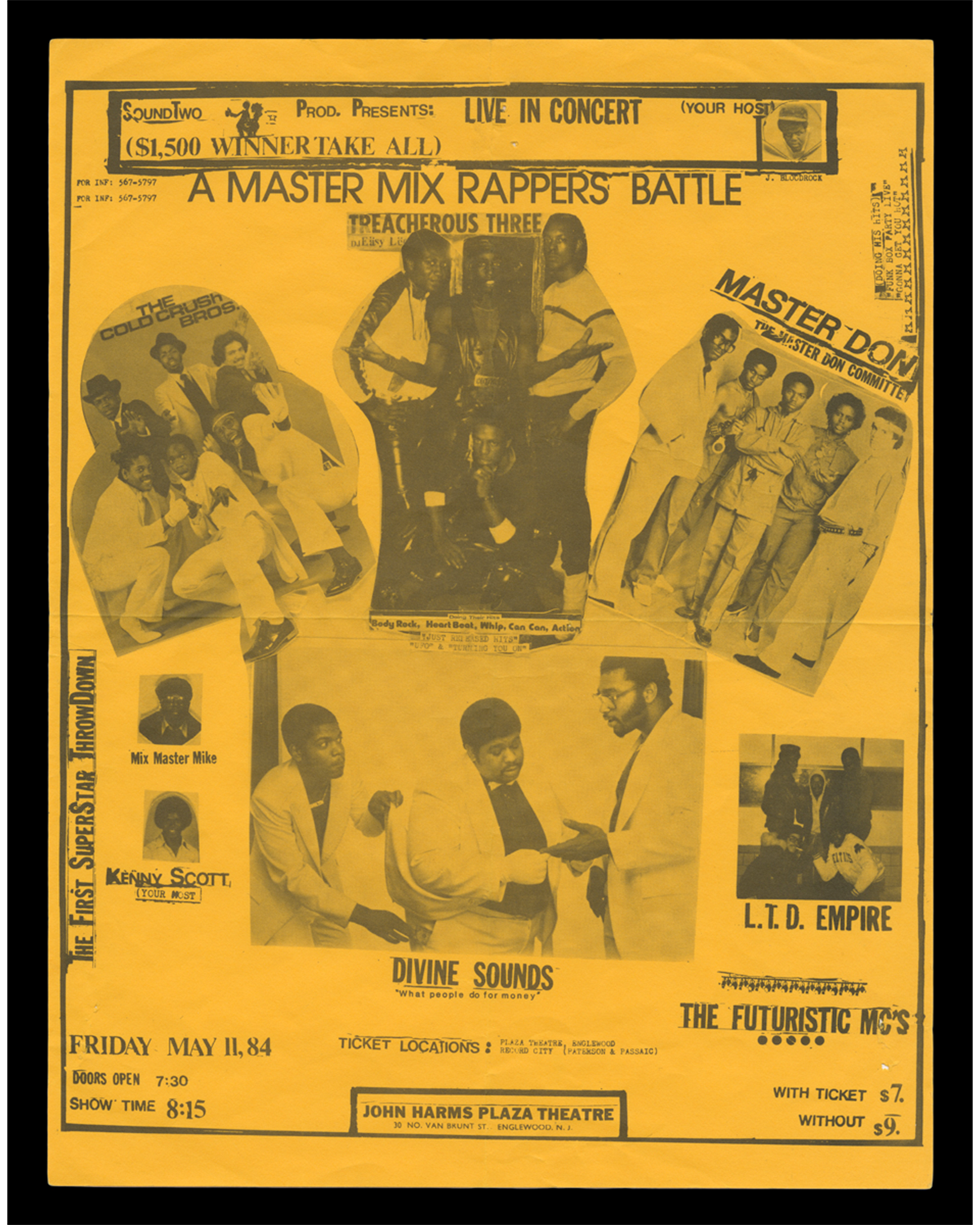 "A Master Mix Rappers Battle," 1984. / THF721983
What is now called rapping has deep roots in Black American culture and in other parts of the African diaspora. Everyone from jazz band leader Cab Calloway to the poetry collective The Last Poets spoke rhythmically over music in styles similar to hip-hop emcees. Caribbean "toasting" songs were also foundational to rapping; in "toasting," Jamaican DJs spoke in a sing-song tone over the records that they played at parties or on the radio. Traditions like these influenced DJs, including Kool Herc, to bring their friends, e.g. Coke la Rock and Clark Kent, to join them and rap while the DJ played music.
These early emcees were masters of ceremony at parties; they would rhyme over a few bars of music to hype up a crowd or tell someone that their car was double parked. This is why many early rappers included the moniker "MC" in their names. From this came a culture of braggadocious and sometimes insulting raps pointed at rival emcees who played at the same events or venues: battle rapping. During the late 1970s and early 1980s, rap battles, like "Master Mix Rappers Battle," were promoted to draw crowds to clubs. The crowds' response — applause, cheers, jeers, and boos — determined the winners of these battles. Some of the top-billed emcees who participated in the "Master Mix Rappers Battle" were or would soon become famous. The Cold Crush Brothers were already legendary by 1984. The crew battled the Grand Wizzard Theodore and the Fantastic Five at Harlem World in 1981. This performance is considered one of the first important rap battles in hip-hop history. Bootleg recordings of the battle were distributed among young hip-hop enthusiasts and inspired aspiring emcees such as Darryl McDaniels, DMC of Run DMC. In 1982, the Cold Crush Brothers re-created the Harlem World battle for the big screen in a film called Wild Style.
Members of the Treacherous Three influenced the changing sound of hip-hop over the next decade. Emcees Kool Moe Dee and Spoonie Gee were forefathers of the subgenres New Jack Swing and Gangsta Rap, which both grew in popularity during the late 1980s and early 1990s.Master Don and the Committee — sometimes billed as Masterdon Committee or Death Committee — did not achieve the same level of fame as their competitors. After scoring a New York City radio hit with their song "Funkbox Party" in 1983, their success remained mostly localized. However, they were innovators as one of the first mixed-gender rap crews with the inclusion of DJ Master Don's sister, Pebblee Poo.
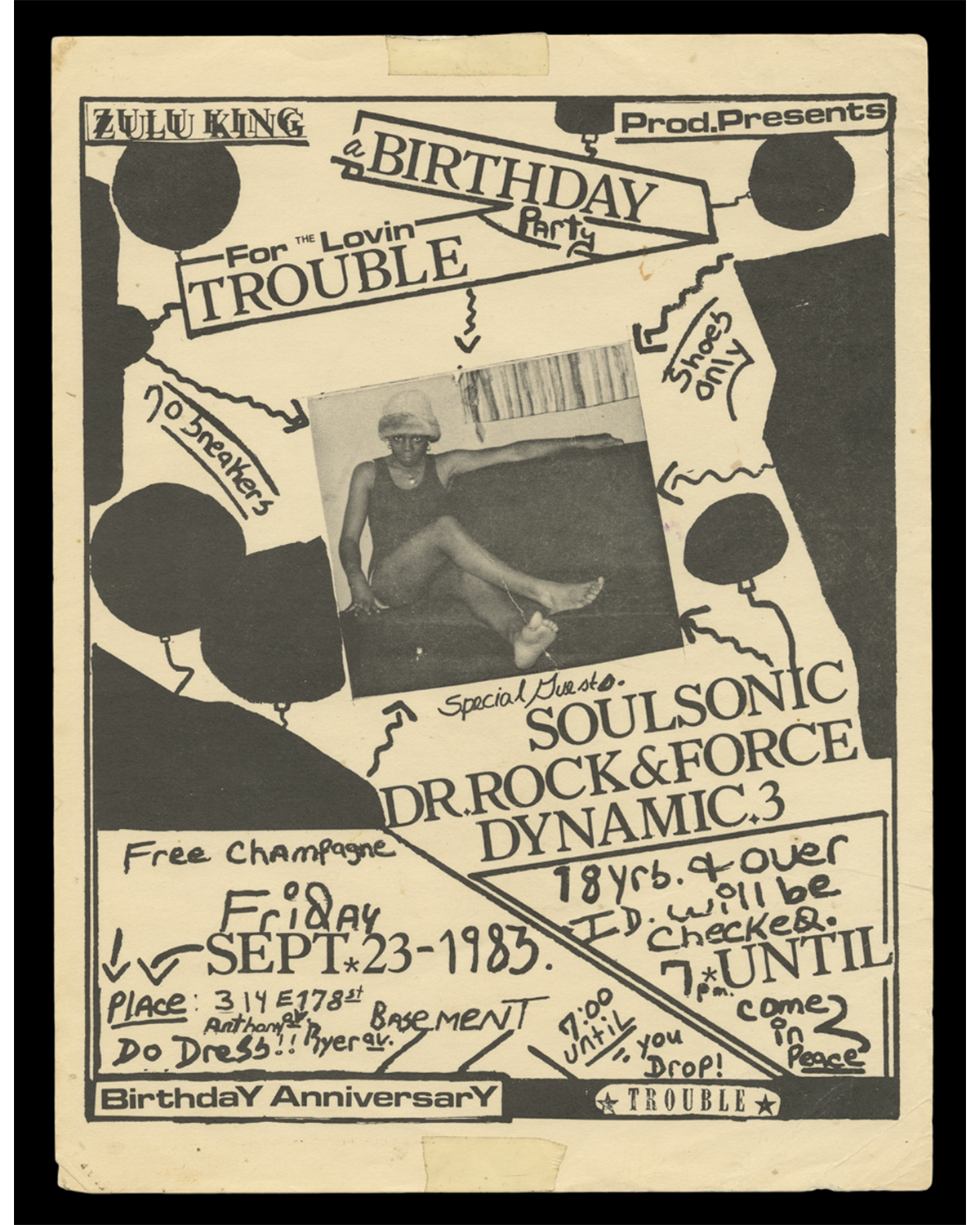 "A Birthday Party for the Lovin' Trouble," 1983. / THF721984
Hip-hop is not just a music genre; fashion has been baked into the culture since the beginning. There are many examples of the symbiotic relationship between hip-hop and style. Artists have started fashion labels like Roc-a-Wear, and emcees often call out their favorite brands in their lyrics like in "My Adidas" by Run DMC.
Early in hip-hop's development, there seemed to be a divide in the culture about how to dress. On the one hand, the young working-class Black and Puerto Rican audience would wear street styles from brands that they had already in their closet, like Kangol or PRO-Keds. They might add personalized touches to their outfits such as permanently creasing their jeans. If they were a dancing b-boy or b-girl, they might rep their dance crew by wearing uniform clothes.
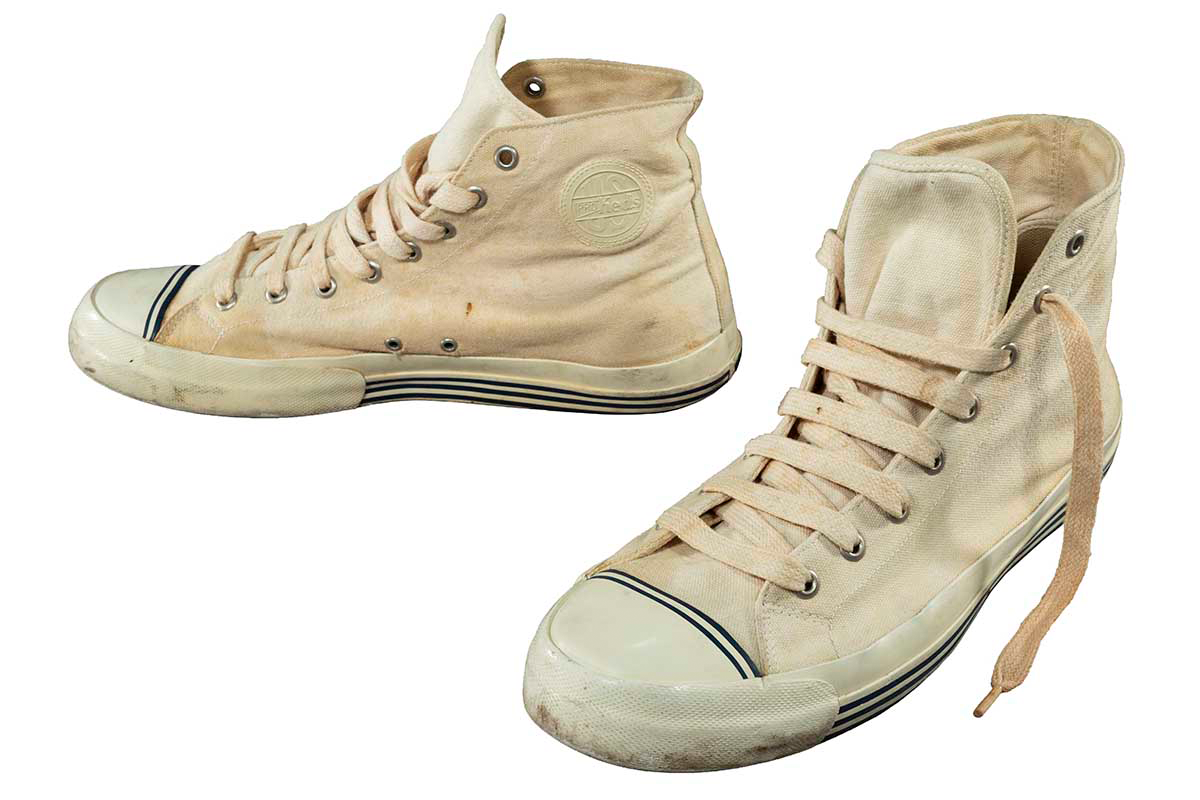 PRO-Ked "69ers" Shoes, Worn by DJ Kool Herc, circa 1980. In hip-hop's early days, PRO-Ked basketball shoes were the sneakers of choice for DJs, emcees, and audiences alike. PRO-Ked shoes were so common among Black and Hispanic youths in the Bronx that the shoes were nicknamed “Uptowners,” referring to the borough’s location./ THF191954
On the other hand, there was the influence of discotheque culture. In the disco clubs, it was common for people to dress in their finest and most eye-catching apparel. For those who bridged the disco and hip-hop worlds, the glamorous get-ups were more appealing. DJ Hollywood — one of the first people to rap rhythmically over music and influence early emcees — enforced a strict dress code wherever he performed. At a DJ Hollywood party, streetwear and sneakers were strictly prohibited.
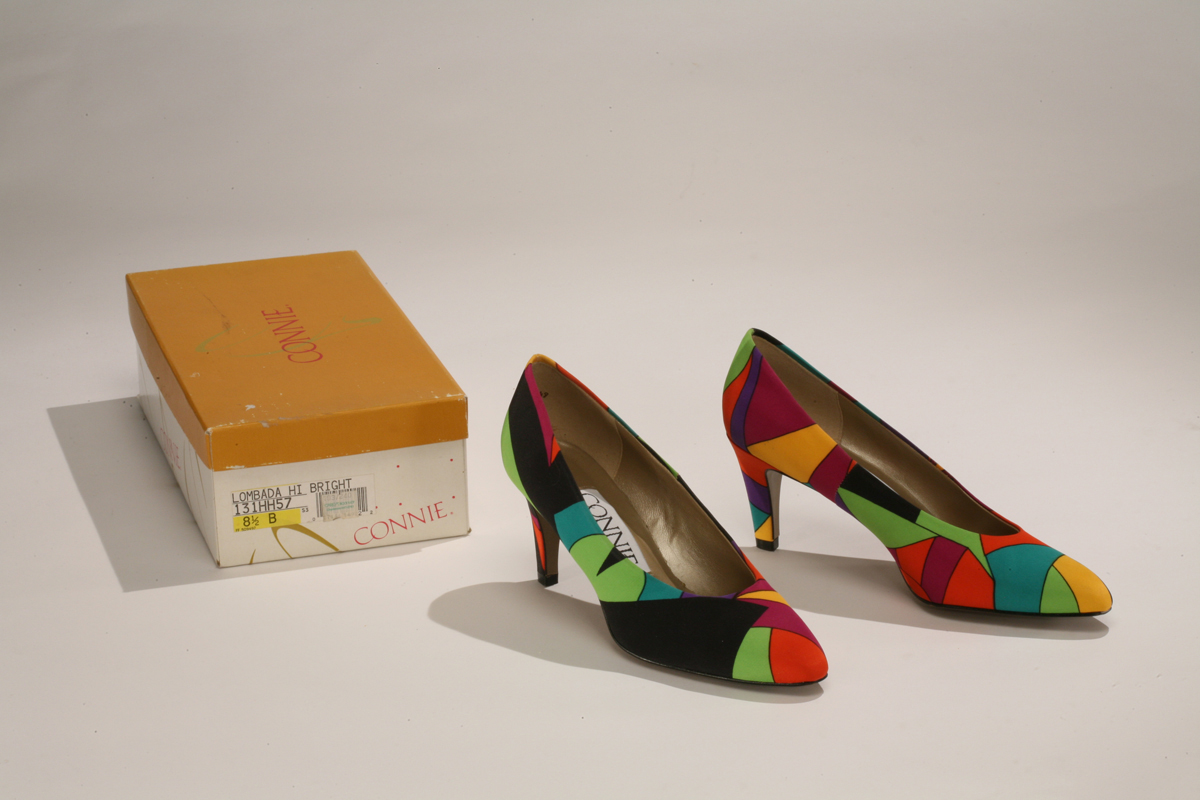 Women's "Lombada Hi Bright" Pumps, 1980-1990. Low-heeled shoes like these were popular from the 1970s until the 1990s as nightclub culture developed. The lower center of gravity made the shoes easier to dance in. They exemplify what a fashionable partygoer might wear. / THF65284
During the 1980s, many emcees and DJs embraced luxury fashion as they gained fame. For example, Grandmaster Flash and the Furious Five performed in elaborate leather outfits, purported to cost over $1,000 each. One fashion pioneer, Harlem-based Daniel "Dapper Dan" Day, noticed this trend and opened his boutique Dapper Dan of Harlem in 1982. He designed custom clothes made of leftover materials from haute couture brands like Louis Vuitton. Dapper Dan blended street fashion and high fashion; he prominently displayed brand name logos on his clothing and innovated the concept of "logomania" in fashion.
These three flyers represent just some of the many stories that transformed hip-hop into the cultural phenomenon it is today. If you are interested in seeing more party and event flyers from this era of hip-hop, check out Cornell University Library's hip-hop collection.
Kayla Chenault is the Associate Curator at The Henry Ford.
Series | |
|---|---|
Themes |