
Search
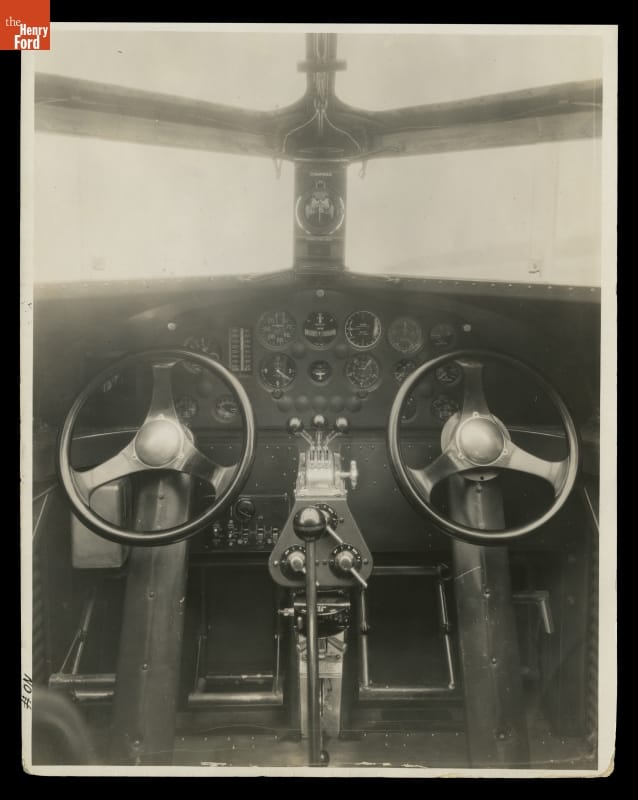
- Cockpit Controls inside a Ford Tri-Motor Airplane, 1927-1930 - With its large, thick wing, the Ford Tri-Motor was very stable in flight. The three engines provided an excellent safety margin. The plane could fly well with two motors, and it could maintain level flight with only one. Cockpit design was efficient. Dual controls allowed either the pilot or co-pilot -- or, in bad weather, both -- to fly the craft.
- 1927-1930
- Collections - Artifact
Cockpit Controls inside a Ford Tri-Motor Airplane, 1927-1930
With its large, thick wing, the Ford Tri-Motor was very stable in flight. The three engines provided an excellent safety margin. The plane could fly well with two motors, and it could maintain level flight with only one. Cockpit design was efficient. Dual controls allowed either the pilot or co-pilot -- or, in bad weather, both -- to fly the craft.
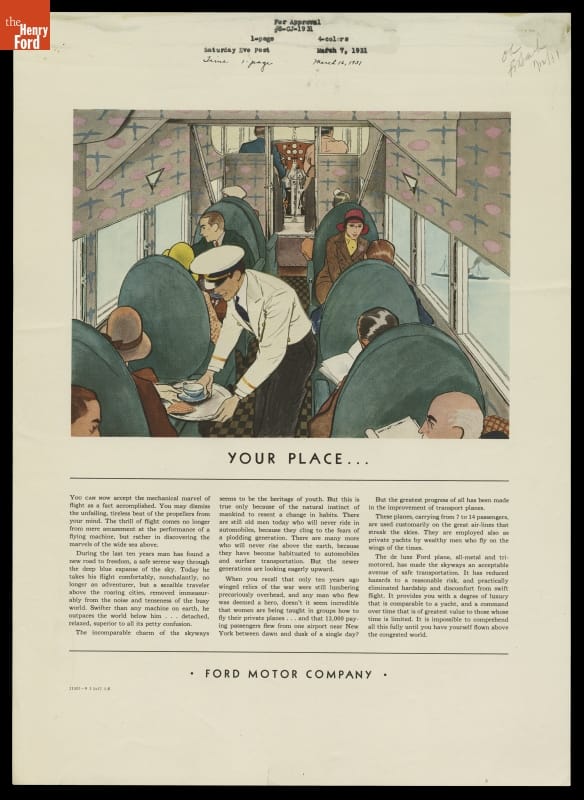
- Advertisement Promoting Commercial Flight in Ford Tri-Motor Airplanes, "Your Place...," March 1931 - While air travel was not exactly an everyday experience by March 1931, when Ford Motor Company published this advertisement, it was certainly a regular feature of American life. Ford rightfully claimed some credit for that. Its all-metal Tri-Motor airplane, built from 1926-1933, was rugged, reliable, and widely used in both passenger and freight airline service.
- March 01, 1931
- Collections - Artifact
Advertisement Promoting Commercial Flight in Ford Tri-Motor Airplanes, "Your Place...," March 1931
While air travel was not exactly an everyday experience by March 1931, when Ford Motor Company published this advertisement, it was certainly a regular feature of American life. Ford rightfully claimed some credit for that. Its all-metal Tri-Motor airplane, built from 1926-1933, was rugged, reliable, and widely used in both passenger and freight airline service.
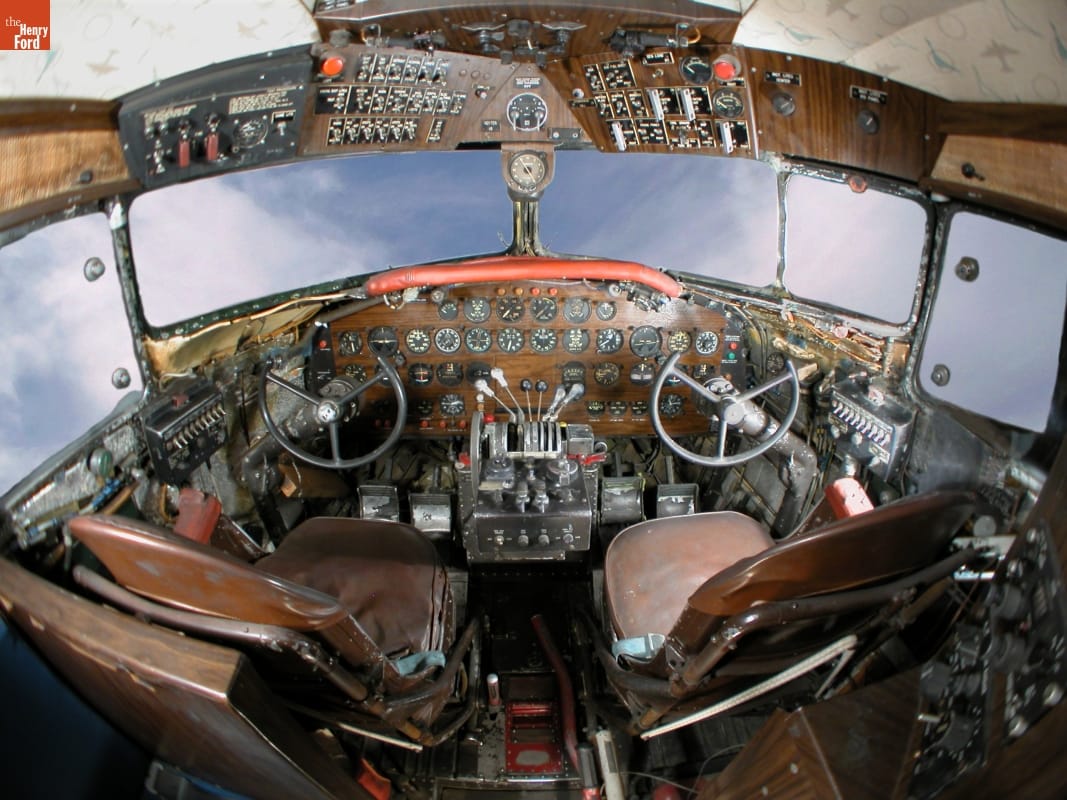
- Cockpit of the 1939 Douglas DC-3 Airplane, Photographed in 2003 - The Douglas DC-3, first flown in 1935, made use of several advancements in aircraft design. Internal bracing for the wings allowed for streamlined surfaces. Engine cowlings and retractable landing gear reduced drag. Improved engines increased range. The result was a rugged, stable airplane easy for pilots to handle. By 1939, DC-3 planes carried 75 percent of U.S. air travelers.
- 2003
- Collections - Artifact
Cockpit of the 1939 Douglas DC-3 Airplane, Photographed in 2003
The Douglas DC-3, first flown in 1935, made use of several advancements in aircraft design. Internal bracing for the wings allowed for streamlined surfaces. Engine cowlings and retractable landing gear reduced drag. Improved engines increased range. The result was a rugged, stable airplane easy for pilots to handle. By 1939, DC-3 planes carried 75 percent of U.S. air travelers.
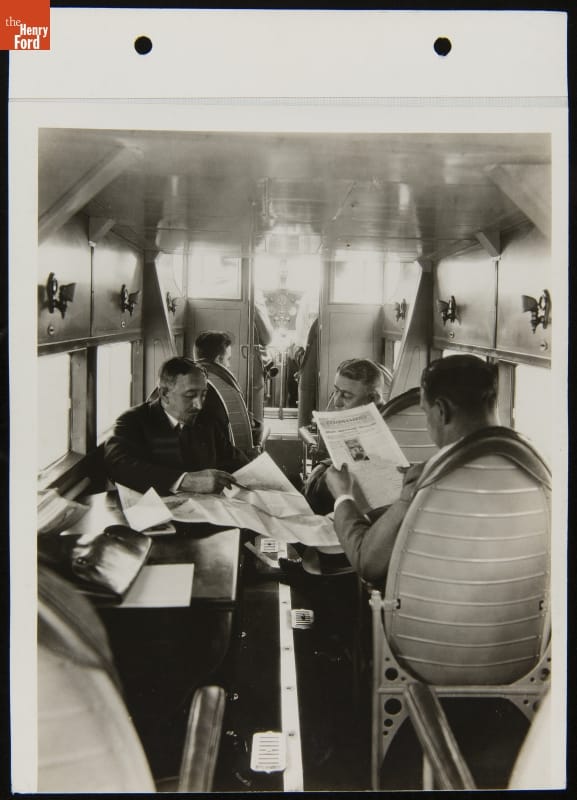
- Ford Tri-Motor Airplane, Interior View of Passenger Cabin, October 1929 - Passenger air travel was a completely new -- and perhaps fearsome -- concept for most Americans in the 1920s. Images like this, used in national advertisements for the Ford Tri-Motor, helped convince a skeptical public of the appeal of flying in a Ford plane. Airplane amenities included beautifully decorated interiors, food and refreshments served by an attendant, comfortable wicker chairs, and a toilet equipped with running water.
- October 01, 1929
- Collections - Artifact
Ford Tri-Motor Airplane, Interior View of Passenger Cabin, October 1929
Passenger air travel was a completely new -- and perhaps fearsome -- concept for most Americans in the 1920s. Images like this, used in national advertisements for the Ford Tri-Motor, helped convince a skeptical public of the appeal of flying in a Ford plane. Airplane amenities included beautifully decorated interiors, food and refreshments served by an attendant, comfortable wicker chairs, and a toilet equipped with running water.