
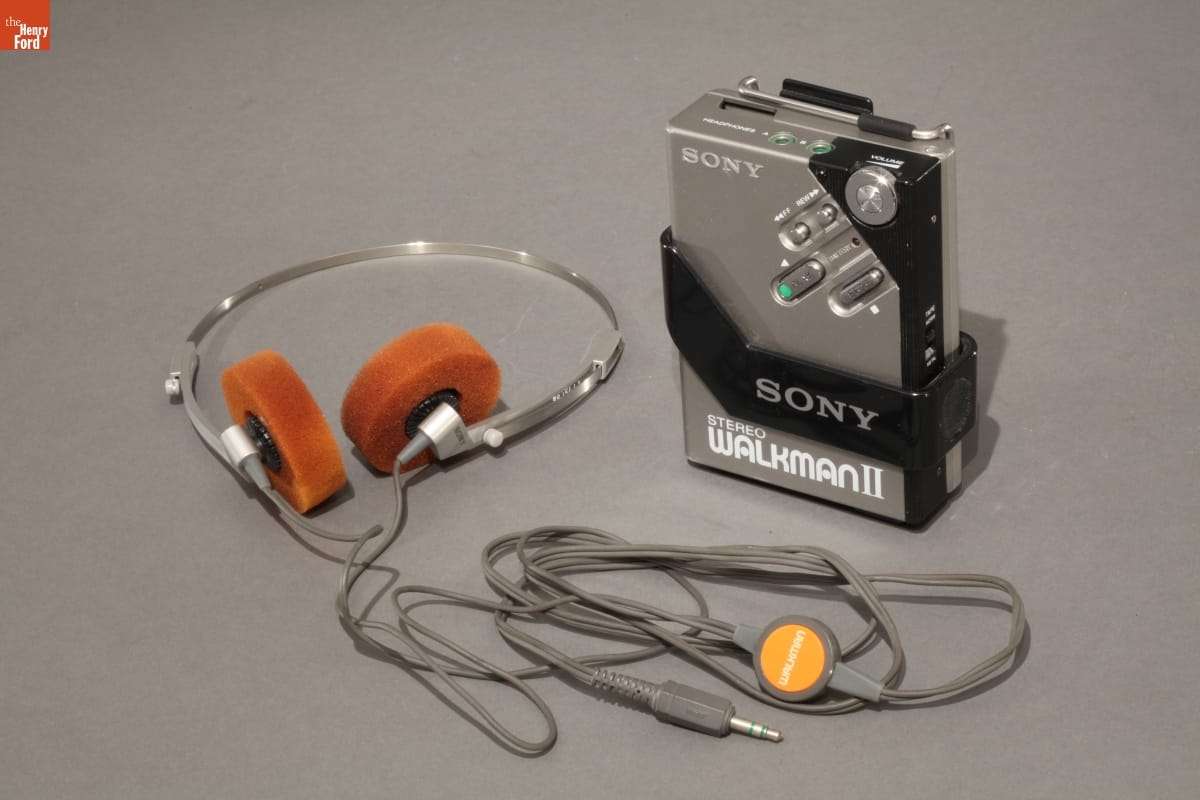
Sony Walkman II, circa 1982
THF153124 / Sony Walkman II, circa 1982
01
Artifact Overview
Introduced in Japan in 1979 and in the US the following year, the Walkman allowed users to enjoy music while walking, exercising, or using public transport. It changed the way people enjoy music--providing a private experience in the midst of everyday life--encouraging a trend that escalated with the development of the iPod and other digital music players.
Artifact Details
Artifact
Cassette recorder
Date Made
circa 1982
Creators
Place of Creation
Location
at Henry Ford Museum in Your Place in Time
Object ID
99.151.1
Credit
From the Collections of The Henry Ford. Gift of John Wright
Material
Plastic
Metal
Color
Gray (Color)
Black (Color)
White (Color)
Dimensions
Height: 4.25 in (Cassette player)
Width: 1.125 in (Cassette player)
Length: 3 in (Cassette player)
Inscriptions
on cassette player:
SONY / STEREO / WALKMAN II / SONY WM-2 / CASSETTE PLAYER | BATTERY SUPPLY:1.5v x 2 / IEC R6 JISUM-3 SIZE AA / SONY CORP. / MADE IN JAPAN | STEREO CASSETTE PLAYER WM-2 / SONY / TAPE / NORM / METAL
on belt clip:
SONY / WALKMAN / 5 MADE IN JAPAN
on headphones:
SONY / WALKMAN / MADE IN JAPAN / R / L
Keywords |
|---|
02
Related Content
 Set
SetPortable Music
- 18 Artifacts
Introduced in Japan in 1979 and in the US the following year, the Walkman allowed users to enjoy music while walking, exercising, or using public transport. It changed the way people enjoy music--providing a private experience in the midst of everyday life--encouraging a trend that escalated with the development of the iPod and other digital music players. Set
SetCommunications and Information Technology
- 50 Artifacts
This is one of the first 50 Apple 1 computers. Apple 1s were the first pre-assembled personal computers; Steve Wozniak assembled this one in Steve Jobs's family home. Before the release of the Apple 1, owning a personal computer meant building it yourself. Wozniak's refined engineering skills, coupled with Jobs's bold marketing abilities, led to a revolutionary and affordable product--as well as a successful company. Set
SetCurators' Choice: Info Technology & Communications
- 25 Artifacts
Thomas Edison's electric pen, an ancestor of both the mimeograph and the tattoo needle, was a successful product in the mid-1870s. Users would write normally with the pen, which, instead of a nib, had a needle powered by an electric motor. The needle poked holes into a stencil, which was then used to copy the document. Many businesses found document duplication an attractive possibility.