
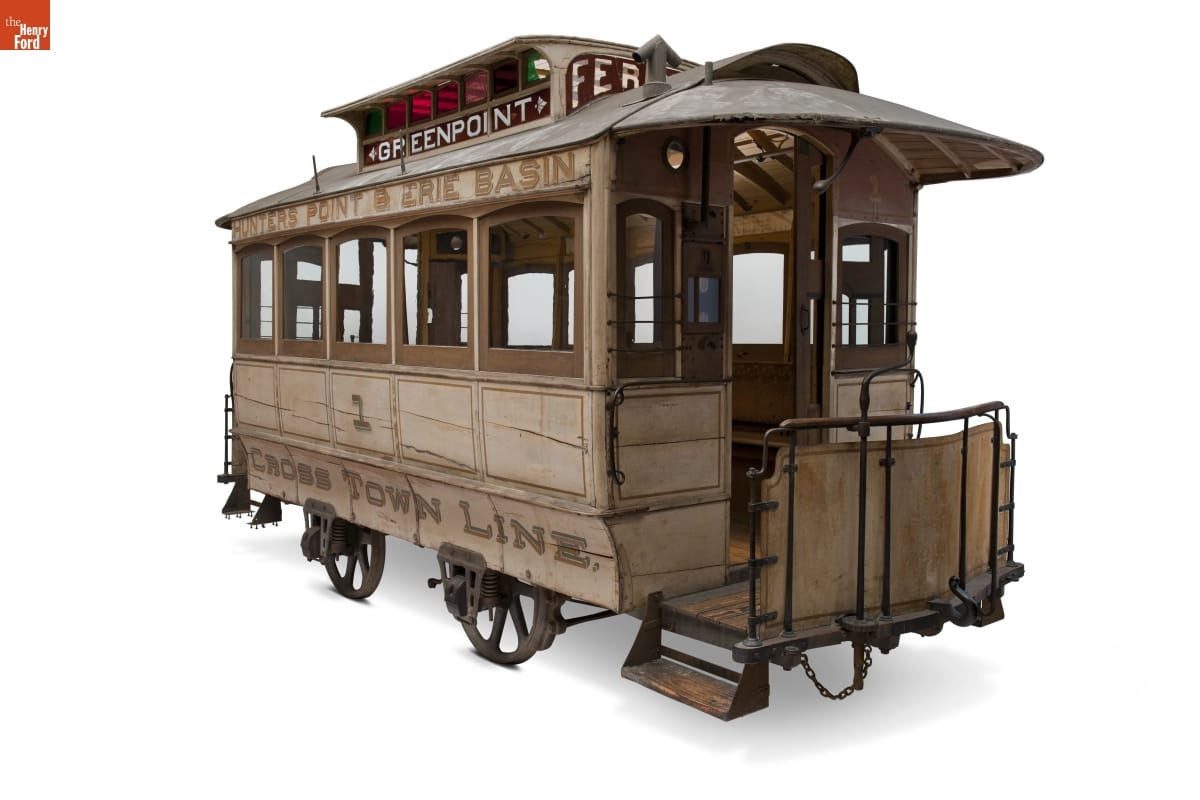
Jones Horse-Drawn Streetcar, circa 1875

THF91050 / Jones Horse-Drawn Streetcar, circa 1875
01
Artifact Overview
The horse-drawn streetcar was an important means of public transportation in 19th-century American cities. New York's Brooklyn City Railroad ran this car on its line between Hunters Point in Long Island City, and Erie Basin in South Brooklyn. But horses were expensive to stable and feed -- and messy too. Operators embraced electric streetcars starting in the late 1880s.
Artifact Details
Artifact
Horsecar
Date Made
circa 1875
Creators
Location
at Henry Ford Museum in Driving America
Object ID
28.810.1
Credit
From the Collections of The Henry Ford. Gift of the Brooklyn City Railroad Company.
Material
Wood (Plant material)
Iron (Metal)
Glass (Material)
Tin (Metal)
Color
Cream (Color)
Brown
Bluish green
Red
Dimensions
Height: 120 in
Width: 83 in
Length: 213 in
Specifications
Make & Model: Jones horse-drawn streetcar, about 1875
Maker: J.M. Jones and Sons, West Troy (Watervliet), New York
Height: 120 inches
Width: 83 inches
Wheelbase: 97 inches
Overall length: 213 inches
Number of horses: 1
Number of passengers: seats 16
Keywords |
|---|
02
Related Content
 Set
SetOnline Horse-Drawn Vehicles Collection
- 29 Artifacts
The horse-drawn streetcar was an important means of public transportation in 19th-century American cities. New York's Brooklyn City Railroad ran this car on its line between Hunters Point in Long Island City, and Erie Basin in South Brooklyn. But horses were expensive to stable and feed -- and messy too. Operators embraced electric streetcars starting in the late 1880s. Set
SetLesson: Transportation for People and American Attitudes
- 16 Artifacts
Few American cities embraced the automobile like Los Angeles. The southern California metropolis opened the first of its many limited-access freeways in 1940. Work on the Harbor Freeway, seen here, began in the early 1950s. Now designated Interstate 110, this freeway connects the downtown area with the Port of Los Angeles to the south, and with Pasadena to the northeast. Set
SetBefore Cars
- 23 Artifacts
Abbot, Downing & Company of Concord, New Hampshire, was the largest and best-known maker of stagecoaches. Sturdy, durable, and comfortable, Concord coaches were shipped by rail all over the country. Set
SetVehicle Viewer
- 99 Artifacts
Americans didn't invent the automobile, but we embraced it and quickly made it our own. Cars cruise through our music, movies, and dreams. They drive innovation and create frustration. They are objects of beauty and sources of blight. The vehicles in the "Driving America" exhibit reveal how the car reshaped our culture and landscape. The decisions we make now, individually and collectively, will define our automotive future.