
Paul Revere: A Revolutionary
Share
share
Famed for his midnight ride, Paul Revere's contributions to the founding of America have been attributed to his participation in the Revolutionary War. Often overlooked is his role in establishing American industry. A talented artisan, but also an ingenious businessman, Revere's knack for observation and adaptability made him a revolutionary in early manufacturing.
THF128562
Caster, Made by Paul Revere, 1760-1785
Paul Revere learned the silversmith trade from his father. When his father passed, Revere inherited his shop and tools. Needing a steady income, he produced and sold a wide variety of silver objects, including items like this caster.
View ArtifactTHF151589
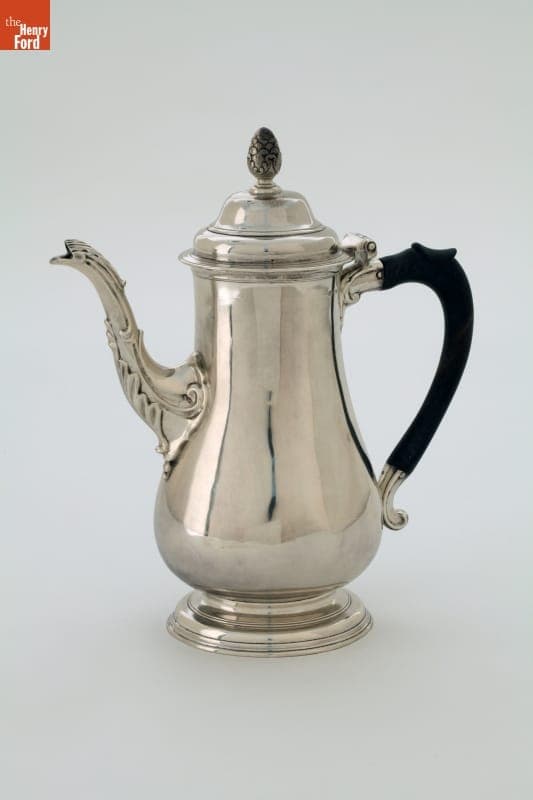
Coffeepot, Made by Paul Revere, 1755-1765
Wealthy citizens used luxury silver items to consume popular drinks like tea and coffee. Much of Revere's income relied upon selling these expensive objects. When Britain passed the Townshend Revenue Act taxing tea, angry colonists boycotted the beverage, affecting what Revere could sell.
View ArtifactTHF11644
Engraving, "A View of Part of the Town of Boston in New-England and British Ships of War Landing their Troops!," 1768
Outrage from citizens caused Britain to send troops to Boston in 1768. Paul Revere documented their landing in this printed illustration. From decorating many of his silver pieces, Revere developed a skill for engraving. He transferred this skill to engraving copperplates used in the art of printed illustrations.
View ArtifactTHF8141
Engraving, "The Bloody Massacre Perpetrated in King-Street, Boston on March 5th, 1770"
Revere’s customer network grew through his participation in multiple organizations, including the "Sons of Liberty," a Patriot group. Paul lent his skills to the group's anti-British cause by producing this print of the Boston Massacre. The print further fueled colonists’ anger against the Crown.
View ArtifactTHF130817
The Bloody Massacre Perpetrated in King-Street, Boston on March 5th, 1770
During the Revolutionary War, the Massachusetts provisional government commissioned Revere to print paper currency. Due to limited wartime materials, Revere cut down his Boston Massacre copperplate so he could fit designs for currency on the backside. Revere later reprinted copies of "The Bloody Massacre" from his edited plate.
View ArtifactTHF166148
Teapot, Made by Paul Revere, 1782
Throughout his career, Revere kept his business current by adapting his silverwork to evolving American tastes. He returned to his craft as the Revolutionary War concluded and produced this teapot in the newly popular neoclassical style.
View ArtifactTHF155246
Teapot, Made by Paul Revere, 1785-1795
Revere acquired new machinery in 1785 which allowed him to mass-produce sheet silver. The sheets could be cut to form standardized pieces for items like this teapot. The new process reduced the amount of time and skill that it took Revere's silver shop employees to manufacture goods and increased his profits.
View ArtifactTHF130820
The Massachusetts Centinel Newspaper for January 28, 1786
With increased profits from more efficient manufacturing processes, Revere earned money that he could invest in new ventures. One such venture was selling imported goods. The hardware ad published on the last page of this Massachusetts Centinel illustrates his retail endeavors.
View ArtifactTHF129606
Bell, Cast by Joseph Warren Revere, circa 1834
Another one of Paul Revere's investments was an iron and brass foundry. At the foundry, he taught himself and his sons how to cast items considered rare in early America, like bells and cannons. Producing a range of metal products, the Reveres put themselves at the forefront of the manufacturing industry.
View ArtifactTHF257676
Broadside Notice of Naval Battle during the War of 1812, "Captain Hull's Victory"
Revere and his sons opened the nation's first copper rolling mill. An early client of the Reveres was the U.S. Navy, which requested copper sheathing for ships like the U.S.S. Constitution. During the War of 1812, the Constitution defeated the British Guerriere, celebrated in this broadside.
View ArtifactTHF166267
Reproduction of a Paul Revere Teapot, 1930
Patriotic exhibits at the 1876 Centennial Exhibition in Philadelphia sparked an interest in examining America's early history. Over time this interest grew into a movement in the decorative arts and architecture known as the Colonial Revival. Boston silversmith George Gebelein was so taken with the work of Paul Revere that he made fine reproductions of Revere's signature pieces, such as this teapot.
View ArtifactTHF173022
Revere Ware Saucepan, 1950-1960
Paul Revere left a lasting manufacturing legacy. The copper business he started with his son continued through the centuries. By the 1950s, the company expanded into cookware. Their stainless steel, copper-clad line called "Revere Ware" became a favorite with cooks.
View Artifact

