
Charles Lindbergh
Share
share
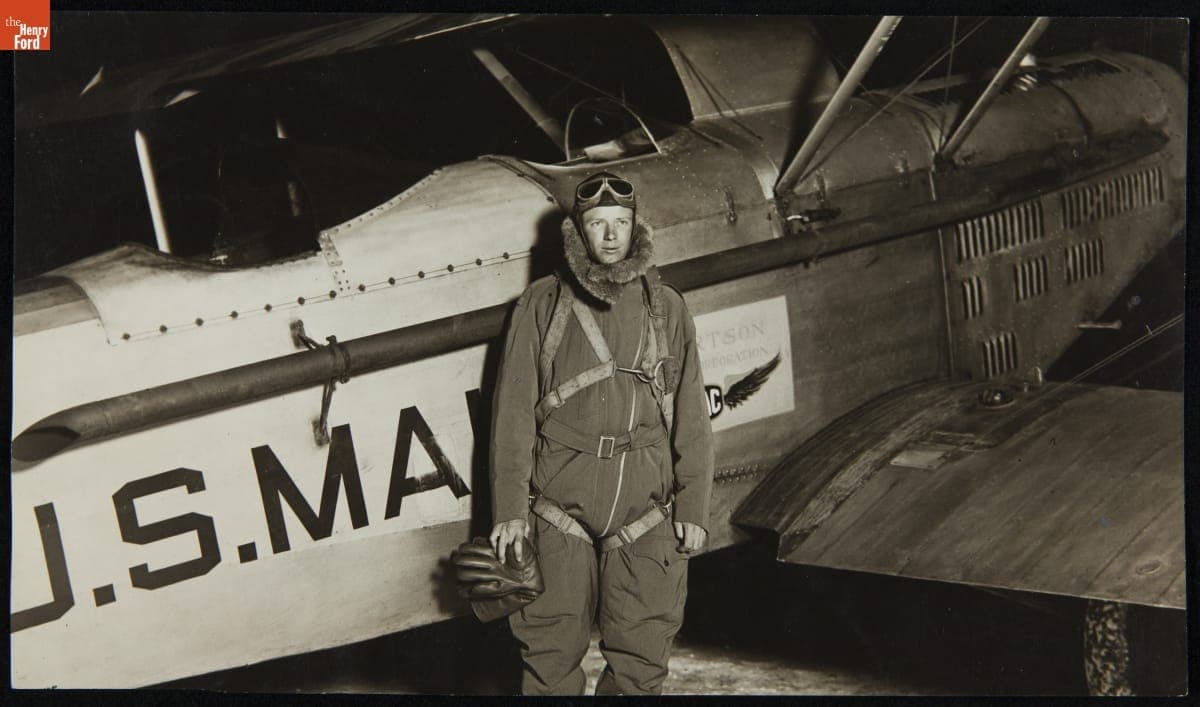
Born in Detroit, Charles Lindbergh grew up in Little Falls, Minnesota, where he developed his lifelong loves of nature and machinery. After a short stint at the University of Wisconsin, he went to Nebraska to learn how to fly. Lindbergh earned his place in history in May 1927 piloting the first solo, non-stop, transatlantic flight. He became an instant – and reluctant – global celebrity commemorated in songs, souvenirs, books and films.
Charles Lindbergh with Curtiss P-1 B Airplane at Ford Airport, August 1927
Charles A. Lindbergh (1902-1974) is remembered for his historic May 1927 solo transatlantic flight from New York to Paris. His triumph fired the public’s imagination, and encouraged investors and passengers alike to take commercial airlines seriously. Lindbergh used his enormous fame to champion aviation and, later, environmental causes. But celebrity brought hardship as well as opportunity to the quiet pilot.
View ArtifactCharles Lindbergh at 14 Months, 1903
Charles Augustus Lindbergh was born to Charles A. and Evangeline Land Lindbergh on February 4, 1902. Though he was born in his mother's hometown of Detroit, Michigan, Lindbergh grew up in Little Falls, Minnesota, near where his father's family had settled after emigrating from Sweden. Charles A. and Evangeline had a difficult marriage and drifted apart, though they never formally divorced.
View ArtifactCharles Lindbergh with His Father, Charles August Lindbergh, circa 1910
Charles August Lindbergh was born in Stockholm, Sweden, and -- as an infant -- immigrated to the United States with his parents in 1859. After his first wife died, Lindbergh married Evangeline Land, with whom he had son Charles Augustus Lindbergh -- the future aviator. The elder Lindbergh represented Minnesota's 6th congressional district in the U.S. Congress from 1907 to 1917.
View Artifact1920 Excelsior Motorcycle Owned by Charles Lindbergh
Seven years before his famous solo transatlantic flight, 18-year-old Charles Lindbergh purchased this Excelsior motorcycle in his hometown of Little Falls, Minnesota. During his student days at the University of Wisconsin, Lindbergh rode the bike on trips to Madison, Wisconsin; Camp Knox, Kentucky; and Jacksonville, Florida. The rough, punishing roads had Lindbergh making frequent repairs to the motorcycle.
View ArtifactCharles Lindbergh on the Motorcycle He Rode from Chicago to Louisville in 24 Hours, 1921
Charles Lindbergh indulged his interests in machinery and speed by purchasing an Excelsior motorcycle in 1920. Lindbergh rode the bike from his boyhood home in Little Falls, Minnesota, to attend the University of Wisconsin-Madison. His marathon Chicago-Louisville run was made in the summer of 1921, when Lindbergh traveled from Madison to Camp Knox, Kentucky, for ROTC training in field artillery.
View ArtifactSecond Lieutenant Charles Lindbergh, March 1925
Charles Lindbergh enlisted in the Army's Air Service Reserve Corps in 1924, partly for patriotic reasons and partly to access sophisticated aircraft. He graduated as a second lieutenant in 1925. After his historic 1927 solo transatlantic flight, Lindbergh was promoted to colonel and awarded the Medal of Honor. In 1954 he was elevated to brigadier general in the Air Force Reserve.
View ArtifactCharles Lindbergh Leaves Chicago with the U.S. Mail, February 21, 1928
After barnstorming and piloting in the Army Reserve, Charles Lindbergh started flying mail between St. Louis and Chicago in 1925. The job provided sound experience flying in all conditions. Following his 1927 solo transatlantic flight, Lindbergh used his newfound fame to advance aviation however he could -- from organizing transcontinental airline service to making promotional air mail flights over his old route.
View Artifact1927 Ryan "Brougham" NYP B-1 Monoplane, Replica of the "Spirit of St. Louis"
Warner Bros. built this airplane for its 1957 movie The Spirit of St. Louis. The film's star, Jimmy Stewart, donated it to The Henry Ford in 1959. The replica is faithful to Charles Lindbergh's original with two exceptions. The replica's wingspan is shorter, and its cabin has two seats. On Lindbergh's plane, large fuel tanks left room for only one seat.
View ArtifactPaper Bowtie, "Welcome Lindbergh," 1927
After his New York to Paris flight in May 1927, Charles Lindbergh was welcomed as a conquering hero wherever he went. That summer he flew his Spirit of St. Louis on a tour that took him to each of the 48 states then in the Union. Admirers might have greeted Lindbergh while wearing paper bowties like this one.
View ArtifactPhonograph Record, "Lucky Lindy" and "Lindbergh (The Eagle of the U.S.A.)," 1927
Charles Lindbergh gained international fame with his solo transatlantic flight from New York to Paris. The reluctant celebrity was praised in several popular songs, with none more successful than "Lucky Lindy" written by Abel Baer and L. Wolfe Gilbert. Singer Jack Kaufman recorded the tune for Harmony Records on May 25, 1927 -- a mere four days after Lindbergh's flight!
View ArtifactLindy, The New Flying Game, 1927
In 1927, Charles Lindbergh became the first person to fly solo across the Atlantic. Americans were captivated by this amazing feat. Parker Brothers capitalized on the public's fascination with their new hero and produced this game. Similar to their Touring card game, Lindy requires players to collect mileage cards to win. Other cards help or hinder the traveler's progress.
View ArtifactCharles Lindbergh Pencil Box, circa 1927
Charles Lindbergh's solo New York to Paris flight in May 1927 made him a hero around the world. "Lindy" appeared on posters, sheet music, coins, tapestries, and almost every other imaginable souvenir. Lindbergh appears alongside his airplane, the Spirit of St. Louis, on this pencil box. "WE," the title of Lindbergh's 1927 memoir, refers to the pilot and his plane.
View ArtifactCharles Lindbergh's Spirit of St. Louis Airplane at Ford Airport, August 1927
In 1927, Charles Lindbergh flew his Spirit of St. Louis to Ford Airport in Dearborn, Michigan. The pair was newly famous for completing the first non-stop flight from New York to Paris. During their visit, Henry Ford accepted Lindbergh's invitation for a ride. Though Ford had been invested in aviation since 1909, this was his first trip in an airplane.
View ArtifactHenry Ford and Charles Lindbergh at Ford Airport, Dearborn, Michigan, August 10, 1927 - 1
Henry Ford and Charles Lindbergh shook hands during Lindbergh's August 10-12, 1927, visit to the Michigan cities of Dearborn and Detroit. The stop was part of a national tour during which Lindbergh flew the Spirit of St. Louis to every one of the 48 states in the Union at that time.
View Artifact1928 Franklin Airman Sport Sedan, Personal Car of Charles A. Lindbergh
Franklin automobiles, built from 1902 until 1934, were distinguished by their air-cooled engines. When Charles Lindbergh flew across the Atlantic with an air-cooled motor in 1927, Franklin played up the connection by introducing an "Airman" sedan and giving this example to the aviator. In turn, Lindbergh gave the car to Henry Ford in 1940 for inclusion in Henry Ford Museum.
View Artifact"The Spirit of St. Louis," by Charles A. Lindbergh, 1953 - 1
In 1927, Charles A. Lindbergh became the first man to fly solo across the Atlantic. Lindbergh recounts this historic flight and his early days in aviation in The Spirit of St. Louis. Written in 1953, the book became a bestseller and won the Pulitzer Prize.
View ArtifactMovie Poster, "Spirit of St. Louis," 1957
The 1957 film The Spirit of St. Louis recounted Charles Lindbergh's early years in aviation and his historic solo transatlantic flight of 1927. Based on Lindbergh's Pulitzer Prize-winning memoir of the same name, the film starred the celebrated screen actor James Stewart. The movie was a passion project for Stewart, a great admirer of Lindbergh and an enthusiastic pilot himself.
View ArtifactJimmy Stewart Visiting Henry Ford Museum, October 20, 1979 - 1
Renowned screen actor Jimmy Stewart was also an avid pilot. His work and his hobby came together when Stewart starred as Charles Lindbergh in the 1957 film The Spirit of St. Louis. Three replicas of the title airplane were used in the movie, and Stewart purchased one of them. The actor donated his plane to Henry Ford Museum in 1959.
View Artifact

