
Portable Music
Share
share
This group of artifacts challenges our notion of what "portable music" has meant, from the early 20th-century to present day. Some objects may seem familiar--some may seem laughably large to be considered "portable" today. An evolution of listening styles is also present: from the open channels of radio for news and top-40 music--to formats like the LP and MP3 that allowed people to take control of their listening experience, minus the DJ.
First Portable Superheterodyne Radio Receiver, Made by Edwin Howard Armstrong, 1923 - 2
Edwin H. Armstrong was a pioneer of radio engineering, credited as the inventor of FM radio. In 1918 he filed a patent for the superheterodyne radio circuit. This technology increased the sensitivity and selectivity of radio receivers. The radio depicted is the first portable superheterodyne radio receiver ever made. Armstrong gave it to his wife, Marion, on their 1923 honeymoon.
View ArtifactOperadio 2 Portable Broadcast Receiver, 1923-1927
The Operadio 2 was among the first generation of commercial portable radios. While a "mobile" device weighing 30 pounds may be laughable to us now, the Operadio was a groundbreaking device. A self-contained system, its carrying case conceals batteries, a speaker horn--and a loop antenna in the lid that attaches to the top, where it swivels for better reception.
View ArtifactPocket Radio, circa 1925
This "Pocket Radio" contains one vacuum tube, is battery-operated -- and portable. It was advertised as a "travelers delight," weighing four pounds and measuring 12 inches long. The set received local broadcast stations and could be connected to an antenna to increase its power. Laughably large by today's standards of portability, in the mid-1920s, most consumer radios were table-top sized or larger.
View ArtifactCrosley Portable Radio, Model E10-307M, 1949-1950
Radios for the home were often showpieces--examples of the most current and fashionable design--but the focus of this radio is portability and durability. Battery operated, it is made of durable plastic, and a handle assists in carrying the set. The overall design is reminiscent of a lunchbox. In addition to radios, Crosley manufactured automobiles and household appliances.
View ArtifactRCA 45 rpm Record Player, Model 6-JY-1C, 1949-1951
The 45 rpm record format was developed at RCA in 1949 under the leadership of David Sarnoff. The 45 format typically held one song per side, requiring active forms of listening. This record changer allowed stacks of durable 45s to be set on the top spindle; as each record finished playing, a new record would drop down onto the turntable.
View ArtifactMagnavox Transistor Radio, Model AM-2, 1956
The size of radios shrank following the advent of transistor technology. Even the smallest vacuum tubes were bulky, and their power consumption ensured the need for large batteries. Transistor radios made of lightweight plastics were cheap and truly portable. With the addition of an earphone a radio such as this allowed the listener to enjoy a completely personal listening experience.
View ArtifactZenith "Zenette" Transistor Radio, 1960-1963
The size of radios shrank following the advent of transistor technology. Even the smallest vacuum tubes were bulky, and their power consumption ensured the need for large batteries. Transistor radios made of lightweight plastics were cheap and truly portable. With the addition of an earphone a radio such as this allowed the listener to enjoy a completely personal listening experience.
View ArtifactZenith Portable Phonograph, Model FP-6VA, circa 1962
Today, we think of portable music devices as something that can be carried in a pocket. Until the rise of the Walkman in the 1980s, mobile media players where people could select their own music usually meant bulky devices with a convenient handle attached. Zenith was a key client of Mel Boldt and Associates, designers of this player.
View ArtifactPlaytape Cartridge Tape Player, Model 1320, 1966-1968
The Playtape was a two-track audiotape player system designed by Frank Stanton in 1966. He marketed this device as a portable music player and a business dictation machine. Its 24-minute cartridges typically played two or four songs on a continuous loop. The Playtape was successful among youth, however, the introduction of the eight-track player caused its popularity to be short-lived.
View ArtifactElgin Portable 8 Track AM FM Stereo Player, Model RT-5530, circa 1972
The popularity of the eight-track player was--much like the transistor radio--based upon its portability. While heavy, these players nonetheless offered a smaller footprint than portable record players, and could be carried and played while in motion without skipping. This particular player unfolded to reveal two speakers; its stereo sound was a nod to expensive high-fidelity equipment.
View ArtifactZenith "My Radio" Pendant Transistor Radio, circa 1970 - 1
The size of radios shrank following the advent of transistor technology. Even the smallest vacuum tubes were bulky, and their power consumption ensured the need for large batteries. Transistor radios made of lightweight plastics were cheap and truly portable. With the addition of an earphone a radio such as this allowed the listener to enjoy a completely personal listening experience.
View ArtifactSony Integrated Circuit Portable Radio, Model ICR-100, circa 1972
The Sony ICR-100 was the first integrated circuit (IC) radio. During the early 1970s, IC's allowed electronic products to miniaturize. They were used in handheld calculators, toys, automobiles--and significantly impacted the computer industry. Smaller than transistor radios of the time, this radio would have acted as a symbol of its owner's desire and ability to possess the latest technology.
View ArtifactBig Bird Radio, 1976-1978
When Sesame Street debuted on public television in 1969, it was an immediate hit with its pre-school audience. Mixing education and fast-paced entertainment, kids laughed at the antics of puppet characters like Big Bird, Cookie Monster, and Bert and Ernie. Licensed toy products featuring the show's characters began to appear on toy shelves. In 1972, over nine million were sold.
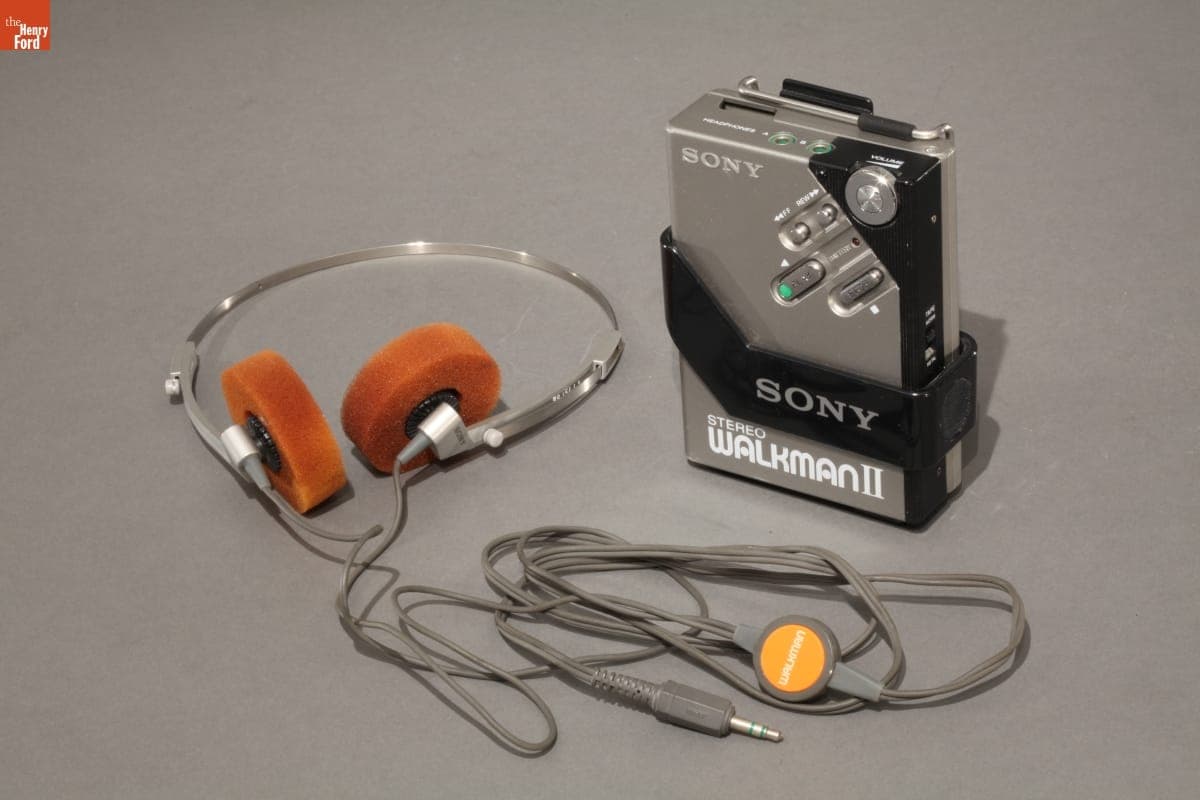
View ArtifactSony Walkman II, circa 1982 - 1
Introduced in Japan in 1979 and in the US the following year, the Walkman allowed users to enjoy music while walking, exercising, or using public transport. It changed the way people enjoy music--providing a private experience in the midst of everyday life--encouraging a trend that escalated with the development of the iPod and other digital music players.
View ArtifactSharp QT 50 Portable Radio Cassette Player, 1986 - 1
In the early 1980s Japanese electronics manufacturers began to develop a sense of how to shape American tastes in design, terming their approach "lifestyle design." This boombox represents the first example of a Japanese electronics firm tapping into the international trend toward postmodernist design. It references 1930s American streamline design, while simultaneously drawing inspiration from 1950s American vernacular design.
View ArtifactSony SRF-39FP AM/FM Prison Radio, circa 2000
This AM/FM pocket radio is a popular audio player, used in US prisons. Its transparent case and headphones are designed to prevent the storage of contraband, making routine cellblock checks more efficient. Owning a radio in prison allows inmates to gain a sense of privacy, comfort, and personal agency, allowing them to follow news and entertainment from the outside world.
View ArtifactiPod nano MP3 Player & Earbuds, circa 2008
The iPod Nano is a MP3 digital music player, and is one of the best-selling music players in history. Like transistor radios and Walkmen, iPods provide an affordable way to listen to music on the go. They are excellent examples of convergence media--allowing people to listen to songs, FM radio, podcasts--as well as watch videos and store photos.
View ArtifactiPhone, 2007 - 1
The iPhone was the apotheosis of the cellphone as pocket computer--powerful technology in a sleek package. This handheld is a music player, a mobile phone, and an internet-enabled device in one, with a trendsetting touchscreen interface. The iPhone's release in 2007 was a well-choreographed media event, with potential buyers waiting in lines for hours at Apple stores across the country.
View Artifact

