
Hay
Share
share
Hay is a mixture of cut grasses or crops like alfalfa or clover that keeps farm animals well fed during winter months. Making hay is a labor-intensive and time-consuming process--farmers cut, dry, and store hay all summer long. It is also a race against time--rain damages the crop drying in the fields. Mechanical innovations have reduced the time and labor--but not the urgency--required to complete this essential chore.
THF32421
Scythe, circa 1880
Swinging a scythe to cut acres of grass several times a year required many laborers and lots of time. Farmers used long scythes like this one to cut wide swaths with each swing. Farmers used this method for hundreds of years before innovators introduced mechanical mowers that saved time and physical exertion.
View ArtifactTHF235036
John Burroughs Sharpening a Scythe near Slabsides, circa 1910
Scythes needed constant attention because each swing through the grass dulled the blade. A sharp blade made cutting easier and less physically taxing on the laborer. Mowers would frequently stop and sharpen their blades with a whetstone.
View ArtifactTHF173881
Ambler's Mowing Machine, circa 1836
The invention of the mower replaced the labor-intensive work of the scythe. Instead of walking across a grass field, farmers could sit on a mower while a team of horses or oxen generated the power that activated the cutting mechanism. A moveable sickle blade affixed to a metal bar cut a wider swath than the hand-wielded scythe, reducing the number of passes across the field.
View ArtifactTHF97259
Hubbard Meadow Lark Mower, 1866
Innovators improved mowers to cut grass quickly. They affixed sickle blades on bars that oscillated as the team of horses pulled the mower through the field. The sickle bar, lowered to one side of the machine, cut the swath of grass. The farmer could raise the bar around obstacles or lift it completely off the ground for travel between fields.
View ArtifactTHF96688
The Old Farmer's Almanac, Number 84, 1876
Haying is a race against time. Farmers gambled with the weather as soon as they cut the grass; one heavy rain could ruin an entire crop. A successful hay crop required approximately three dry days in a row, and farmers cut grasses three to four times a year. Farmers relied on the prognostications of almanacs to help them strategize their haying schedule.
View ArtifactTHF97255
Hay Rake, circa 1882
Once cut, grasses lay in the field to dry completely. For centuries laborers used hand rakes to ventilate hay as it dried. This horse-drawn dump rake moved hay quickly and reduced labor needed to consolidate hay from the swath into a windrow. Farmers then pitched hay from the windrow into a cart or wagon to haul it from the field.
View ArtifactTHF97263
Hay Tedder, circa 1875
Farmers used tedders to fluff up cut grasses, increasing air circulation to hasten drying before moving it into their barns. Hay tedder manufacturers claimed that fluffed hay would dry completely--and quickly--before storage. Farmers who used a hay tedder might reduce some of the stress but not eliminate the risk involved with their race against the weather to get hay under cover before a rain.
View ArtifactTHF33791
Hay Loader, circa 1895
Prior to the hay loader, farmers used pitchforks to manually toss cured hay from the ground into a wagon or cart to move it from field to barn. Hay loaders reduced the physical labor of this task. Farmers could sit and drive their team of horses over the windrows, while this machine did the heavy lifting.
View ArtifactTHF286060
Photograph, "Hay Press and Work Crew," 1915-1925
The hay press, a box that pressed cured grass into easily transportable bales, became an essential tool for farmers who raised more hay than their livestock consumed. This photograph shows workers feeding loose hay into a press -- this one powered by horses. Farmers could sell the bales to wholesalers who shipped them to urban markets.
View ArtifactTHF32438
Double Harpoon Horse Hay Fork, 1913
Moving loose hay was hard but necessary work. Most farmers stored harvested hay in barns to keep it dry and have it near animals' stables or feedlots. Hay lifting forks -- usually operated with ropes, pulleys, and lever releases -- could move large quantities of hay from wagons into a barn's haymow or loft. These devices saved time so farmers could get more hay under cover, faster.
View ArtifactTHF111177
Ford Model T Truck Hauling 8,000 Pounds of Hay, 1921
This overloaded Model T reportedly carried 8000 pounds of hay. That amount of hay could feed one cow for 296 days or one horse for 400 days. Imagine the volume of hay needed to feed large herds of farm animals!
View ArtifactTHF129652
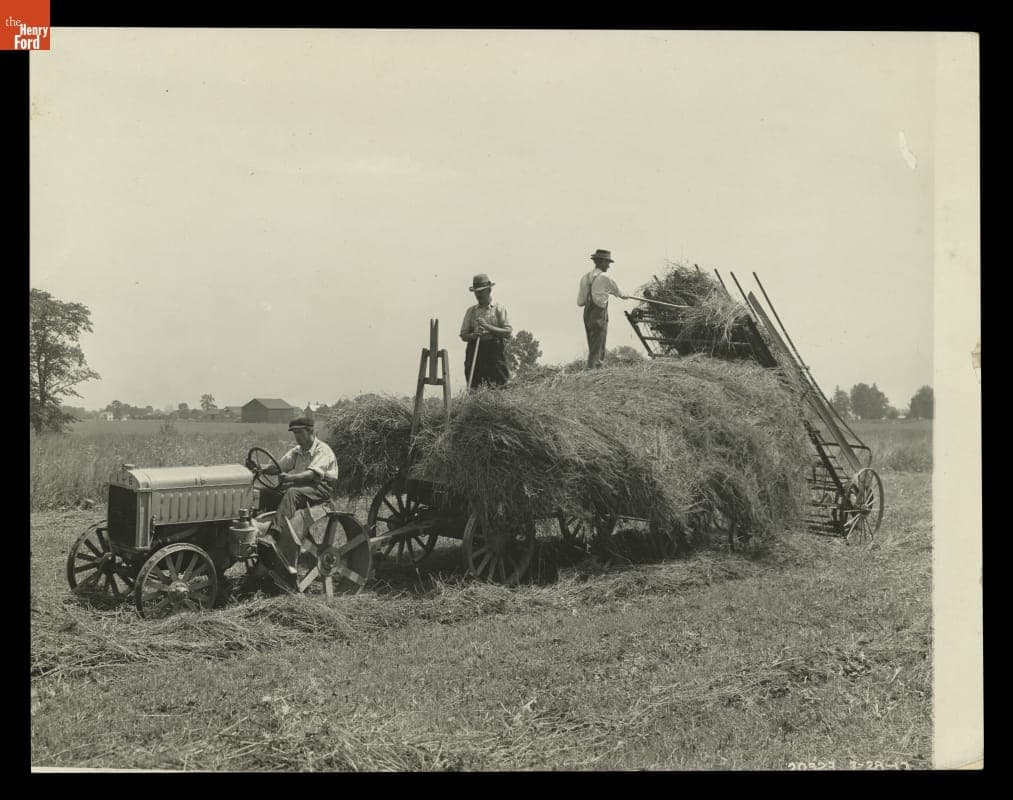
Fordson Tractor Pulling Hay Wagon at Henry Ford Farms, 1917
Prior to the tractor's invention, farmers used draft animals to pull mowers, rakes, tedders and hay loaders through fields and to power presses and operate hay forks. Tractors provided more horsepower, and implement companies invented new tractor-drawn machinery including automatic hay balers. Ironically, the tractor replaced the power source that needed hay to survive.
View ArtifactTHF171307
Automatic Pick-Up Baler, circa 1943
Farmers transformed pastureland into crop fields after World War II. They relied on automatic hay balers to make hay for livestock increasingly confined to feedlots. Farmers pulled the baler to the hayfield behind a tractor. The baler picked up cured hay directly from the windrow, compressed it and tied it into bales. Workers loaded bales onto wagons or trucks for transport to storage sheds or barns.
View ArtifactTHF287161
1960 Advertisement for the Ford 981 Diesel Tractor and Ford 250 Hay Baler, "Up To 10 Tons Per Hour...That's Making Hay the Ford Way!"
After World War II, prices for agricultural commodities dropped as production increased. Many farmers responded by converting pastures to cropland to further increase yields. Thus, hayfields became critical for supplying livestock feed year-round. This 1960 advertisement promoted the new Ford baler that could tie 5 bales a minute and process up to 10 tons of hay per hour.
View Artifact

