
Building Eagle Boats at the Rouge
Share
share
Over the years, Ford Motor Company's River Rouge factory turned out everything from tractors to cars to pickup trucks. But its first products had no wheels at all. From May 1918 to October 1919, Ford built 60 "Eagle" anti-submarine patrol boats at the Rouge. World War I ended before any of the Eagles saw action, but they proved that even warships could be made on an assembly line.
THF80636
World War I Poster, "They Kept the Sea Lanes Open," circa 1917
German submarines threatened Allied merchant ships throughout World War I. Allies countered by escorting merchant ships with naval vessels and aircraft, and by building fast patrol boats equipped with anti-submarine depth charges. With American shipyards taxed to their limits already, the U.S. Navy enlisted automaker Henry Ford to mass produce Eagle patrol boats for the war effort.
View ArtifactBook of USS Eagle 200 Foot Naval Patrol Boat Blueprints, 1918-1919
Ford's proposal was revolutionary. He would build the boats with the assembly line techniques he developed for his automobiles. Sophisticated naval vessels would become factory-built goods, assembled in greater Detroit by Ford's own workers rather than traditional shipwrights. Finished boats would reach the Atlantic Ocean via the Great Lakes and the St. Lawrence River.
View ArtifactAlbert Kahn Drawings for the "Plant in Which Henry Ford Will Employ 15,000 to Make Submarine Killers," April 1918
Henry Ford's plan called for a specially designed main building in which to manufacture the Eagle boats. He turned to architect Albert Kahn, who had designed Ford's Highland Park automobile plant, to plan the Eagle facility. Kahn envisioned a long, well-lit structure capable of housing multiple production lines.
View ArtifactStaking out Site of Ford Rouge Plant "A" Building, First Structure of the Eagle Boat Factory, February 1918
Ford Motor Company's landlocked Highland Park plant obviously wasn't suitable for a shipyard. Fortunately, Henry Ford owned property near the mouth of the Rouge River that he'd purchased for future expansion. The Rouge site was ideal for Ford's Eagle facility. It was on level ground, near existing railroad lines, and -- after dredging -- within navigable reach of the Detroit River.
View ArtifactFord Rouge Plant "B" Building Shipyard Construction, 1918
Ford owned some 1,000 acres of land at the mouth of the Rouge. He agreed to provide five acres as the location for the Eagle boat complex. In return, the federal government agreed to pay for several buildings, a boat launching mechanism, and docks. The government also paid $490,000 to widen and deepen the river.
View ArtifactFoundation Pilings for Ford Rouge Plant Shipyard "E" Building, May 1918
One of the Rouge site's main assets -- its proximity to the Rouge and Detroit Rivers – was also one of its drawbacks. The marshy ground was soft and muddy. Hundreds of wooden pilings were driven under each building to support the structures. Stacks of additional pilings are visible in the background of this photo.
View ArtifactConstruction of Ford Rouge Plant "B" Building for Eagle Boat Assembly, May 1918
Once the pilings were driven, buildings went up quickly. The federal government paid the $3.5 million required to build the Rouge shipyard but gave Ford the option to buy it at a reduced price after the war. The finished "B" Building -- the heart of the complex -- was 1,700 feet long by 350 feet wide with 13 acres under its roof.
View ArtifactProgress on Prototype Eagle Patrol Boat, Ford Highland Park Plant Craneway, March 1918
While construction was underway on buildings at the Rouge, Ford workers built a prototype Eagle boat at the company's Highland Park plant. The prototype allowed Ford workers to refine the design for maximum efficiency in construction, and to create patterns and templates for making duplicate parts. The prototype was later moved to the Rouge, in sections, via railroad flatcars.
View ArtifactHenry Ford and Secretary of the Navy Josephus Daniels with the Eagle Boat Prototype, Ford Highland Park Plant, April 1918
Josephus Daniels (center), Secretary of the Navy, inspected the Eagle boat prototype in April 1918. The Navy's near constant design and specification changes posed a serious challenge to Ford's production schedule. For all of its strengths, the Ford assembly line method wasn't well suited to these frequent modifications.
View Artifact2500 Horsepower Steam Turbine Engine Used in Eagle Boats, Ford Motor Company, October 1918
Ford Motor Company had little input on the actual design of the Eagle submarine chasers. However, Henry Ford did suggest that the Eagles be powered by steam turbine engines rather than conventional reciprocating engines. Turbines were lighter and more efficient, yielding a greater power-to-weight ratio. They were quieter as well.
View ArtifactProgress on Prototype Eagle Patrol Boat, Ford Highland Park Plant Craneway, March 1918
Henry Ford also insisted that the Eagle boats' hull panels be flat rather than curved. Flat panels could be produced in quantity much more quickly, speeding the assembly process. Still, it took time for Ford's workforce to master the procedure. Early boats exhibited problems in the bolting, riveting and welding of their hull plates.
View ArtifactLaying the First Eagle Boat Keel, Ford Rouge Plant "B" Building, May 1918
The Eagle boat assembly line did not move continuously like Ford's Model T line – warships were a bit more complex than automobiles. Instead, the boats moved step-by-step through a series of seven assembly stations. Each keel was laid on a large flatcar on rails. When work was finished at a given station, workers moved the flatcar to the next position.
View ArtifactAssembling the First Eagle Boat in the Ford Ship Plant (Rouge Plant "B" Building), June 1918
Three tracks ran along the length of the "B" Building. Each track had room for seven boat hulls, meaning that 21 different Eagles could be under construction at any one time. A hull typically spent three days at each station. Traveling cranes were placed over each track, allowing parts to be hoisted into place quickly.
View ArtifactPedestal of "Listening Device" for Submarines, Made by Ford Motor Company for Use on Eagle Boats, June 1918
Submarines were so effective because they were hidden from view until they attacked. Sailors couldn't protect themselves from what they couldn't see. With support from the U.S. Navy, Thomas Edison devoted much time and effort to developing a reliable method of detecting submarines, either by sound or magnetic field. The first Eagle boats were equipped with Edison's detection devices.
View ArtifactPlating the Hull during Ford Eagle Boat Assembly, 1918
Ford's production plans were ambitious. The company intended to turn out one finished boat each day. But those plans were challenged by the company's inexperience with shipbuilding, and by constant design changes from the Navy. Nearly 8,000 Ford employees worked on Eagle boats at the operation's peak.
View ArtifactBuilding Turbine Engines for Eagle Boats at the Ford Highland Park Plant, October 1918
While construction of the boats themselves was concentrated at the Rouge, their propulsion systems were largely built at Ford's Highland Park plant. This included the turbine engines. Each engine developed around 2,000 horsepower. Each boat carried two oil-burning boilers to generate steam for its single turbine.
View ArtifactEagle Boat #57 Assembly at Ford Motor Company Rouge Plant, April 1919
Skilled riveters were in constant demand at the Rouge. Each Eagle boat was held together by some 260,000 individual rivets. The factory had its own on-site riveting school that trained 40 new people every two days. The noise inside the "B" Building must have been tremendous. Imagine the clamor made by teams of riveters working on 20 boats at once.
View ArtifactLaunching of First Eagle Boat at Ford Rouge Plant, 1918
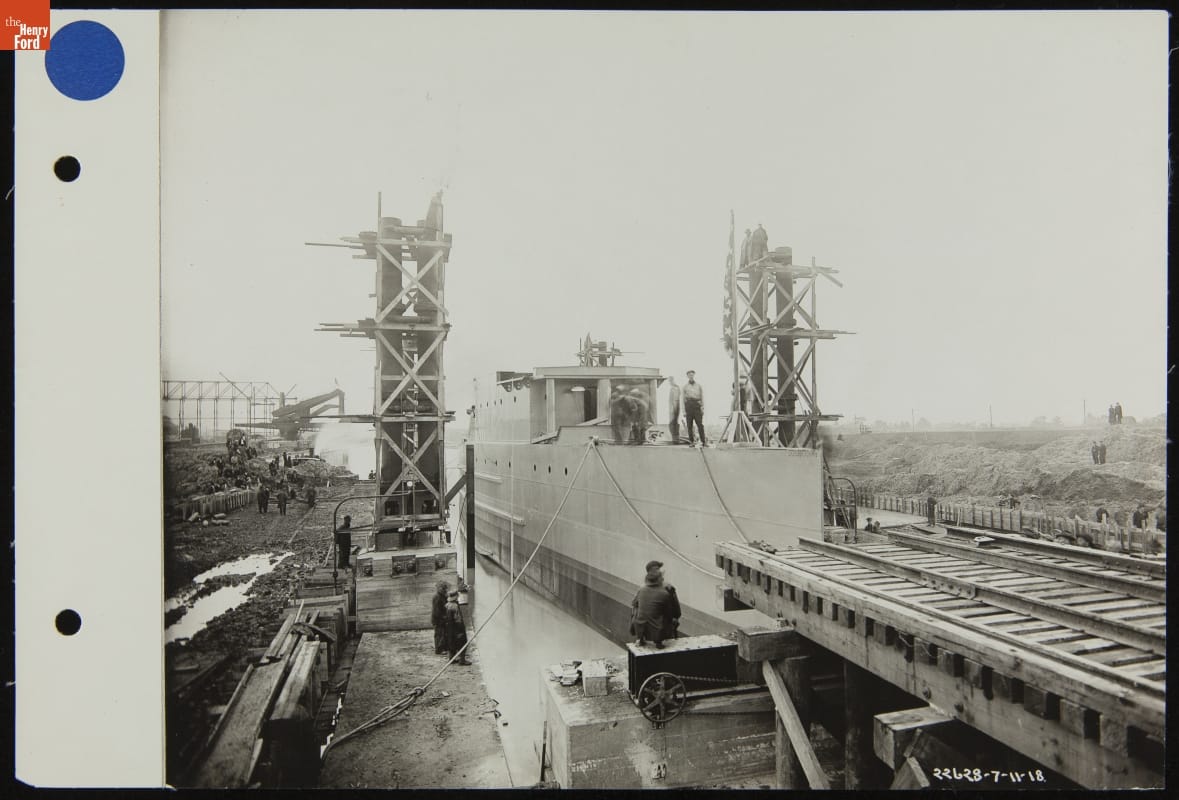
Once basic assembly was completed inside the "B" Building, Eagle boats from each of the building's three tracks were moved, one at a time, onto a transfer table located between the building and the river channel. The transfer table moved each boat sideways until it lined up with Ford's single launching mechanism.
View ArtifactEagle Boat #1 Ready to be Launched, Ford Rouge Plant, July 11, 1918
Ford launched each boat into the river with a moveable steel trestle. The hydraulic trestle lowered the boat into the water like a giant elevator. The whole process took about 40 minutes, from the time the boat left the "B" Building until it was floating. The first Eagle boat dropped into the Rouge River on July 11, 1918.
View ArtifactEagle Boat in Boat Slip at the Ford Rouge Plant, August 1918
After an Eagle boat was launched, it was docked in a channel next to the factory. Boilers, motor parts and armaments were then installed. Eagles were variously armed with anti-aircraft guns, machine guns, and depth charge projectors. As many as eight boats could be outfitted in the channel at one time.
View ArtifactLaunching World Record Eagle Boat #59, Built in 10 Days, April 1919
After working through its various problems with design and specification changes, manufacturing processes, and employee training, Ford Motor Company eventually hit its stride with Eagle production. Boat #59 was built from start to finish in just 10 days -- the record time for any of the Eagle boats constructed by the automaker.
View ArtifactEagle Boats Lined Up at Ford Rouge Plant Dock, February 1919
The Navy commissioned the first finished Eagle in late October 1918 -- not long before the November 11 armistice ended the war. The Navy cut its initial order of 100 Eagles to 60. Finished boats crowded the Rouge's dock over the winter of 1918-19. After the spring thaw, they were sent to the Navy's base at New London, Connecticut, to await assignments.
View ArtifactHammerfest, Norway from USS Eagle 3, Bound for Arkhangelsk, May 20, 1919
Though none of them saw combat in World War I, the Eagle boats weren't entirely untested in military situations. Three were sent to northern Russia in 1919 to aid the American Expeditionary Force in action against the Bolsheviks. The boats patrolled the waters off of Arkhangelsk, near the Arctic Circle. Some of the participating Americans called themselves the "Polar Bears."
View ArtifactEagle Boat at Sea, 1919
Each Eagle boat was driven by a single screw propeller and had a top speed of around 18 knots. Each boat measured 200 feet long with a beam of 33 feet and a total weight of 615 tons. Cruising range for an Eagle was around 3,500 miles, while a typical crew included four officers and 54 enlisted sailors.
View ArtifactEagle Boat, circa 1918
All told, Ford built 60 Eagle boats between May 1918 and October 1919 at a cost of about $750,000 per vessel. Though the Eagles never served in the Great War, the U.S. Navy defended the boats and their associated costs. Had the war continued into 1919, Navy officials maintained, the Eagles "would undoubtedly have been effective."
View ArtifactFord Eagle Boat Submarine Chaser at Sea, 1919
The 60 finished Eagles found various uses. Some served in the Navy, while others functioned as training vessels in the Naval Reserve. Five were assigned to the Coast Guard. By 1941, only eight remained in service. Each performed anti-submarine patrols along the American coasts during World War II. The last Eagle boat was struck from the Navy's roster in 1947.
View ArtifactAerial View of Ford Rouge Plant, 1930
After Eagle production ended, Ford exercised its option to buy the "B" Building from the federal government. The other Eagle structures were demolished, but "B" became the core of Ford's Rouge factory complex that, in subsequent years, built everything from Model As to Mustangs. Considered a temporary structure when erected in 1918, the "B" Building (center left) remained in use until 2004.
View Artifact

